
Understanding Changes to Child Care Policies is an ongoing evaluation of child care subsidy policies that were new in the state of Vermont in 2021 and in 2023, and aimed at expanding access to affordable child care for families. Child Trends and its partners—the Vermont Department for Children and Families’ Child Development Division (CDD) and Building Bright Futures—work to better understand how changes to child care subsidy policy can influence providers’ stability and business operations and families’ access to child care and early education.
This four-year project is funded by the Administration for Children and Families’ Office of Planning, Research, and Evaluation (OPRE). The Child Trends team works closely with state partners to ensure that research questions and findings inform the policies’ ongoing implementation and examine the impacts of the new policies.
Briefs and reports
Vermont’s State-funded Child Care Subsidy Expansion Supports Families and Providers
Vermont Policy Changes Associated With Increase in Supply of Child Care
Vermont’s Child Care Subsidy Expansion Means More Families Have Affordable Child Care
Vermont’s Child Care Subsidy Program Expands Access and Reduces Cost
 Vermont By the Numbers
Vermont is home to approximately 32,000 children under age 6, about 7 percent of whom live in households at or below the federal poverty level.
Vermont has the nation’s highest percentage of residents (65%) who live in rural areas.
In December 2024, more than 10,000 children in the state received a child care subsidy.
Timeline
To help families overcome these barriers and ensure a stable child care sector, Vermont provides child care subsidies to families with low incomes through the Child Care and Development Fund (CCDF) and to upper- and middle-income families via state funds. A 0.44 percent payroll tax funds subsidies for families with higher incomes. In 2021 and 2023, Vermont changed its CCDF-funded child care subsidy payment policies, increasing state funding considerably, through laws known as Act 45 and Act 76.
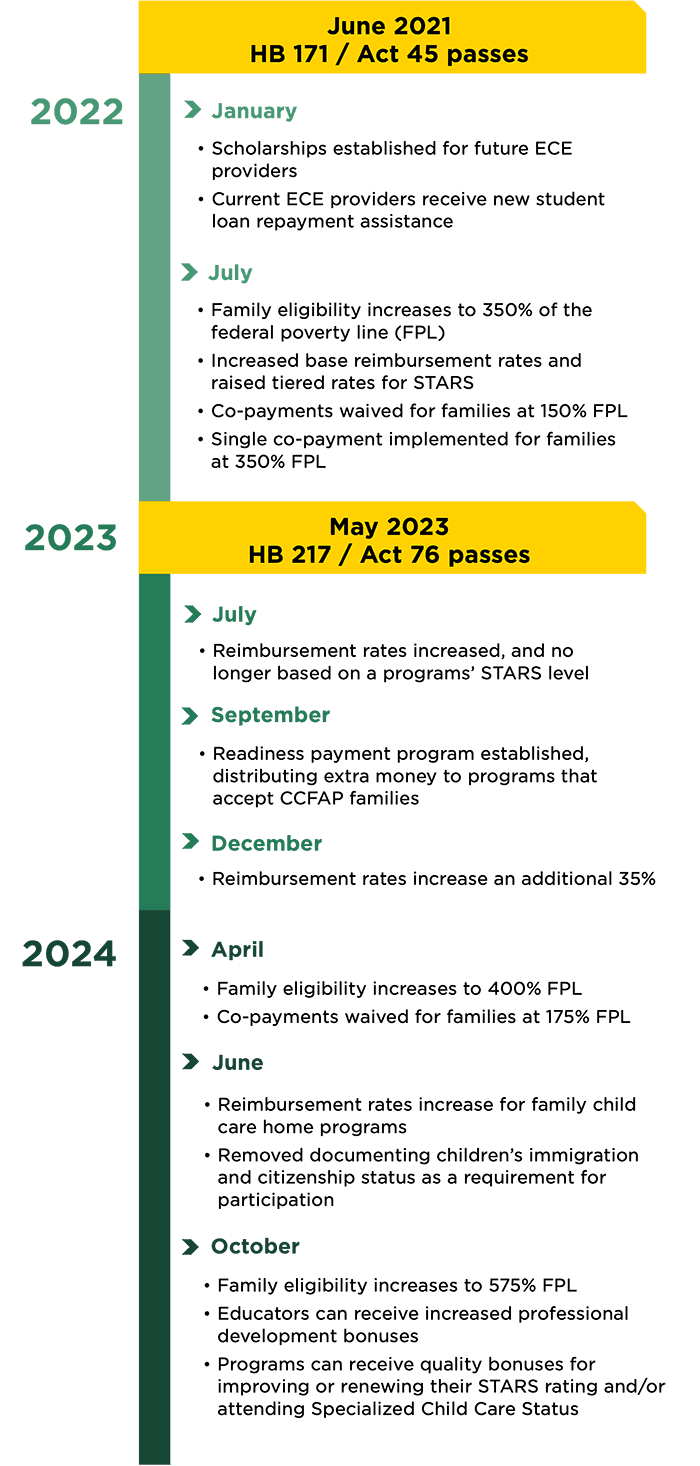
The timeline below depicts the policy changes enacted and put into practice since 2021. Taken together, these policies will:
- Increase the number of children and families eligible to receive child care subsidies, including for those earning incomes up to 575 percent of the poverty threshold.
- Increase payments to providers caring for children who receive a subsidy.
- Provide additional incentive payments to providers for achieving higher levels of quality in the Quality Rating System (QRS) and for increasing and maintaining infant and toddler capacity.
Timeline of Changes to Child Care Policies in Vermont
Research Approach
By examining the effects of Vermont’s changes to its CCDF payment policies in 2021 and 2023 through a mixed methods approach, we aim to uncover whether these policy shifts increased equal access to high-quality child care for families who are eligible for subsidies and altered the supply of child care in the state. We are currently in Phase II of this work; highlights from Phase I also appear at the top of this page.
Learnings
In Phase II of this project, Child Trends is using a mixed-methods approach—including surveys, focus groups, and in-depth interviews—to evaluate CCDF policy changes, with a focus on payment policies, providers and families in rural and low-income areas, families who are recent immigrants, and families with infants or toddlers. We aim to answer the following questions:
- How have policy changes led to equal access to ECE for families?
- How have policy changes enabled providers to support equal access to ECE for children and families?
- How have policy changes impacted the ECE workforce to help them support equal access to ECE for children and families?
As we have learnings to share, we will post them here.
Vermont’s State-funded Child Care Subsidy Expansion Supports Families and Providers
Vermont Policy Changes Associated With Increase in Supply of Child Care
During Phase I, we surveyed parents and providers to give CDD more information about the implementation of new subsidy policies and the degree to which parents and providers were aware of the 2021 policy changes. The project team also analyzed American Community Survey (ACS) data to provide CDD with an understanding of where in Vermont families who qualified for subsidies lived and where demand was highest for subsidized child care.
Our main findings included the following:
- Most child care providers were aware of the 2021 changes to child care subsidy policies.
- Most parents, including those who received subsidies, were not aware of the new family share copayment policy.
- Of the families who did know about the family share payment policy change, most learned about it from their child care provider.
Project Team
Child Trends

Patti Banghart Gottesman
Senior Policy Specialist I

Sara Amadon
Senior Research Fellow IIEarly Childhood Research Operations Manager

Jennifer Cleveland
Senior Research Scientist I

Kara Ulmen
Senior Research Analyst

Sarah Daily
Research ScholarProgram Area Director, Early Childhood Education

Kate Steber
Research Scientist II

Katie Richards
Senior Research Analyst

Sage Caballero-Acosta
Senior Research Assistant

Kylee Novak
Research Assistant
Elizabeth Reddington
Senior Research Analyst

Rowan Hilty
Research Scientist I

Julianna Carlson
Research Scientist

Jing Tang
Research Scientist II

Phoebe Harris
Senior Policy Analyst
Vermont Department for Children and Families – Child Development Division
- Karolyn Long
- Chris Case
- Janet McLaughlin
Building Bright Futures
- Morgan Crossman
- Anna Brouillette
Related Projects
Minnesota Child Care Policy Research Partnership
Maryland Child Care Policy Research Partnership