



Child welfare agencies use a mix of federal, state, local, and other sources to fund the programs and services they provide. Major federal sources include Title IV-E of the Social Security Act, Temporary Assistance for Needy Families (TANF), and the Social Services Block Grant (SSBG), among others. States also use their own state and local tax dollars to fund child welfare services and activities. In addition, some states access other funds—like child benefits (such as Social Security) and family income (such as child support)—to supplement federal, state, and local funding streams.
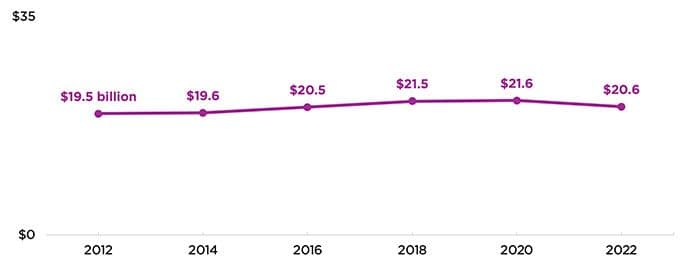
Child welfare agencies reported spending a total of $34.3 billion from federal, state, local, and other sources in state fiscal year (SFY) 2022. This amount represents a 3 percent decrease from SFY 2020 to SFY 2022, but a 3 percent increase over the past decade.
Child welfare agencies’ spending, SFYs 2012-2022
Source: SFY 2022 Child Welfare Financing Survey
Note: All dollar amounts have been inflated to 2022 levels. The figures presented in this graph reflect an analysis of the 29 states with sufficient data across all six surveys conducted by Child Trends from 2012 to 2022 (surveys are conducted every two years). Therefore, the SFY 2022 amount in this figure ($20.6 billion) differs from the total reported amount in the text ($34.3 billion).
The increase in child welfare agency spending over the past decade has been driven primarily by the creation and expansion of several programs funded by Title IV-E of the Social Security Act and the infusion of time-limited pandemic relief funds. At the same time, fewer children have entered foster care in recent years; there are new restrictions on the use of Title IV-E dollars and reduced child welfare agency spending from TANF and SSBG; and flat appropriation levels for Title IV-B of the Social Security Act have caused it to lose value over time due to inflation.
Child Trends and Child Welfare Financing
Child Trends researchers explore many aspects of how child welfare is funded; every two years, we conduct a national survey of state child welfare financing, with support from Casey Family Programs and the Annie E. Casey Foundation. These data result in a national report, state-level factsheets, funding source factsheets, and other products that describe funding sources such as Title IV-E, TANF, state/local funding, and more.
Child Trends partners with states to examine child welfare systems, helping leaders understand financing options and paths to promote best practices and improve outcomes for children and families. If you are interested in learning more about our work in this area, please contact Kristina Rosinsky.