
A Toolkit for Schools to Inventory Data Assets and Inform Better Decisions - Implementation
Developing a Data Inventory
Elements to include in a data inventory
A data inventory is an adaptable tool comprised of different data elements, meaning it can include any relevant details related to how the data were collected, stored, and used. Data inventories are intended to support organization, management, and decision making, so the data elements included should address at least part of all of those.
- Data organization elements answer “What?” and “Where?” questions, including data sources, data points, storage, access, and point of contact.
- Data management elements answer “How?” and “When?” questions, including data quality, data validation, security, file type, frequency of updates, data use agreements, privacy, retention, archive, and deletion.
- Data-driven decision making elements answer “Why?” questions, including purpose, goals, and linkages.
Definitions Within a Data Inventory
- Data source: Where the data come from
- Data points: The specific pieces of information collected from the data sources
- Data quality: Addresses any challenges around accuracy, completeness, reliability, and validity
- Purpose: An explanation of why the data are being collected and how they will be used
- Goals: What the organization aims to achieve by collecting and analyzing data
Based on a school district’s goals, the inventory can be adapted to include different data elements. For example, if the district’s primary goal is to improve data management practices, then the inventory should include more details with those elements, such as validation, security, and update frequency. Below, we provide a basic template that includes some essential items to include in a data inventory:
Ensuring data quality in a data inventory
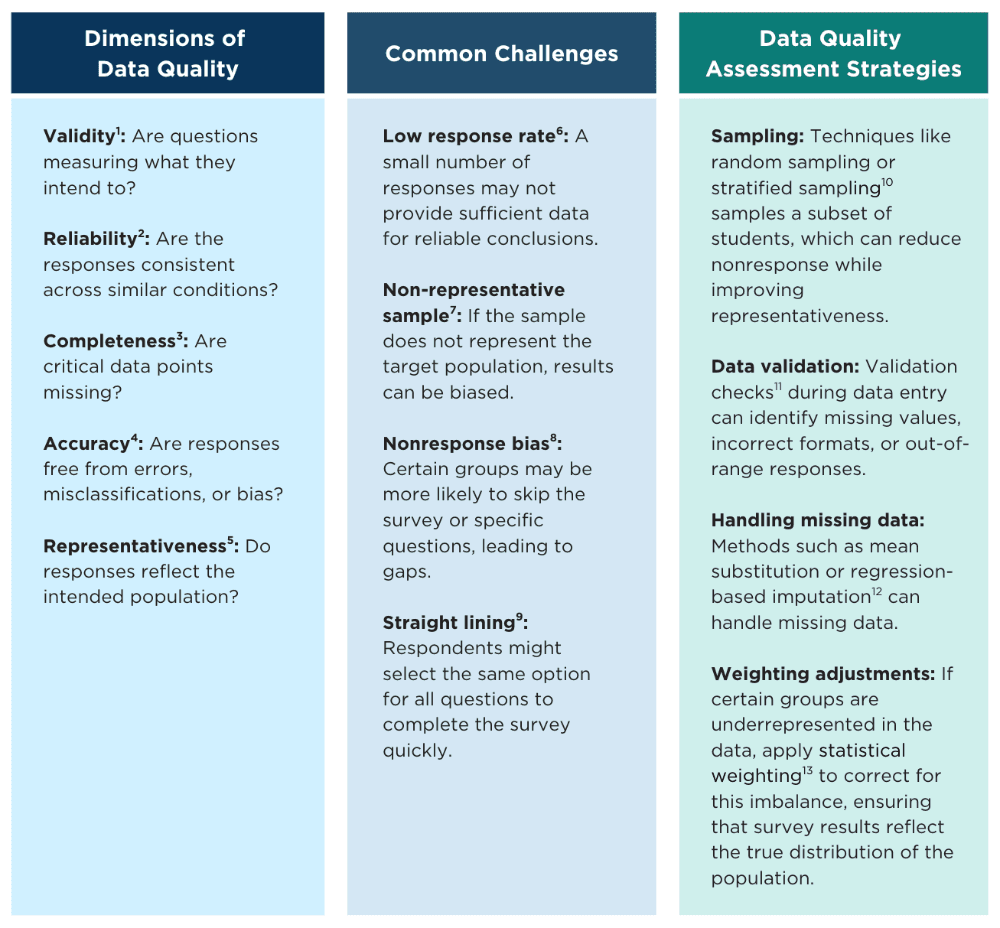
A data inventory can support data governance and data quality by outlining data quality dimensions, identifying quality issues, and documenting data remediation processes. Validity, reliability, completeness, accuracy, and representativeness are important criteria you can use to audit data sets. Each of these dimensions can also present challenges that may compromise data integrity and limit their usefulness. Therefore, when entering a data source into your inventory, include notes on the dimensions of data quality and consider any potential challenges. The visual below outlines the dimensions of data quality, common challenges, and data quality strategies. These can be helpful concepts to incorporate into the data inventory.
Understanding Dimensions of Data Quality, Potential Challenges, and Data Quality Assessment Strategies
1, 2 Dovetail Editorial Team. (2023, February 27). Validity in research: A guide to better results. Dovetail. https://dovetail.com/research/validity-in-research/
3, 4 Gates, S. (2023, July 10). What is Data Completeness? Definition, Examples, and KPIs. Monte Carlo. https://www.montecarlodata.com/blog-what-is-data-completeness/
5, 7, 8 Lammert, J., Moore, H., and Bitterman, A. (2018, August). IDC Parent Involvement Toolkit—Making the Most of Parent Involvement Data: Improving Quality and Enhancing Understanding. IDEA Data Center. Rockville, MD: Westat.
6 Templeton, L., Deehan, A., Taylor, C., Drummond, C., & Strang, J. (1997). Surveying general practitioners: does a low response rate matter?. The British journal of general practice: the journal of the Royal College of General Practitioners, 47(415), 91–94.
9 Reuning, K., & Plutzer, E. (2020). Valid vs. Invalid straightlining: The complex relationship between straightlining and data quality. Survey Research Methods, 14(5), 439-459. https://doi.org/10.18148/srm/2020.v14i5.7641
10 McCombes, S. (2023, June 22). Sampling Methods | Types, Techniques & Examples. Scribbr. https://www.scribbr.com/methodology/sampling-methods/
11 Yale Library. Research Data Management: Validate Data. Yale University Library. https://guides.library.yale.edu/datamanagement/validate
12 Kang H. (2013). The prevention and handling of the missing data. Korean journal of anesthesiology, 64(5), 402–406. https://doi.org/10.4097/kjae.2013.64.5.402
13 Mercer, A., Lau, A., & Kennedy, C. (2018, January 26). How different weighting methods work. Pew Research Center. https://www.pewresearch.org/methods/2018/01/26/how-different-weighting-methods-work/
Getting started with a data inventory
Creating a data inventory might sound like a big task, but it’s an essential step toward making your district’s data work for you. Think of it as building a map for all the information your district collects—where it comes from, how it’s used, and who needs access to it.
This section will walk you through the process, one step at a time. From setting your goals and bringing the right team together to organizing and documenting your data, we’ll help you get everything in order. Along the way, you’ll learn how to create policies to keep your inventory up-to-date and build a culture in which data aren’t just something you collect—they’re something you use to make better decisions for your schools and students.
Process for Developing a Data Inventory
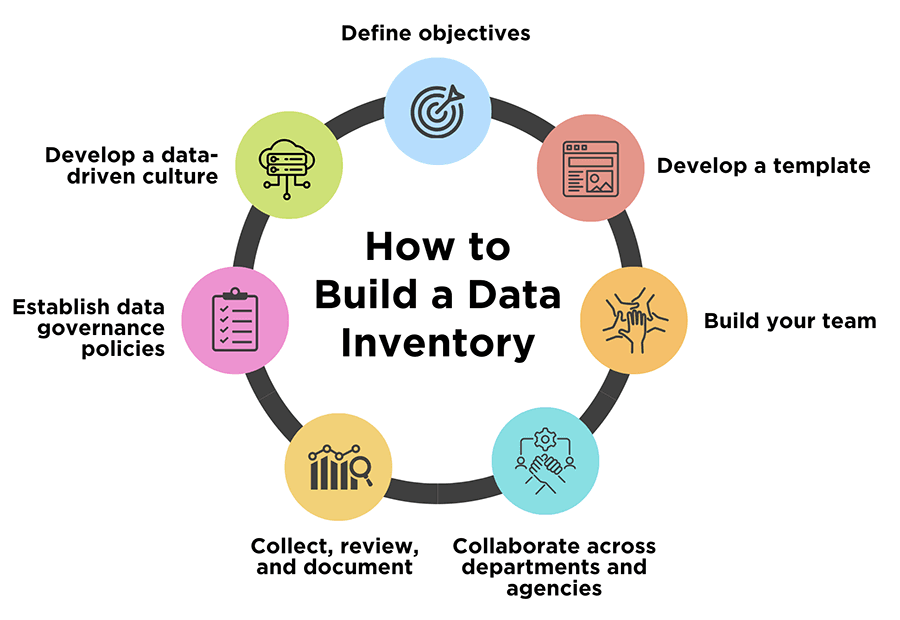
1. Define objectives.
- Clearly state what the inventory should achieve. Ask yourself: What’s the goal of the inventory?
- Is it to organize data more effectively?
- Is it to improve data management practices?
- Is it to support decision making?
- Will it cover the whole district or focus on a specific initiative?
- Clarify the inventory’s purpose before diving in to stay focused and manage the scope.
2. Develop a template.
- Ask yourself: What information is essential to capture?
- Start with a standardized, easy-to-use format that works for different data types.
- Use our sample template as-is or adapt it to your needs.
- Keep it simple and intuitive so everyone can use it confidently.
3. Build your team.
- Ask yourself: Who needs to be involved for this to succeed?
- Identify and assemble a cross-functional team to guide the process.
- Bring together a diverse group of stakeholders (e.g., administration, IT, program managers, data analysts).
- Clearly assign roles for creating and maintaining inventory.
4. Collaborate across departments and agencies.
- Ask yourself: How can we foster collaboration rather than keep all our work siloed?
- Encourage departments and external partners to share information on their data assets for the inventory. Don’t work in silos!
- Host workshops or meetings to encourage departments and partners to share data.
- Build a shared understanding of the inventory’s purpose and structure.
5. Collect, review, and document.
- Ask yourself: How can you prepare your data collection systems to prevent gaps or inconsistencies in the data collection process?
- Begin gathering data systematically, using the template as a guide. Use your template to systematically gather data.
- Check for accuracy and completeness.
- Note any gaps or inconsistencies during the process.
6. Establish data governance policies.
- Ask yourself: What policies are needed to ensure responsible data use?
- Set clear rules for data collection, storage, and usage.
- Define privacy, security, and access protocols.
- Make sure all stakeholders know the policies.
7. Develop a data-driven culture.
- Ask yourself: How can we make data a valued resource, not just a compliance task?
- Make data a valued resource within your district.
- Use training, success stories, and leadership messages to show the inventory’s importance.
- Encourage staff to see the inventory as a tool for improvement, not just another task.
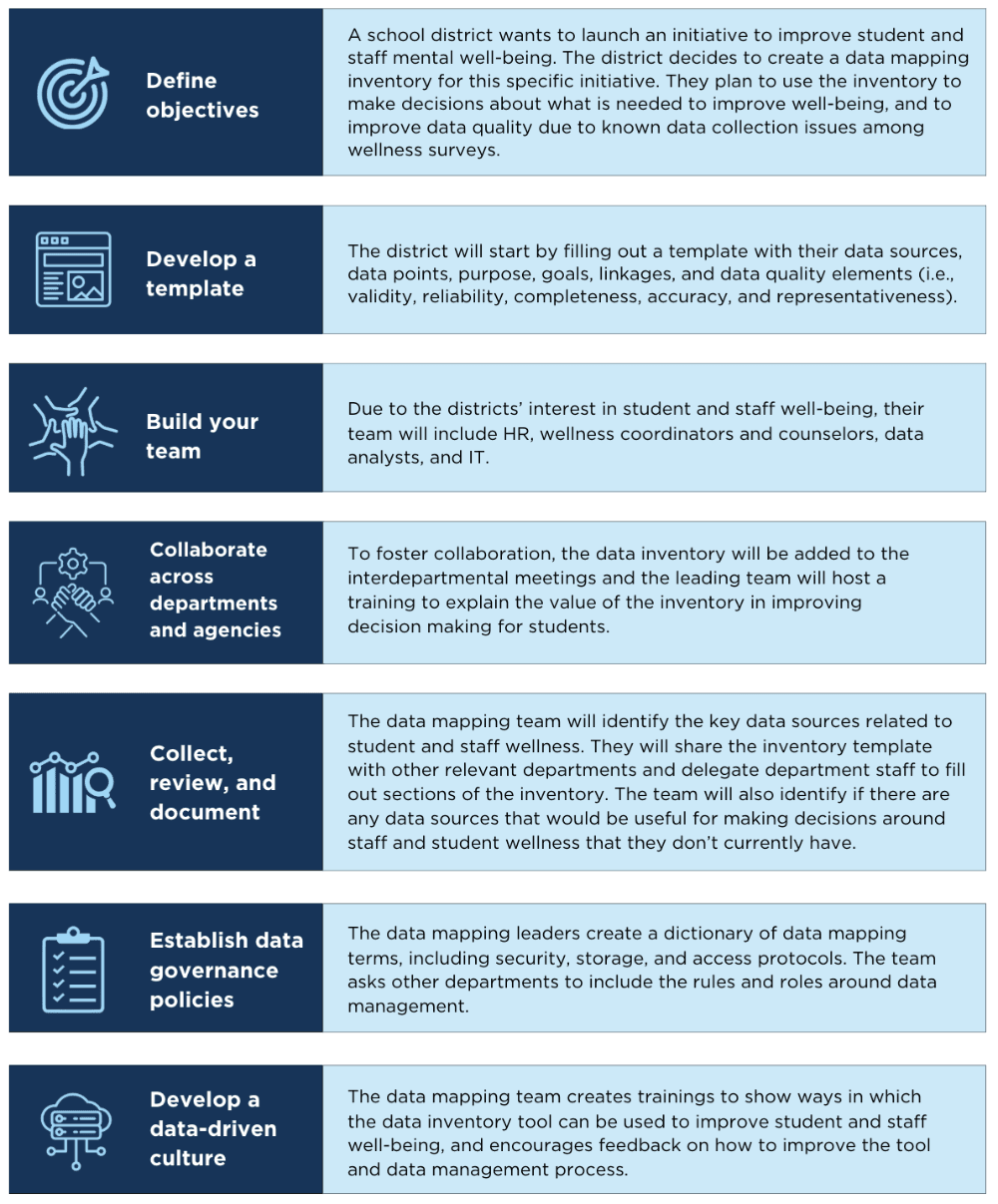
Example of Developing a Data Inventory
Summary
Creating a data inventory may seem like a large task, but it’s a critical step in leveraging your district’s data for meaningful decision making. A data inventory serves as a comprehensive map that details what data your district collects, where these data originate, how they are used, and who needs access to them.