


Recent Child Trends analysis of national survey data suggests that parents of middle and high school students view artificial intelligence (AI) as an issue that schools must address directly. Across survey questions, parents expressed clear expectations for how schools should teach responsible AI (i.e., students using AI in ways that support their education), alongside concerns about how AI use may affect student learning.
When asked how schools should approach teaching responsible AI use as part of middle or high school curricula, 57.6 percent of parents said responsible AI educational materials should be integrated across all classes, either in limited ways (34.4%) or as much as possible (23.2%). Conversely, 28.8 percent preferred that responsible AI be taught in specific classes only, such as computer science. Only 13.5 percent responded that responsible AI should not be taught in schools at all. These responses suggest that most parents view responsible AI use as a broadly relevant skill, rather than a specialized topic.
Parents are divided on AI’s long-term role in education, with some viewing it cautiously and others with greater interest. When asked whether AI will help or harm the quality of their child’s education in the long run, 34.0 percent said AI would substantially or somewhat help, while 36.2 percent said it would somewhat or substantially harm student learning. Another 17.4 percent reported that they do not yet know. This distribution indicates that many parents are still actively weighing AI’s potential benefits against possible risks.
Parents’ priorities are clearest when we examine which aspects of AI concern them the most. When asked to rank potential concerns related to AI use in their child’s education, parents most commonly cited academic honesty (i.e., cheating and plagiarism) as their greatest concern, ranking above data privacy, possible negative impacts on students’ learning, the spread of misinformation, reduced personal connection with teachers or peers, and inadequate training or guidance (see figure below). That academic honesty emerged as the top concern underscores the need for ongoing education on how students can use AI productively.
More than 1 in 4 parents identified academic honesty as their top concern regarding the use of AI in their middle or high school student’s education
Percentage of parents identifying each factor as their top concern regarding the use of AI in education
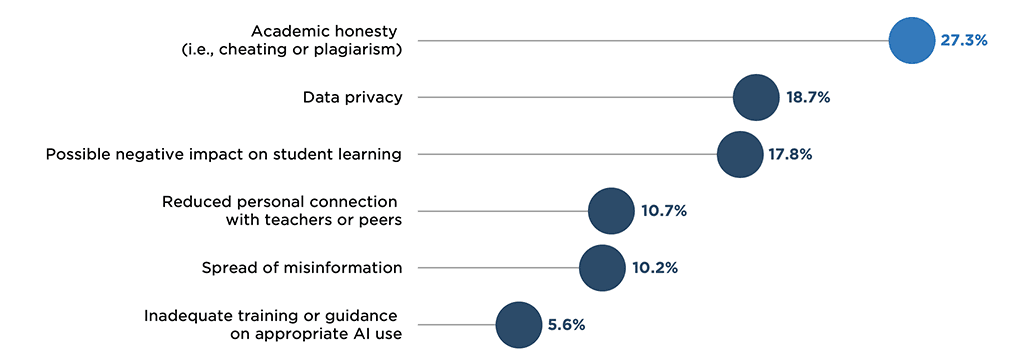
Note: 9.7% of responding parents did not identify any factor as their top concern.
Source: Child Trends analysis of data collected through the AmeriSpeak® panel, a nationally representative, probability-based survey panel of U.S. households. Weighted data are aligned with Current Population Survey benchmarks from the U.S. Census Bureau (n=720)
Taken together, these findings indicate that parents expect schools to teach middle and high school students how to use AI responsibly yet remain cautious about AI’s effects on students’ learning experiences. Parents appear less focused on whether AI is present in schools and more focused on how it is taught, how it is used, and whether its use supports meaningful learning.
Methods
This survey was administered through AmeriSpeak®, a nationally representative survey panel of U.S. households, created and operated by NORC at the University of Chicago. AmeriSpeak uses probability-based sampling methods in which households are randomly selected with a known chance of inclusion, rather than relying on self-selected or convenience samples. This survey targeted parents and caregivers of children ages 12–18. Data were collected in December 2025 using both an online survey and telephone interviews. The final sample included 720 parents and caregivers. Survey weights were applied to align the sample with demographic benchmarks from the U.S. Census Bureau’s Current Population Survey benchmarks including sex, age, education, race/ethnicity, and region. Results for this survey are presented as weighted descriptive statistics generated based on these probability weights.
Suggested citation
Kelley, C. & Holquist, S.E. (2026). Parents want schools to teach responsible AI but worry about impacts on students’ learning. Child Trends. DOI: 10.56417/2697d8020p