


Artificial intelligence (AI) is becoming part of daily classroom practice, whether schools are ready or not. Teachers are using AI tools to save time on lesson planning, generate feedback on student writing, create leveled reading passages, and support students with different learning styles. Students are turning to AI to brainstorm ideas, check their understanding, and—in some cases—complete assignments with little effort. The question is no longer whether AI belongs in schools. It is how to use it in ways that strengthen, rather than undermine, teaching and learning.
While there are a growing number of AI tools for education, not all are designed with the goals, structures, or values of school systems in mind. When AI tools are implemented without alignment to curriculum, pedagogy, or student needs, they can disrupt learning, fuel inequities, and erode trust among educators and families. But when thoughtfully integrated, AI has the potential to enhance instruction, deepen engagement, and build teacher and student agency.
AI Coherence
At Child Trends, we refer to this alignment as “AI coherence.” Drawing from a review of current literature on AI in K-12 education and conversations with education leaders across the United States, we developed a four-level AI Coherence Framework (shown in Figure 1) to support school and district leaders in making AI coherence a central consideration in their decision-making.
The four levels form a pyramid, with each level building on the one below it. Just as strong instruction depends on both solid content and effective pedagogy, coherent AI use depends on layered alignment from technical integrity to classroom implementation.
Figure 1. Framework for Coherent AI Use in K-12 Education
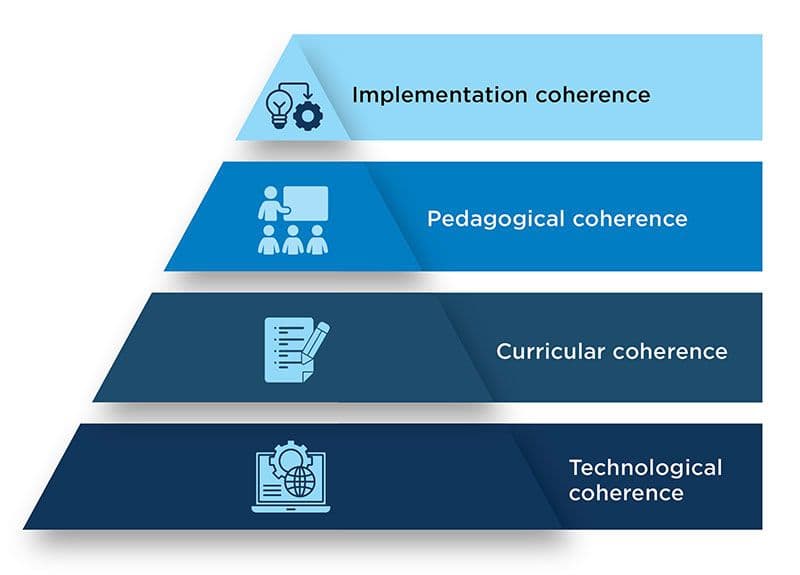
At its core, AI coherence refers to the degree to which AI tools align with the existing goals, systems, and instructional practices of education. It goes beyond technical functionality to ask: Does this AI tool support what students are learning, how they are learning it, and how teaching happens in our classrooms?
The coherence pyramid offers a simple but powerful idea: AI tools are only as effective as their fit with the systems they enter. Technological soundness is essential, but not sufficient. Tools must also reinforce instructional content, reflect how students learn, and be usable in the daily reality of school life.
In the sections that follow, we unpack each level of the framework:
1Technological Coherence: Building the Foundation
The foundation of any coherent AI system is its technological integrity. AI tools must be accurate, secure, transparent, and privacy-preserving. While these standards apply broadly across sectors, they are especially critical in education, where trust and safety are paramount.
Recent developments, such as chain-of-thought reasoning and retrieval-augmented generation (RAG) models, are improving the accuracy and interpretability of AI outputs. These advances allow users, such as students and teachers, to follow an AI tool’s logic, assess its reliability, and understand how it arrived at a response. Still, schools must also scrutinize tools for potential vulnerabilities: Are there safeguards against misuse? Does the tool preserve user privacy, particularly for minors? Does it allow educators to audit and control its behavior?
Technological coherence starts with understanding risk.
For more guidance on how to evaluate AI tools for safety, privacy, and equity, explore our AI Risk Framework for Education. It offers practical support to help school and district leaders build AI systems that are trustworthy and aligned with educational values.
Incoherent or opaque technology can quickly erode trust and open the door to harm. A coherent foundation begins with systems that are not only powerful, but also safe and comprehensible.
2Curricular Coherence: Aligning With the Right Content
Many AI tools are trained on broad internet sources and are not built with district-specific curriculum in mind. As a result, they may introduce content that is out of sequence, misaligned with grade-level standards, or inconsistent with approved materials.
Curricular coherence means AI tools follow the structure and content of a district’s adopted curriculum for a subject. This includes using approved methods to solve problems, referencing the correct materials in the correct order, and reinforcing the key concepts students are expected to learn. For example, a math tool should model how to solve a linear equation using the process taught in Grade 8, not a shortcut that skips essential reasoning steps.
Various techniques, such as RAG and prompting frameworks like the CLEAR framework or decomposed prompting, can help tools reference curated curricular content instead of relying on general web knowledge. But access alone is not enough. To be coherent, AI tools must use curriculum-aligned content in ways that reflect a district’s scope and sequence.
Curricular coherence ensures that AI tools support student learning by staying grounded in what is being taught, when it is being taught.
3Pedagogical Coherence: Supporting How Students Learn
While curriculum defines what students are expected to learn, pedagogy focuses on how that learning happens. AI tools that do not consider pedagogical goals can unintentionally promote behaviors, such as shortcutting, over-reliance, or passive consumption. Pedagogically coherent tools support the process of skill development, critical thinking, and student engagement. A pedagogically coherent tool should:
- Provide step-by-step feedback without giving away the final answer
- Encourage students to reflect on their thinking and learning process
- Support formative assessment and differentiated instruction
- Align with district policies on academic integrity and appropriate use
This is especially important in areas like writing, where students may be tempted to submit AI-generated content in place of their own work. Coherent AI tools in writing should help students learn how to plan, revise, and express their ideas, not just rely on automation to complete tasks for them.
Another key challenge in achieving pedagogical coherence is balancing the needs and expectations of different stakeholders. While teachers may prioritize tools that reinforce key concepts and align with instructional goals, students often seek tools that help them work more efficiently or offer support when they feel stuck. A pedagogically coherent approach recognizes both perspectives and ensures that AI tools promote learning strategies that are consistent with instructional practice, while also being accessible and responsive to students’ experiences.
4Implementation Coherence: Grounding Tools in Real-World Use
Even the most technically sound, curriculum-aligned, and pedagogically appropriate AI tool can fall short if it is not used effectively in practice. Implementation coherence means that AI integration must reflect the unique conditions, resources, and cultures of individual schools and districts.
To ensure implementation coherence, school and district leaders can ask:
- Have teachers received training on how to integrate the tool into existing instructional routines?
- Are there clear norms for when and how students should use AI?
- Do students and families understand the educational purpose of the tool?
- Is the tool accessible to all learners, regardless of device availability, language, or learning needs?
Looking for practical steps to support AI implementation coherence?
Our AI-Class Framework offers a guide for achieving implementation coherence. It supports school and district leaders in building staff capacity, creating shared expectations for AI use, aligning tools with instructional routines, and promoting equitable access. Use this framework to guide thoughtful, effective integration of AI into everyday teaching and learning.
This level of coherence also depends on early and ongoing engagement with the school community. Without input from educators, students, and families, AI adoption may feel disconnected from local priorities and values. With thoughtful implementation, AI becomes a tool for innovation that enhances teaching and learning, rather than a source of confusion or resistance.
Why AI Coherence Matters
As schools and districts navigate how to integrate AI into classrooms, coherence offers a clear path forward. It helps leaders make decisions that are grounded in educational goals, responsive to community needs, and practical for real classrooms.
When AI tools are coherent—technologically sound, aligned to curriculum, supportive of learning, and implemented with care—they strengthen instruction and promote equitable access. Without coherence, tools may appear useful on the surface but cause confusion, reinforce inequities, or fail to align with curricular goals.
Our Framework for Coherent AI Use in K-12 Education is a practical tool for school and district leaders who want to make informed, intentional choices about how AI is used in teaching and learning. By using this framework, leaders can ensure that AI serves as a supplement to strong instruction and supports the success of all students.
Suggested citation
Kelley, C., & Holquist, S.E. (2025). Framework for coherent AI use in K-12 education. Child Trends. DOI: 10.56417/1526q9959x