



Child welfare agencies use several large federal funding sources to pay for their work, with the five largest sources—which typically account for more than 90 percent of federal spending on child welfare—being:
- Title IV-E of the Social Security Act
- Title IV-B of the Social Security Act
- Medicaid
- Social Services Block Grant
- Temporary Assistance for Needy Families (TANF)
In addition, child welfare agencies use a variety of smaller federal funding sources, such as:
- Child Abuse Prevention and Treatment Act (CAPTA) grants
- Community-Based Child Abuse Prevention (CBCAP) grants
- Children’s Justice Act grants
- Adoption Opportunities grants
- Adoption and Legal Guardianship Incentive Payments
- Maternal, Infant, and Early Childhood Home Visiting funds
- Family First Transition Act grants
- Coronavirus Relief Fund and Coronavirus State and Local Fiscal Recovery Funds
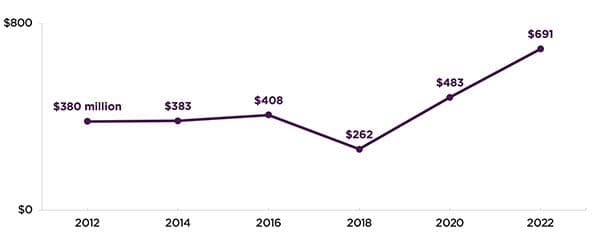
Child welfare agencies reported spending $1.1 billion in funds from these other, smaller federal sources in state fiscal year (SFY) 2022, representing a 45 percent increase from SFY 2020 to SFY 2022 and a 170 percent increase over the past decade.
Child welfare agencies’ use of smaller federal funding sources, SFYs 2012-2022*
Source: SFY 2022 Child Welfare Financing Survey
Note: All dollar amounts have been inflated to 2022 levels.
*The figures presented in this graph reflect an analysis of the 40 states with sufficient data across all six surveys conducted by Child Trends from 2012 to 2022 (surveys are conducted every two years). Therefore, the total amount of SFY 2022 other federal expenditures presented in this graph ($691 million) differs from the total amount presented in the text ($1.1 billion).
The steep increase in child welfare agency spending from these smaller federal funding sources is due, in part, to the time-limited Family First Transition Act grants that provided $500 million to give states additional flexibility and support to implement the Family First Prevention Services Act. The increase is also due to the temporary COVID-19 pandemic-relief funding that was available to states beginning in 2020.
Child Trends and Child Welfare Financing
Child Trends is constantly examining the financing options available to child welfare agencies. Every two years, with support from Casey Family Programs and the Annie E. Casey Foundation, we conduct a national survey of states on the issue. Results from this survey are compiled into a national report, state-level factsheets, funding source factsheets, and other products that describe funding sources such as Title IV-E, TANF, state/local funding, and more.
Child Trends also works directly with states to help them map how their unique child welfare systems are financed, clarify how decisions are made, and offer insights into potential financing-related changes to promote best practices and improved outcomes for children and families. If you are interested in learning more about our work in this area, please contact Kristina Rosinsky.