



Title IV-B of the Social Security Act is an important source of federal funding for child welfare agencies. Title IV-B funding can be used for a variety of child welfare services, including maltreatment prevention, family preservation, family reunification, services for foster and adopted children, and training for child welfare professionals.
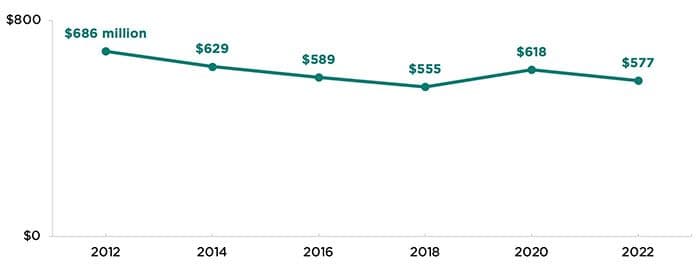
In state fiscal year (SFY) 2022, child welfare agencies across the country spent $632 million in Title IV-B funds. Title IV-B expenditures have decreased by 16 percent over the past decade and by 7 percent since SFY 2020.
Child welfare agencies’ use of Title IV-B funds, SFYs 2012-2022*
Source: SFY 2022 Child Welfare Financing Survey
Note: All dollar amounts have been inflated to 2022 levels.
* The figures presented in this graph reflect an analysis of 42 states with sufficient data across all six surveys conducted by Child Trends from 2012 to 2022 (surveys are conducted every two years). Therefore, the total amount of SFY 2022 Title IV-B expenditures presented in this graph ($577 million) differs from the total amount presented in the text ($632 million).
The downward trend in Title IV-B expenditures from SFY 2012 to SFY 2018 can be attributed to across-the-board spending cuts enacted by Congress beginning in 2013 (i.e., sequestration) and to relatively stable Title IV-B appropriation levels from 2013 to 2017 that have lost value over time due to inflation. The increase in Title IV-B expenditures in SFY 2020—and subsequent leveling off in SFY 2022—is largely due to the infusion of additional resources via the legislation passed in response to the COVID-19 pandemic. Because these funds have since expired, it is possible that Title IV-B expenditures will return to a downward trend in the future.
Child Trends and Child Welfare Financing
Every two years, Child Trends surveys states on how they finance their child welfare systems. This national survey, supported by Casey Family Programs and the Annie E. Casey Foundation, is a trusted source for policymakers and researchers. Along with nationwide data, profiles and factsheets are compiled on each state to describe funding sources such as Title IV-E, Temporary Assistance for Needy Families (TANF), state/local funding, and more.
States also partner with Child Trends to better understand how their unique child welfare systems are financed. This analysis can help leaders make decisions around funding approaches. If you are interested in learning more about our work in this area, please contact Kristina Rosinsky.