



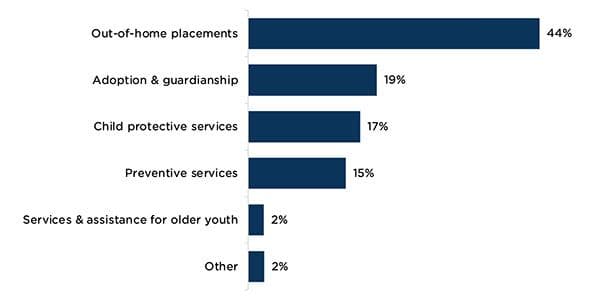
Nearly half of child welfare agencies’ spending in the United States is on out-of-home placements. This category includes costs associated with family-based foster care, congregate care placements, services for children in out-of-home placements and their families, and associated administrative costs.
Figure 1: Where child welfare agencies spent funds in SFY 2022
Source: SFY 2022 Child Welfare Financing Survey
Note: Analysis based on the 43 states that provided sufficient information for SFY 2022. Most states were able to provide only approximations of how their funds were spent.
A much smaller proportion of child welfare funds were used for adoption and guardianship, preventive services, and child protective services. A very small percentage was used to provide services and assistance for older youth.
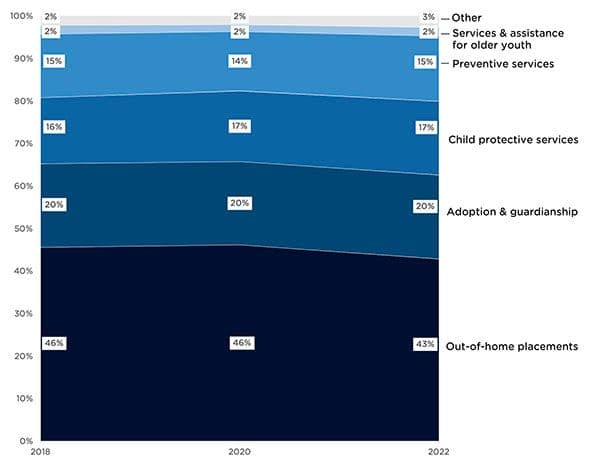
While this distribution of spending has held relatively steady over recent years, child welfare agencies have been trying, when possible, to prioritize prevention more than out-of-home placements. In fact, one goal of the Family First Prevention Services Act of 2018 was to provide more funding for prevention. Therefore, a reasonable question is whether child welfare agencies’ use of funds has shifted over the last several years due to the Family First Prevention Services Act. We observed a slight decrease in the proportion of child welfare agency expenditures used for out-of-home care from state fiscal year (SFY) 2018 to SFY 2022, providing early evidence of a small shift in focus away from out-of-home care.
Figure 2: Where child welfare agencies spent funds in SFYs 2018-2022
Source: SFY 2022 Child Welfare Financing Survey
Note: Figure based on the 32 states with sufficient data.
While this is a small shift taking place among a subset of states, it is nevertheless promising given the difficulty of shifting practice. Child Trends will continue to monitor this shift as Family First Prevention Services Act implementation continues to expand.
Child Trends and Child Welfare Financing
Every two years, Child Trends—with support from Casey Family Programs and the Annie E. Casey Foundation—conducts a national survey of how each state finances child welfare. These data are compiled and released in a national report, state-level factsheets, funding source factsheets, and other products that describe the use of such sources as Title IV-E and Temporary Assistance for Needy Families (TANF), as well as the breakdown of federal dollars spent versus state and local dollars.
States work directly with Child Trends to better understand their child welfare system financing options. This assistance can help leaders clarify decision making and offer insights to promote best practices and improved outcomes for children and families. If you are interested in learning more about our work in this area, please contact Kristina Rosinsky.