





Early care and education teachers, who teach children from birth to age 5, often seek additional support to respond to challenging behaviors, manage their classrooms, and promote children’s social-emotional development. Georgia’s Department of Early Care and Learning (DECAL) is responding to teachers’ needs by investing in an evidence-based professional development approach focused on social-emotional learning, called the Pyramid Model.
An initial evaluation by Child Trends found that two different types of professional development offered in the Pyramid Model—Foundational Training (e.g., self-paced online training) and Practice-Based Coaching (individualized classroom coaching)—were linked to improvements in teachers’ knowledge of social-emotional learning. However, only teachers who participated in Practice-Based Coaching showed significant improvements in observed classroom practices that promote children’s social-emotional development. Notably, these gains persisted into a new school year, even with a new group of children (see Figure).
Figure: Use of social-emotional learning practices increased significantly only among teachers who received Practice-Based Coaching
Average observation score among teachers participating in Practice-Based Coaching and Foundational Training
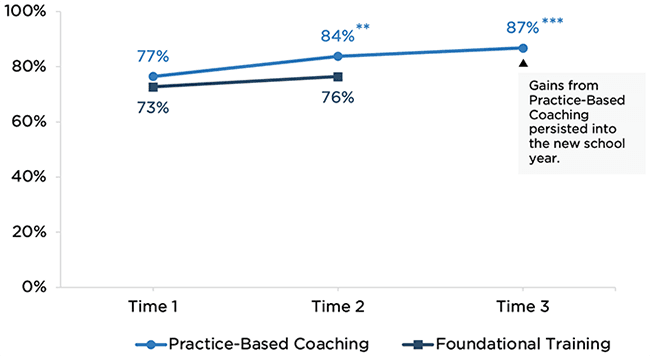
Source note: Georgia Pyramid Model Training Comparison Study. Teacher observation data (from TPOT/TPITOS) at Time 1 (January 2025) and Time 2 (April/May 2025; 2024-2025 school year), and Time 3 (September/October 2025; 2025-26 school year), N=45 for Foundational Training, N=22 for Practice-Based Coaching. ** p ≤ 0.01. *** p ≤ 0.001.
The Pyramid Model is an evidence-based framework of practices designed to promote young children’s social-emotional competence, prevent challenging behaviors, and support children who need more individualized intervention. DECAL’s professional development approach includes Foundational Training, which introduces teachers to Pyramid Model practices through self-paced online modules with peer learning community sessions, and Practice-Based Coaching, which provides individualized support through one-on-one coaching and on-site group trainings. For the evaluation, DECAL wanted to explore whether adding Practice-Based Coaching after Foundational Training would provide additional benefits for teachers. Initial findings suggest that it does, highlighting the complementary roles of these professional development approaches: Foundational Training builds teachers’ knowledge of Pyramid Model practices, while Practice-Based Coaching helps them extend that knowledge and translate it into their daily practice through individualized support and guidance.
Together, these findings suggest that offering both approaches sequentially may strengthen professional learning and help teachers use Pyramid Model practices. Future evaluations will examine the effects of DECAL’s leadership coaching, which is designed to help staff embed the Pyramid Model across their program.
To learn more, read the report.
Suggested citation: LaForett, D.R., Davis, A., Bredeson, M., Novak, K., & Keaton, H. (2026). Practice-based coaching helps turn knowledge into practice for early care and education teachers in Georgia. Child Trends. DOI: 10.56417/7712l2184s