

This brief describes the landscape of home visiting within American Indian and Alaska Native (AIAN) communities and provides a brief overview of the federal investment in home visiting for AIAN families through the Maternal, Infant, and Early Childhood Home Visiting (MIECHV) Program, which includes dedicated funding for the Tribal Maternal, Infant, and Early Childhood Home Visiting (TMIECHV) Program. Then, drawing on data dashboards from MIECHV and TMIECHV, we describe three opportunities for federal investments to build on the benefits of home visiting for AIAN families.
Home Visiting’s Importance to American Indian and Alaska Native Families and Communities
Home visiting, a service delivery strategy that provides education and support to families in their homes, is an important program in the lives of many American Indian and Alaska Native (AIAN)[1] children and families. AIAN and other Indigenous communities often conceptualize child caregiving in broad and holistic ways—for example, by sharing responsibility for caregiving across family members, generations, and communities and grounding this responsibility in shared cultural values. Practices grounded in Indigenous worldviews, such as family caretaking and community and extended family support for caregiving, align with and complement many core components of home visiting programs. For example, home visiting uses a strengths-based approach in working with families; emphasizes relationship-building and goal alignment between families and their home visitors; and values respect for family context, culture, and voice.
Home visiting also addresses many outcomes of interest within AIAN communities. Research and evaluation studies have demonstrated positive impacts of home visiting on outcomes related to family economic self-sufficiency, maternal health, positive parenting practices, reductions in child maltreatment, and linkage and referral to needed services. Home visiting research and evaluation data have been an important part of supporting the delivery and tailoring of services to AIAN communities—for example, through examining the effectiveness of specific models and ensuring the reach and quality of services within specific programs. Research and evaluation will continue to be essential tools for ensuring that benefits reach AIAN families where they are—and in ways that meaningfully support their well-being.
A Broad Range of Home Visiting Programs Serve AIAN Communities
Home visiting programs, which are funded through multiples sources, may reach AIAN families in a variety of ways. Home visiting programs connect expectant and new parents of young children (typically birth to age 5) with a trained home visitor who helps families strengthen their parenting skills, build their knowledge of child development, and connect with community resources. Across the country, more than 120 Indigenous-led organizations provide home visits through models such as Family Spirit, Parents as Teachers, and Nurse-Family Partnership. Additionally, Tribal communities might also provide home visiting through homegrown models, community-specific programs, and coordinated care initiatives, and via interventions used alongside home visiting models (e.g., supplementing home visiting services with a culturally based parent training curriculum, such as Positive Indian Parenting).
While formal home visiting programs date back to the late 1800s in the United States, the last 15 years have seen significant expansion via a large federal investment. The Maternal, Infant, and Early Childhood Home Visiting (MIECHV) Program, established in 2010, is legislatively funded and administered by the U.S. Department of Health and Human Services’ (HHS) Health Resources and Services Administration’s (HRSA) Maternal and Child Health Bureau, in partnership with the Administration for Children and Families (ACF). The MIECHV Program funds voluntary, evidence-based (as defined by HHS) home visiting services in 50 states, the District of Columbia, and five U.S. territories for families in communities at risk for adverse maternal and child health outcomes. In fiscal year (FY) 2024, MIECHV reached more than 70,000 families through nearly 1 million home visits.
The MIECHV Program includes a specific set-aside to reach Tribal communities. This amount is 6 percent under the most recent program reauthorization and the funding amounts will grow over time: Tribal MIECHV (TMIECHV) received $12 million in funding in FY 2022 and $36 million in FY 2025, and funding will increase to $48 million by FY 2027. TMIECHV, administered by ACF, funds Tribes, consortia of Tribes, Tribal organizations, and Urban Indian Organizations through two channels: Development and Implementation grants for those that have never implemented a home visiting program, and Implementation and Expansion grants for those that currently serve families with home visiting programs and plan to continue or expand services. Together, both TMIECHV streams supported 50 Tribal entities in FY 2024. With TMIECHV funding, Tribal communities deliver home visiting through approaches known as "evidence-based" (models that meet the HHS criteria for evidence-based programs within AIAN communities) or "promising" (models that do not yet qualify as evidence-based but have a plan for rigorous evaluation, including those that meet evidence-based criteria for other populations). They also implement innovative approaches to supporting families’ mental health and well-being (e.g., connecting to Native culture and traditions) and create culturally tailored programming to support implementation success stories (e.g., preserving and integrating Elder wisdom).
Opportunities to Build on the Benefits of Home Visiting for AIAN Families
Recent funding expansions create opportunities to strategically harness the benefits of home visiting for AIAN children and families, and data and evaluation efforts can help ensure that these benefits are achieved. The new TMIECHV Outcomes Dashboard and the MIECHV Outcomes Dashboard provide valuable information about the reach, services provided, and family outcomes for both programs on an annual basis, and highlight several opportunities to serve more families, align measurement, and facilitate collaboration across programs.
First, data from the TMIECHV and MIECHV dashboards reveal opportunities to reach more AIAN children and families. In 2024, there were approximately 557,500 AIAN children from birth to age 6 living in the United States who were likely eligible for home visiting.[2] In FY 2024,[3] Indigenous-led organizations, including TMIECHV-funded programs, served approximately 4,107 children. In the same period, the MIECHV program served approximately 1,467 AIAN children. Together, these data suggest that only about 1 percent of all AIAN children living in the United States who were likely eligible for home visiting received home visiting services in 2024 (Figure 1).
Figure 1. In 2024, about 1 percent of AIAN children who were likely eligible for home visiting services received them.
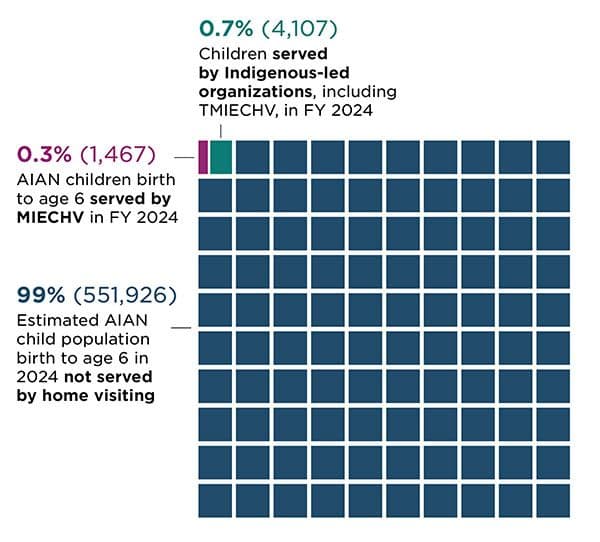
Notes: The estimated AIAN child population includes 557,500 children under age 6 and not yet in kindergarten from 429,600 AIAN families who were likely eligible for home visiting (defined as meeting at least one of the following criteria: families who included a child under age 1, included a single mother, included a parent with no high school diploma, included a pregnant woman or mother under age 21, and/or had a low income). Exact age data for children served by Indigenous-led organizations is not available, but given the home visiting models implemented by these organizations, most children served would be birth to age 6.
Source: Authors’ calculations using data from the TMIECHV Outcomes Dashboard, the MIECHV Outcomes Dashboard, and the National Home Visiting Research Center Home Visiting Yearbook.
However, the estimated AIAN child population not served may include some children who were previously served or served by funding streams not tracked within the sources used to inform these estimates; therefore, it may be an underestimate. Nevertheless, the data indicate room to extend the reach of home visiting services within the AIAN child population and to expand investments in data to more accurately track the degree to which eligible AIAN children are being served.
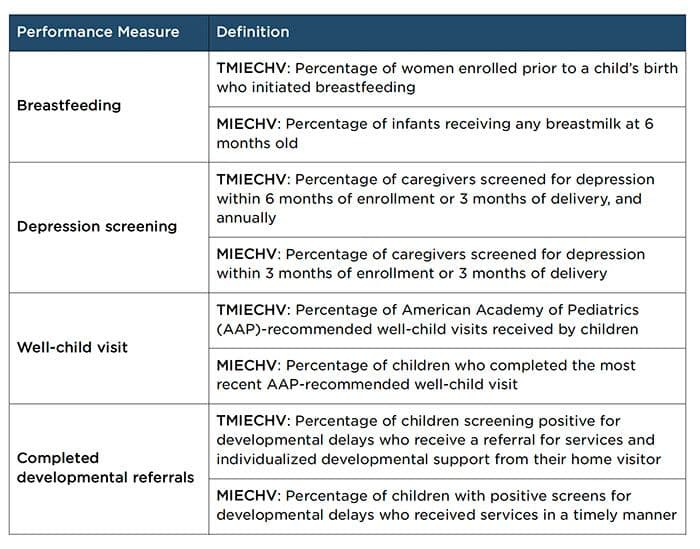
Second, opportunities exist to align performance measures across TMIECHV and MIECHV to better understand the benefits of these programs for AIAN children and families. Currently, TMIECHV and MIECHV outcomes are difficult to compare to each other because the performance metrics differ for each program—even when the programs aim to measure the same outcome. For example, both programs aim to measure breastfeeding as a program outcome, but the MIECHV Program uses a more stringent definition (percentage of infants receiving any breastmilk at 6 months old) than the TMIECHV Program (percentage of women enrolled prior to a child’s birth and who initiated breastfeeding), making direct comparisons difficult (Table 1). Breastfeeding initiation is one of several measures that many home visiting programs monitor to ensure that families are connected to relevant services that support maternal and child health.
Table 1. Example differences in TMIECHV and MIECHV performance measures
Even with differences in the performance measures, however, data from the Tribal MIECHV Outcomes Dashboard and the MIECHV Outcomes Dashboard show that both programs have improved in most of their performance measures over the past several years. For example, although breastfeeding is measured differently within TMIECHV and MIECHV, data indicate positive trends in breastfeeding outcomes across families served by these programs from FY 2021 to FY 2024 (Figure 2). These trends demonstrate the ongoing benefits of federal home visiting for children and families.
Figure 2. Although measured differently, rates of breastfeeding in both TMIECHV and MIECHV programs increased slightly from FY 2021 to FY 2024.
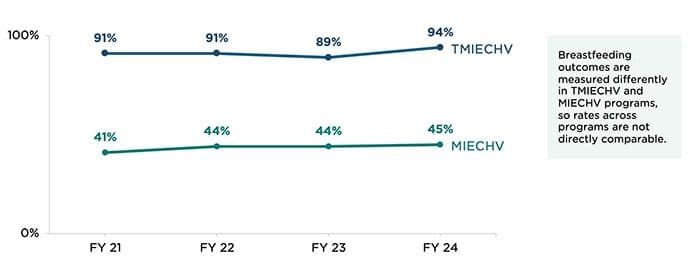
Note: Breastfeeding outcomes are measured differently in TMIECHV and MIECHV programs, so rates across programs are not directly comparable. It is not possible to disaggregate outcome measures by race/ethnicity for either program, so figures represent outcomes for all program participants and are not limited to AIAN families.
Source: Data from the Tribal MIECHV Outcomes Dashboard and the MIECHV Outcomes Dashboard.
While the measurement differences across TMIECHV and MIECHV preclude direct comparisons between the programs, it is important to acknowledge that the outcome measures for both programs were thoughtfully developed with input from the field and key interested parties (including TMIECHV grantees and MIECHV awardees). Additionally, given that the measures have been used in their current form for several years, changing them could present challenges for understanding progress within programs over time. Any changes to outcome measures would therefore have to be made carefully, with significant input from the impacted communities (e.g., TMIECHV and MIECHV programs, Indigenous-led organizations) and in alignment with both HRSA and ACF priorities.
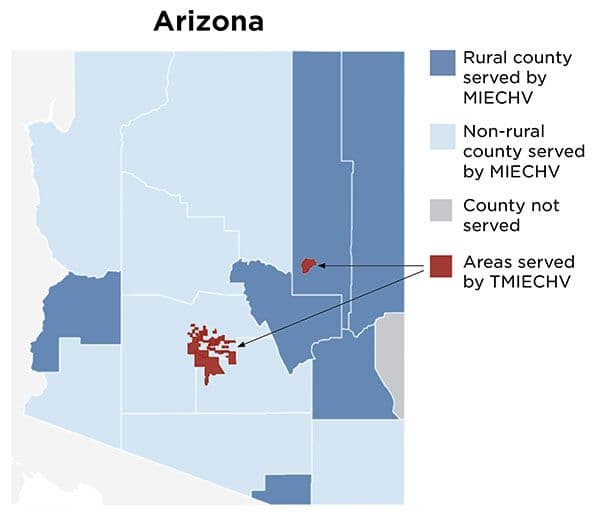
Finally, both dashboards include maps of where families are served by each program, revealing opportunities for collaboration between TMIECHV and MIECHV in areas where both programs serve AIAN families in the same geographic location. For instance, in Arizona, the Native American Community Health Center serves families (via TMIECHV funding) in counties that also have home visiting programs funded via MIECHV (Figure 3).
Figure 3. Programs funded by TMIECHV and MIECHV serve similar geographic areas in Arizona.
Map shows an overlay of geographic areas in Arizona served by programs with TMIECHV and MIECHV funding.
Source: Maps from the Tribal MIECHV Outcomes Dashboard and the MIECHV Outcomes Dashboard.
In these and other areas with both programs, Tribal entities and state awardees could collaborate on things like workforce development activities (e.g., shared training and consultation), particularly in rural communities where access to resources may be limited. Programs could also partner for recruitment and engagement efforts to help families connect with a home visiting program that best fits their needs. Additional opportunities exist for information sharing and coordination. In some AIAN communities, for example, families who participate in home visiting funded by a state’s MIECHV Program may also receive services such as health care or child care provided by a Tribal entity, providing an opportunity to strengthen coordination of these complementary supports. Regions with both MIECHV and TMIECHV funding may also present opportunities for programs interested in aligning performance measures to pilot new approaches for tracking progress toward important goals for AIAN families.
Conclusion
Home visiting supports AIAN families throughout the country. Recently released data through the TMIECHV and MIECHV outcomes dashboards highlight the potential to serve more families, align performance measures, and facilitate and enhance collaboration across programs that serve AIAN families in the same geographic region. The recent drastic growth of federal investment in home visiting provides the chance to leverage these opportunities and continue learning from data and evaluation efforts to maximize the benefits of home visiting services for AIAN children and families.
Footnotes
[1] American Indian and Alaska Native (AI/AN) is the primary population descriptor used throughout this brief. However, related terms such as Native, Indigenous, and Tribal are also used when appropriate—especially when referring to data and references that use those terms, in recognition that the terminology may have specific meaning within the original source.
[2] This represents the number of children under age 6 and not yet in kindergarten from 429,600 AIAN families who are likely eligible for home visiting (defined as meeting at least one of the following criteria: families who included a child under age 1, included a single mother, included a parent with no high school diploma, included a pregnant woman or mother under age 21, and/or had a low income). AIAN families include those with mothers or other primary caregivers who were AIAN alone or as one of multiple races.
[3] Data from FY 2024 represent information from October 1, 2023, to September 30, 2024.
Suggested citation
Crowne, S., Padilla, C. M., & Around Him, D. (2026). Opportunities to maximize home visiting benefits for Native families through data and collaboration. Child Trends. DOI: 10.56417/6615j100x