




Home visiting programs play a critical role in helping families strengthen parenting skills, nurture parent-child relationships, and promote healthy child growth and development. Studies show that home visiting programs are successful in improving maternal and child outcomes related to birth weight, cognitive development, and child abuse and neglect, among others. Home visiting programs are also well-positioned to address outcomes related to parent and child nutrition.[1] However, while many home visiting programs provide some nutrition-related support, few have targeted this issue comprehensively, representing a promising area for future program development.
Conceptual Framework
To learn more about how home visiting programs approach talking to families about nutrition, we conducted a literature scan and talked with members of the home visiting community—including parents and home visiting program staff—about their experiences.[2] We learned home visiting programs’ efforts to improve nutrition-related health outcomes align with the field’s overall two-generation approach in reaching both parents and children. We also learned that nutrition-related activities and intended outcomes in home visiting vary by children’s life stages because families’ needs evolve over pregnancy, infancy, and early childhood.
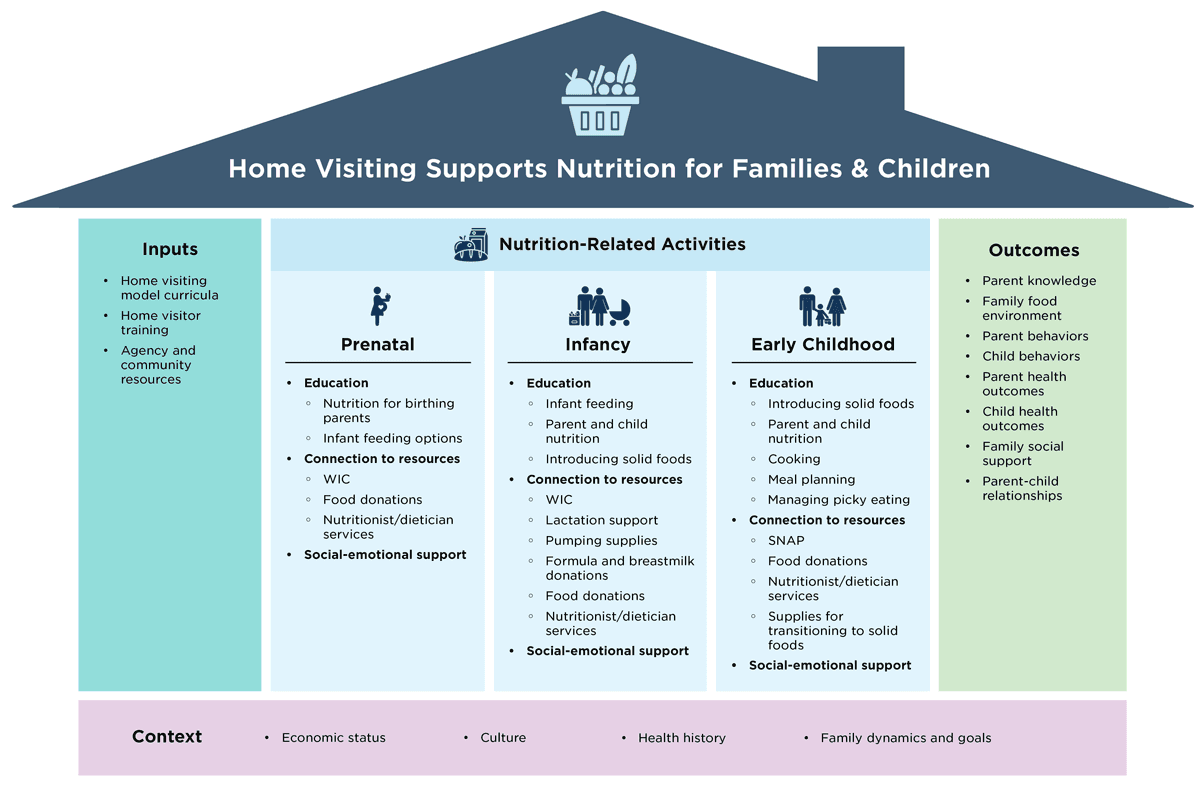
Below, we present a conceptual framework that visualizes inputs, activities, and intended outcomes of home visiting’s work focused on nutrition.[3] The framework also identifies contextual factors that inform these efforts. We then elaborate on each component of the framework, highlighting insights from families and home visiting program staff and spotlighting relevant research.
Inputs
A range of inputs inform the kinds of support that home visiting programs provide families (e.g., topics discussed, resources provided). Among these are home visiting model curricula, which include guidance regarding how and when certain topics are addressed as well as educational materials for home visitors and families. Related to curricula are training opportunities for home visitors on nutrition-related topics. Many home visitors described receiving little formal training on nutrition and expressed interest in learning more so they can provide more comprehensive support to families.
“I think that trainings on nutrition for home visitors are a little lacking. I don’t see them coming through very often and so I think home visitors are going off of what they know or common sense or through experience, but aren’t getting regularly trained on nutrition and how to talk about that with families.”
-Supervisor
The support programs provide is also shaped by the resources available within the home visiting agency and the wider community. For example, some home visiting program staff described the value of having access to a lactation consultant on staff to support families.
“I have a certified lactation consultant on my team that came from WIC, so that’s helpful. She breastfed her kids for a long time, so she’s great and a big support for moms that are going into breastfeeding—what they can do, what they can eat, things like that.”
-Supervisor
Home visiting staff also described partnering with programs in the community to enroll families in home visiting. For example, many home visiting programs receive referrals from the Special Supplemental Nutrition Program for Women, Infants, and Children (WIC).
Activities
Within home visiting programs, there is considerable variation in both the types of nutrition-related supports offered to families and the extent of these supports. This section describes examples of the types of activities that programs may offer by life stage.
Prenatal
Home visiting programs often begin working with families during pregnancy, when parents are preparing for their baby’s arrival. During this phase, nutrition-related activities are primarily focused on supporting a healthy pregnancy—for example, by encouraging a healthy diet for pregnant parents and managing conditions including anemia and gestational diabetes. This support takes the form of education for parents and, in some cases, liaising with medical providers. During the prenatal period, activities may also include educating families about their options for feeding their babies after birth. Additionally, home visitors may connect families with community resources to support adequate family nutrition and health, including WIC and the Supplemental Nutrition Assistance Program (SNAP), and provide them with social and emotional support as they navigate pregnancy-related challenges.
 Play video
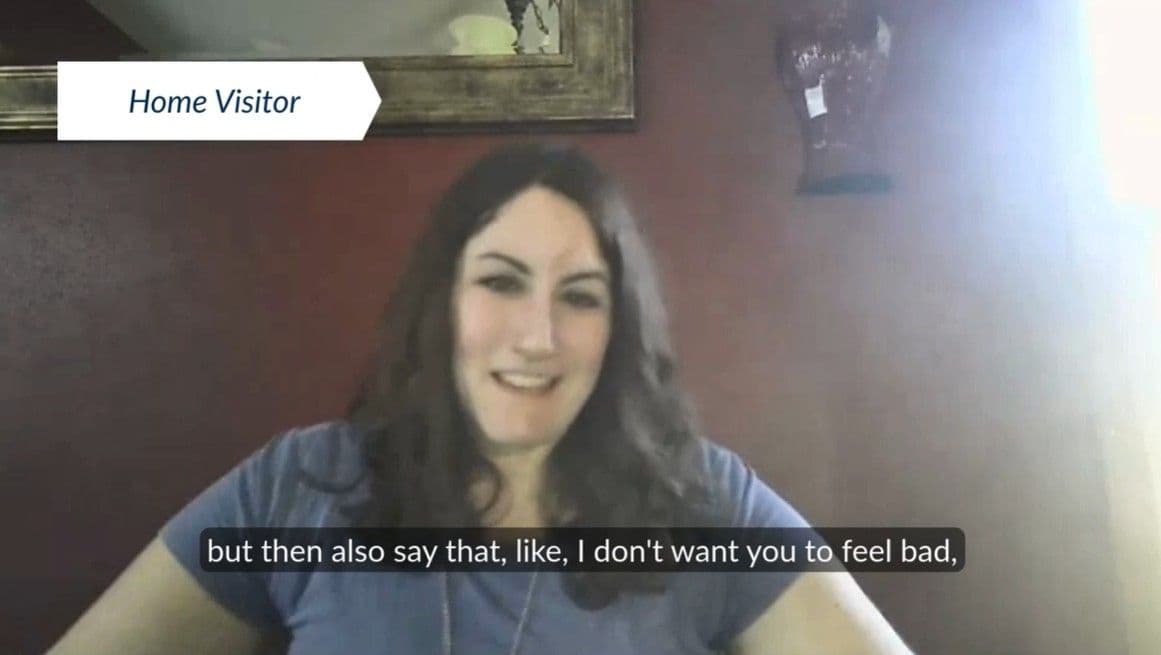
“I was getting more self-conscious over my weight, so we would be like … ‘Don’t worry and stress about your weight. You know your baby is getting all the nutrition from your body.’ … She was just really supportive and really kind. That comfort is what I needed.”
-Parent
“[My home visitor helped me by] just giving me a heads up of certain foods to avoid and to eat. Like, it’s OK to indulge in my cravings, but also to eat some of the healthy stuff too at the same time, like making sure I’m eating my greens. … You always hear the lecture of ‘Oh, you’re supposed to be eating right.’ She actually went off like, ‘What are your cravings?’ and then built up off of that.”
-Parent
Infancy
After babies are born, home visitors continue to provide education to parents and caregivers. Topics of education often focus on infant feeding, including support for breastfeeding—an area of particular focus for home visiting programs funded by the federal Maternal, Infant, and Early Childhood Home Visiting (MIECHV) Program—and pumping. Home visitors also educate families on formula feeding (e.g., how to correctly prepare bottles). Home visitors may also begin educating families on how to transition babies to solid foods in preparation for the weaning process.
Related to breastfeeding and pumping, some home visiting programs guide families on how to navigate breastfeeding and pumping breast milk as parents transition back to working outside the home. This guidance may include safely handling of pumped milk and information about the Fair Labor Standards Act, which requires employers to give nursing workers the space and time to pump privately.
“[My home visitor] would help me with buying breast milk bags and then also for daycare, helping me with [instructions] so that daycare could know how to store and how long breastmilk lasts.”
-Parent
Some home visiting programs also provide education related to parent nutrition, often emphasizing how a parent’s diet can affect their child’s nutrition, particularly when infants are breastfeeding.
 Play video
“She knew I was breastfeeding so she wanted to make sure I was eating good. When I was breastfeeding, you get so wrapped up in taking care of everybody else, you forget to take care of yourself. She was like ‘Are you eating? Are you taking your prenatal vitamins?’ That was another thing I never knew about, still taking my prenatal vitamins to not lose the nutrition for yourself while you’re trying to give nutrition to your kids.”
-Parent
Parents generally identified these supports as helpful; however, in some cases, families and home visitors noted that, during this period, babies’ needs often take priority over those of their parents. Several home visitors and families shared that they would like to see a greater emphasis on parent nutrition during the infancy phase.
“You have to take care of yourself first as a parent and then, you know, take care of your child after that because your cup needs to be filled before you can be a good parent to your child.”
-Home visitor
In addition to education, home visitors continue to connect new parents and caregivers to community resources to support nutrition during the infancy phase. These include referrals to WIC, formula and breastmilk donations, food donations, lactation support, pumping supplies, and nutritionist/dietician services.
“I got connected to a group [breastmilk donors] where I was able to get breastmilk. My [home visitor] had gone about to find out if it was a good source or not and what questions I should ask the moms before I accepted the milk.”
-Parent
“Whatever I needed, I always get from my home visitor. So, for example, with the formula, we were trying different formulas. She would bring different brands for me to try to see what will agree with [my son] or what he might like.”
-Parent
Home visitors also function as an important source of social and emotional support and encouragement to parents and caregivers as they navigate the challenges of the postpartum period.
 Play video
Early childhood
As children grow and begin eating solid foods, the supports that home visiting programs provide evolve. In this phase, topics of education often include when and how to introduce solid foods, including safety-related topics (e.g., how to minimize choking risks), parent and child nutrition, cooking and meal planning, and how to manage picky eating. These topics are most often addressed during home visits, but some home visitors also described addressing them via group events, including at events focused on cooking, grocery shopping, and gardening.
 Play video
“We talked about making our own baby food, which was kind of cool…so she was actually educating me about it. ‘It’s very simple, all you have to do is cook it for this [amount of time] and grind it up, and that’s it. You don’t have to feel like you have to go and buy it.’ So she was just being really resourceful…she was just tailored to what we needed and what we were wanting during that time.”
-Parent
As in earlier phases, the educational content during this phase most often focuses on children. However, home visitors and families again identified a need to place greater emphasis on parents’ and caregivers’ nutrition, both to ensure that adults’ own needs are met and to ensure that adults model positive habits for children.
 Play video
In addition to education, home visitors connect families to community resources, including SNAP, food donations, nutritionist/dietician services, and supplies to facilitate the transition to eating solid foods (including highchairs, spoons, and plates).
“Every developmental milestone that he hit, there was food and nutrition information. She would even bring me gift cards to be able to buy foods that would help [my son] … my son had anemia and there was a point in time where he wasn’t gaining weight and she would bring information or connect me to different places, for example with a pediatrician, and give me information to ask about what I can try to help him gain weight.”
-Parent
 Play video
Home visitors also continue to provide families with social and emotional support as they navigate the challenges of parenthood, including challenges related to food and nutrition.
“I’m pretty comfortable talking to her about anything. I feel like especially because she has been, like, a huge staple in my son’s life, because they have such a great relationship, I feel like she’s always considering my son—emotionally, his health, and everything. I feel like I don’t have an area where I’m not comfortable talking to her about that.”
-Parent
Outcomes
Participation in home visiting is associated with a range of nutrition- and health-related outcomes, including parents’ knowledge of nutrition topics, families’ food environments, parent and child behaviors, and health outcomes for parents and children. Home visiting is also a mechanism to provide social and emotional support and strengthen parent-child relationships. This section describes some documented outcomes from the academic literature that were emphasized by families and home visiting program staff.
Prior studies have shown that home visiting increases parents’ knowledge of nutrition-related topics, including infant feeding and parent and child nutrition.
“Whatever I was unsure about, or didn’t have much knowledge about, I would always ask and she would always give me information … She had so much information to give to me to make sure that me being a parent was a breeze and not something that was very stressful.”
–Parent
 Play video
Home visiting can also positively affect families’ food environments. This mechanism includes ensuring that families have access to adequate food—for example, by making connections with WIC, SNAP, and food and formula donations.
“[My home visitor’s] support was very helpful, because my husband stopped working for a while. She told me where there were food pantries, and sometimes picked up food for me, which helped us a lot at that time. If it hadn’t been for her, I wouldn’t have known about these things.”
–Parent (translated from Spanish)
“Oftentimes, especially with prenatal parents, they’re not sure about what they qualify for. So it’s providing information on what resources are in the community. It might be helping them sign up for programs like WIC and SNAP. And sometimes it’s even transporting to get those resources.”
-Supervisor
Beyond helping ensure that families have enough food to eat, some evidence suggests that home visiting can positively impact the type and quality of food available in the home.
Related to the food environment, evidence suggests that home visiting can also affect parent and child behaviors, including behaviors related to the initiation and duration of breastfeeding, adult physical activity, diet, cooking healthy foods, and other food-related routines (including developmentally appropriate feeding skills and practices).
 Play video
Evidence suggests that home visiting programs may also improve health outcomes for children and families. For example, during pregnancy, home visiting has been associated with reductions in rates of pregnancy-induced hypertension and lower gestational weight gain. Home visiting has also been associated with long-term health effects, including healthy blood pressure for parents and healthy weight for children.
Home visiting can also increase families’ sense of social and emotional support. By acting as members of families’ support networks, home visitors can function as health supporters who help families navigate challenges related to food and nutrition—including infant feeding, transitions to solid foods, and picky eating—and ensure that the nutritional needs of both adults and children are met.
Home visiting activities focused on nutrition may also foster more positive and nurturing relationships between parents and children. For example, efforts to support breastfeeding may encourage secure parent-child attachment. Encouraging family meals may offer parents and children an opportunity to communicate and bond.
“Food is a way that we connect with people we love. And I think that incorporating that into the culture and the home visiting program, that will make a lasting impression for families.”
-Parent
“When our daughter was first admitted into the [home visiting] program, she was staying in foster care, and so we were not able to be as hands-on as we wanted to be as parents. And one of the ways we were able to maintain a strong connection with her was by providing breastmilk and then we provided all her food once she started eating food … for other families that might be involved in the foster care system when their child is going through a home visiting program, I think that using nutrition as a way to connect with your child and using the home visiting program to help support that connection is something that would be helpful for families that might be positioned the way ours was.”
-Parent
Context
Home visiting program staff and families identified multiple contextual factors that inform families’ interest and ability to engage in and benefit from nutrition-related activities.
Many identified low economic status as an important constraint many families face when making decisions related to food and nutrition.
“I guess maybe the only uncomfortable part would be, like, if I know I'm broke and I know all these, all this better organic food is more expensive. Like I probably would be like, ‘Oh, thank you for the information.’ And then when they leave, I would probably be like, well, I'm not going to do it.”
-Parent
 Play video
Program staff and families also shared the importance of acknowledging and accommodating the role of culture in shaping families’ food practices and preferences.
“[My home visitor] did talk about certain foods that were part of my Native culture. She wasn’t from the same Tribe, but she was Native, so she knew at least an outline of some of the certain foods that we do eat … We talked back and forth about what her Tribe did and what my Tribe did.”
-Parent
 Play video
Families’ health histories also affect their experiences of nutrition-related activities in home visiting programs. Many parents described how their own health conditions, or those of their children, influenced their nutrition- and food-related needs and the types of support they received from their home visitors.
“My son has a wheat allergy, so [my home visitor] is doing a lot to help with me finding different resources of what we can eat and keeping him up on his nutrition and intake … She’s keeping me motivated to want to look it up more and figure out more instead of letting my fear take over.”
-Parent
“We found out that my oldest had autism, so when he was getting into those new foods, he was very picky about what he wanted to eat. [My home visiting nurse] was learning and I was learning of good things to try, and we got to learn together. It was fun getting to learn together and figure out ways to help provide nutrition for my son.”
-Parent
Additionally, family dynamics and family goals also inform home visiting program participants’ experiences of nutrition-focused activities. Some families may be more interested in these topics than others or require more or different levels of support. For example, while some parents appreciated support from their home visitors regarding postpartum weight loss, others cautioned against programs focusing explicitly or exclusively on weight and weight-loss.
“One thing that I think should not be talked about when it comes to nutrition in a home visiting program is nutrition related to weight management, especially when talking about children. I think that that's not the point. Healthy side effects might be, you know, weight management. But I think focusing on activities like, you know, how nutrition feeds children and families’ abilities to do activities together, to focus on school, to sleep well, to explore new experiences. That's where the focus should be when it comes to nutrition in any home visiting program.”
-Parent
Overall, parents reported appreciating the extent to which their home visitors were responsive to their interests and needs.
“She was pretty much tailored to my family. She was able to mold to my family with what I needed, me and my family, during that time.”
-Parent
Conclusions and Directions for Future Research
Our initial literature scan and conversations with members of the home visiting community highlight the many ways in which home visiting programs already support children’s and families’ nutrition through education, connection to resources, and social-emotional support. Home visiting—especially nutrition-specific activities—benefits children and families through improved parent knowledge, family food environments, and health outcomes; through positive parent and child behaviors and relationships; and through increased social and emotional support.
This work also revealed some opportunities to further strengthen nutrition supports within home visiting. For example, the home visiting field needs to further develop model guidance and curricula to more comprehensively address family nutrition, including parents’ nutritional needs. Relatedly, there is a need to provide more training to home visitors on nutrition-related topics so they feel comfortable (and are knowledgeable) supporting families around nutrition.
Future research can support implementation efforts. For example, more research is needed on what kinds of nutrition-related home visiting supports families themselves would find most helpful, and on what kinds of training and resources most effectively prepare the home visiting workforce to support families with nutrition-related topics. Finally, future research should continue to explore and expand upon current innovative practices that can be integrated into home visiting to promote healthy nutrition practices and positive child and family health outcomes.
Methods
This project aimed to understand how home visiting programs are engaging in conversations around nutrition with families, the nutrition-related supports home visiting programs provide to families, and how these supports evolve as families' needs change during pregnancy, infancy, and early childhood. Key activities included a literature search on Google Scholar to identify academic articles on this topic, along with interviews with families participating in home visiting and home visiting staff to gather their insights and experiences.
Using Boolean operators, the research team searched for “home visiting” along with nutrition-related words and phrases. We supplemented this search with a hand search, which involved checking reference lists of original sources to further identify relevant sources for review. A total of 48 sources were included in our review, a majority of which were peer-reviewed articles.
Using our team's networks, we reached out via email to families participating in home visiting and to home visiting staff to schedule 30-minute interviews to hear their experiences. We interviewed nine parents who participated in home visiting, three home visiting supervisors, and two home visitors, utilizing thematic analyses to identify themes. Interview participants were compensated with a $25 gift card.
Child Trends and Home Visiting
Experts at Child Trends have extensive experience researching and supporting home visiting. Our multidisciplinary team works with federal, state, local, and philanthropic partners to evaluate and strengthen home visiting programs. Recent publications highlight strategies to increase recruitment and uptake of home visiting, to build policies that support the home visiting workforce, and to examine implementation quality using a conceptual framework.
In addition, we helped the Health Resources and Services Administration design the MIECHV Program Outcomes Dashboard. We also provide support to state and federal home visiting programs through data analysis, data visualization, technical assistance, and policy development. If you are interested in learning more about our work on these topics, please contact Sarah Crowne or Christina Padilla.
Acknowledgements
The authors would like to thank Kylee Novak for their support editing the videos for this piece. The authors would also like to thank the home visiting program participants, home visitors, and supervisors who shared their time, experiences, and perspectives with us for this project.
Notes
[1] We use “parents” throughout to refer to those in a parenting role, including parents, grandparents, kinship care providers, and foster parents.
[2] In this project, we define “home visiting” broadly, including programs using a range of models, provider types, and durations.
[3] Note that the inputs, activities, intended outcomes, and contextual factors listed in this model are intended to be illustrative but not exhaustive.