
Child Trends, in partnership with the University of California San Francisco, is conducting a rigorous evaluation of the Let’s Talk Birth Control intervention (“Let’s Talk”). Let’s Talk is a multi-level, clinic-based intervention for adolescents and young adults (AYA) and health care providers that includes both in-person and online components. The program aims to increase providers’ capacity to deliver person-centered contraceptive care to AYA with the ultimate goal of improving young people’s self-efficacy to discuss, obtain, and correctly use contraceptive methods, and to increase their use of preferred contraceptive methods.
Intervention
Let’s Talk was co-created by Power to Decide and the University of California San Francisco’s Beyond the Pill Program. The intervention consists of a printed contraceptive decision aid (CDA), contraceptive counseling training for providers, and a QR code to the Bedsider.org Method Explorer (ME).
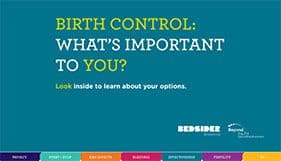
Printed Contraceptive Decision Aid
A printed contraceptive decision aid (CDA) designed for adolescents and young adults addresses seven key factors salient to contraceptive decision making, including privacy, starting and stopping the method, side effects, bleeding, effectiveness, return to fertility, and emergency contraception.
The CDA provides information on the full range of available contraceptive methods, including long-acting methods such as the IUD and implant; hormonal methods such as the shot, pill, patch, and ring; as well as other methods like condoms, withdrawal, fertility awareness, and emergency contraception.
Online Training for Providers
An online training for providers offers guidance on patient-centered contraceptive counseling, including how to use the CDA during clinic visits to support shared decision making with adolescent and young adult patients.
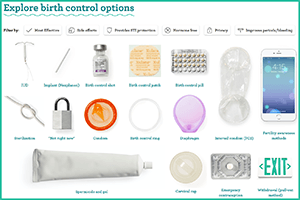
Online Method Explorer
The Bedsider Method Explorer on Power to Decide’s birth control support network includes information on all contraceptive methods and a personalized method comparison feature.
Study Design
Child Trends is conducting a randomized controlled trial to assess Let’s Talk impact on young people’s contraceptive behaviors and associated mediators such as knowledge, self-efficacy, and attitudes related to contraception. From September 2024 to August 2026, the study will enroll 30 federally qualified community health centers from around the United States to implement Let’s Talk or continue with their existing standard of care (based on random assignment). Each health center will enroll approximately 50 female AYA patients ages 15 to 24 during their regularly scheduled sexual and reproductive health or wellness visits. Enrolled participants in the treatment centers receive the CDA to review on their own and then review it with their provider. Enrolled participants in the control centers receive the centers’ existing standard of care. Using patient survey data from baseline, 1 week post-intervention, and 9 months post-intervention—along with implementation data and qualitative findings from patient focus groups and provider interviews—the study will assess intervention fidelity and quality, patient characteristics, patient and provider perceptions of Let’s Talk, and impacts on sexual and reproductive health outcomes.
Timeline
- September 2023 – August 2024: Completed implementation and evaluation planning and piloted the intervention and study procedures at two health centers
- September 2024 – August 2027: Implementation and impact evaluation, with ongoing recruitment and follow-up data collection
- September 2027 – August 2028: Analysis and final reporting
Publications
Let’s Talk Study Participation Overview
Preliminary Findings from an Evaluation of Let’s Talk Birth Control
Project Staff

Kate Welti
Senior Research Scientist

Jennifer Manlove
Senior Research Scholar, Sexual and Reproductive Health

Samantha Ciaravino
Research Scientist
Jane Finocharo
Senior Research Analyst

Elizabeth Quinteros
Research Assistant

Sydney Briggs
Research Scientist
Funding Information
This webpage was made possible by Grant Number TP2AH000097 from the Office of Population Affairs of the U.S. Department of Health and Human Services (HHS). Its contents are solely the responsibility of Child Trends and do not necessarily represent the official views of, nor an endorsement by, OPA/OASH/HHS or the U.S. Government.