


A critical element of a positive family planning care experience is for the client to be able to ask all of their questions and get complete answers from their provider. In fact, in a recent Child Trends survey, 75 percent of family planning clients cited this person-centered approach when asked what had contributed to their positive care visit. High-quality family planning care is both person-centered (meaning it centers individual clients’ preferences during care visits) and offered in settings with efficient infrastructure for ensuring client access and comfort (such as scheduling, record-keeping, and supportive front desk staff). Understanding the most important aspects of a positive or negative family planning visit experience can help health centers adopt strategies to improve service delivery.
Child Trends surveyed 1,016 individuals assigned female at birth who had recently received family planning care and were income-eligible for publicly funded services.[1] Of the 893 respondents who reported a prior sexual and reproductive health (SRH) visit, over three quarters (78%) reported a prior visit they considered “mostly positive” while 19 percent reported a “mostly negative” visit. Respondents were also asked to report on the most important characteristics (up to three) that made their visit experience mostly positive or mostly negative; characteristics were related to interactions with providers and features of the clinic or the appointment. Survey respondents also provided write-in answers that described, in more detail, the factors that made their visit positive or negative; figures 1 and 2 include select quotes that illustrate the top reasons for positive and negative visits. (The full distribution of categorical responses can be found in the Appendix.)
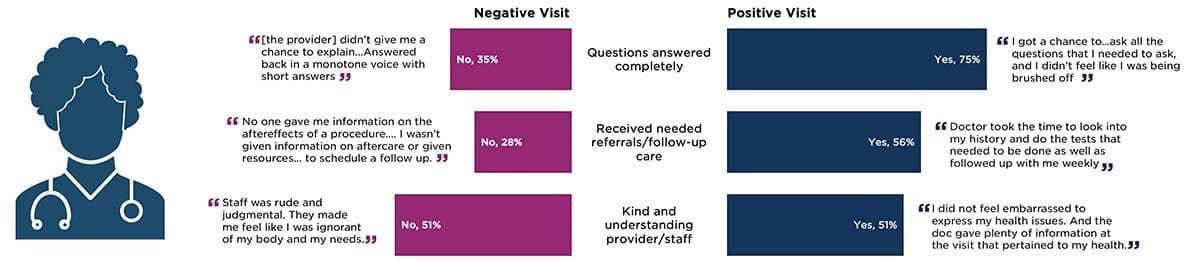
Among responses related to provider-patient interactions (Figure 1), clients characterized positive SRH visits as those in which the provider/staff:
- Gave clients the opportunity to ask questions and answered their questions completely (75%)
- Gave clients needed referrals or follow-up care (56%)
- Were kind and understanding toward clients (51%)
Visits that the clients described as negative were characterized by clients as those in which the provider/staff:
- Treated clients unfairly, made them uncomfortable, and/or were dismissive (51%)
- Did not give clients the opportunity to ask questions or have their questions answered completely (35%)
- Did not give clients needed referrals or follow-up care (28%)
Figure 1: Top 3 provider-related reasons for a positive or negative family planning visit
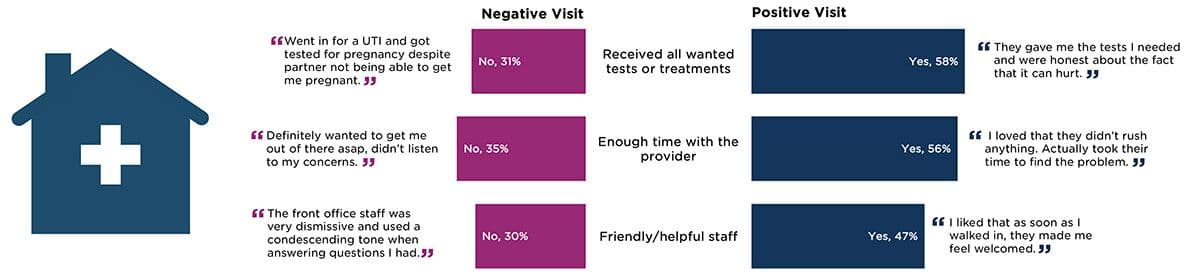
When asked about clinic- or appointment-related factors impacting their experiences (see Figure 2), clients characterized positive SRH visits as those in which:
- Clients received all desired tests or treatments (58%)
- Clients had enough time with the provider (56%)
- The front desk or other staff were friendly and/or helpful (47%)
Visits that clients described as negative were those in which:
- The appointment was too brief (35%)
- Clients received tests or treatments they did not want, or didn’t receive wanted tests or treatments (31%)
- The front desk or other staff were mean or abrupt (30%)
Figure 2: Top 3 clinic- or appointment-related reasons for a positive or negative family planning visit
The common characteristics of both positive and negative visits highlight the importance of person-centered care in family planning settings, which includes respectful and nonjudgmental provider-patient interactions that center clients’ preferences and provide sufficient information about care options and possible follow-up services. These findings also highlight the need for a positive clinic environment (e.g., friendly and helpful staff) and appointments that allow enough time to include person-centered counseling and provide desired tests and treatments.
Appendix : Detailed Breakdown of Survey Responses
Nearly three quarters of respondents to the Child Trends survey (72%) reported that their most recent family planning visit experience was “mostly positive” and only 6 percent rated their visit as negative (“somewhat” or “mostly”; see Figure A1). Respondents also reported on their prior sexual and reproductive health visits (SRH) in the past 3 years. More than three quarters (78%) reported a prior visit they considered “mostly positive” while 19 percent reported a “mostly negative” visit. These percentages include the 14 percent of respondents who reported both a positive visit and a negative visit. An additional 17 percent did not categorize their previous visit(s) as mostly positive or mostly negative.
Figure A1: Approximately 3 in 4 recent family planning clients report being satisfied with their experience
Percentage of clients reporting levels of satisfaction for their most recent visit, and for prior visits in the past 3 years
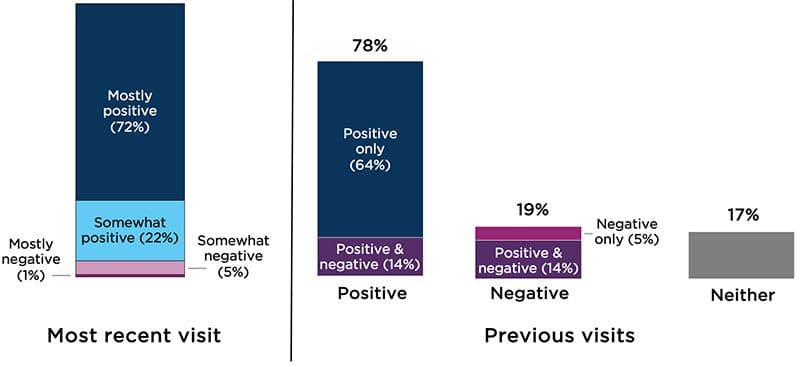
Table A1: Percentage of respondents selecting each visit characteristic, among those reporting each visit type
Methodological note: If a respondent reported a sexual and reproductive health visit in the past 3 years that was either mostly positive or mostly negative, they were asked to select the top three reasons for their rating from a selection of options related to provider-patient interactions and a selection of options related to the appointment or clinic factors.
*Respondents who selected "Other" and then specified interactions with staff who were not front desk staff were categorized into this response category.
This publication was supported by the Office of Population Affairs (OPA) of the U.S. Department of Health and Human Services (HHS) as part of a financial assistance award totaling $1,548,353 with 100 percent funded by OPA/OASH/HHS. The contents are those of the author(s) and do not necessarily represent the official views of, nor an endorsement, by OPA/OASH/HHS, or the U.S. Government. For more information, please visit https://opa.hhs.gov/.
Suggested citation
Welti, K., & Manlove, J. (2024). Person-center care elicits more positive responses from family planning clients. Child Trends. DOI: 10.56417/5821z9314t
Acknowledgements
The authors would like to thank Ria Shelton and Catherine Nichols for their visual design work. We would also like to acknowledge Emma Pliskin and Jane Finocharo for their data analysis work.