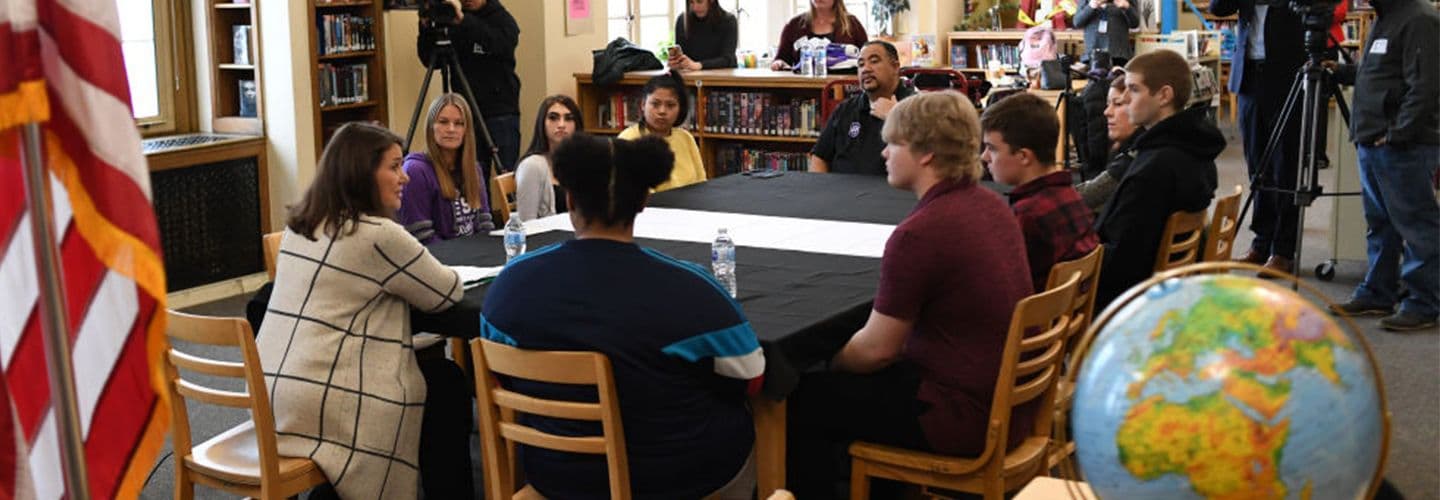
Young people who have lived experience navigating youth-serving systems (e.g., foster care) are increasingly recognized as essential contributors to shaping policies that impact their lives. The Authentic Youth Engagement in Policy Project is conducted by Child Trends in partnership with the Conrad N. Hilton Foundation’s Opportunity Youth, Foster Youth, and Homelessness Initiatives. Through two phases of work, we have examined how youth are meaningfully engaged in policy processes and how that engagement influences policy outcomes, organizational change, youth development, and community outcomes.
Context
Policy advocates and decision makers have increasingly turned to young people with lived experience navigating youth-serving systems (e.g., child welfare, employment) to inform policy. When youth are supported as co-creators and decision makers, their lived experience can strengthen the relevance and impact of policy solutions. Successful youth engagement efforts are typically characterized by organizational structures that provide clear roles, consistent support, and opportunities for leadership.
In addition, meaningful engagement requires adult partners who are prepared to share decision-making power, foster trust, and create conditions where youth feel valued and heard. Without these elements, youth involvement risks becoming superficial or symbolic.
This context has shaped the project’s emphasis on examining young people’s specific roles, the organizational practices that enable their contributions, and the broader environmental factors that influence the success of youth engagement in policy.
Phase I: December 2023 to June 2025
The first phase, a community-engaged research project, was co-designed and co-led with representatives of five grantee organizations, with one young person and one adult representing each organization. Together, these representatives comprised the Youth Engagement in Policy Research Group. This group refined a framework for authentic youth engagement in policy, conducted qualitative research to document promising practices and barriers, and identified actionable insights to strengthen youth policy engagement efforts, both in grantees’ local contexts and nationwide. Child Trends, with consultation from Education Northwest, served as a research and technical assistance partner, facilitating the group’s work while ensuring the rigor and integrity of the project.
Phase I project goals included the following:
- Describe how grantee organizations engage young people in policy advocacy.
- Identify outcomes, challenges, and facilitators associated with authentic youth engagement.
- Refine a research-based framework to guide youth engagement in the policy process.
- Generate findings and recommendations to strengthen policy engagement efforts with young people, both locally and nationwide.
A range of resources were developed at the end of Phase I to help grantees, funders, and practitioners strengthen youth engagement in policy efforts:
- A Comprehensive Library of Community-Engaged Research Resources
- Summary report synthesizing key findings, cross-site themes, and actionable recommendations
- Authentic Youth Engagement in Policy Framework offering practical guidance for implementing meaningful youth involvement in policy processes
- Practice profiles showcasing each grantee’s unique strategies and lessons learned in engaging youth
- Public webinar to share insights and implications with the broader field and support continued learning and application
Phase II: October 2025 to January 2027
Building on Phase I, Child Trends applied the Authentic Youth Engagement in Policy Framework to a geographically diverse group of organizations that engage youth in the policy process across a wide range of issues (e.g., child welfare, education, employment, housing, and juvenile justice). In addition to grantee organizations, Child Trends and the Hilton Foundation identified and invited outside organizations to participate. For each organization, we identified the stages at which they engaged youth, the roles youth play, the strategies organizations use to support youth engagement, the local context, and the outcomes achieved. We then completed a cross-organization analysis.
We then developed and facilitated a Community of Practice that met four times over the course of 2026 to facilitate peer learning on topics identified through the cross-organization analysis. All organizations that participated in the cross-organization analysis were also invited to participate in the Community of Practice; based on learnings from both activities, we are developing a series of tools and resources to build capacity for authentic youth engagement.
Phase II project goals include the following:
- Assess how grantees and other youth-serving organizations engage youth in policy efforts.
- Provide technical assistance and facilitate peer learning through a Community of Practice.
- Develop and disseminate resources to build capacity for authentic youth engagement.
Existing and forthcoming resources to inform funders and practitioners and support organizations to strengthen youth engagement in policy efforts include the following:
- Cross-organization analysis applying the Authentic Youth Engagement in Policy Framework to 32 organizations across the United States
- Self-reflection tool for organizations to document, assess, and strengthen their youth engagement efforts
- Forthcoming blog posts and video featuring organizations and speaking to strategies for (1) engaging youth in policy implementation and (2) training adults to build their capacity for authentic youth engagement
- Forthcoming webinar
Partners
Local partners profiled (Phase I)
- Center for Fair Futures (New York, NY)
Secured $30.7 million in annual public funding for youth coaching and tutoring through youth-led advocacy. - Georgia EmpowerMEnt (Atlanta, GA)
Led advocacy for state legislation to provide postsecondary tuition waivers for young people in foster care attending vocational colleges. - Los Angeles Opportunity Youth Collaborative (Los Angeles, CA)
Proposed—and currently engaged in—a partnership with the Los Angeles County Department of Children and Family Services to create a new Youth Engagement Section that will provide youth-centered case management. - Los Angeles City Youth Development Department & Para Los Niños (Los Angeles, CA)
Launched Youth Advisory Councils at the city’s YouthSource Centers to elevate youth voices in local decision-making processes. - New Orleans Youth Alliance (New Orleans, LA)
Builds young people’s capacity to participate in community leadership roles through the annual cohort-based Youth Leadership Fellowship.
Youth Engagement in Policy Research Group (Phase I)
- Jamya Clark, New Orleans Youth Alliance
- Teddy DeLeon-Alvarado, Para Los Niños
- Blandina Flores, Para Los Niños
- Brisia Gutierrez, Los Angeles Opportunity Youth Collaborative
- Iziko Calderon, Los Angeles Opportunity Youth Collaborative
- Sam Joo, Para Los Niños
- Nadirra Monrose, Center for Fair Futures
- Faith Robinson, New Orleans Youth Alliance
- Deven Rudy-Johnson, MSW, Georgia EmpowerMEnt
- Kyra Stoute, Georgia EmpowerMEnt
- Tony Turner, Center for Fair Futures
Participating Organizations (Phase II)
See list Appendix B here for a list of participating partners.
Child Trends Staff
Phase I
- Principal investigators: Amy McKlindon, Samantha Holquist
- Staff: Alyssa Scott, Ja’Chelle Ball, Jessica Conway, and Sage Caballero
- Senior advisors: Karin Malm (Child Trends), Elizabeth Jordan (Child Trends), and Julie Petrokubi (Education Northwest)
Phase II
- Principal investigators: Amy McKlindon, Alyssa Scott
- Former principal investigator: Samantha Holquist
- Staff: Ja’Chelle Ball, Karlee Naylon, Liv Reyes
- Senior advisor: April Wilson
Funder
This project is supported by the Conrad N. Hilton Foundation through its Opportunity Youth (Phase I and II) and Foster Youth (Phase I) Initiatives.