
ECE Access Framework
Access to early care and education (ECE) is defined by more than just the number of available child care slots—it’s about ensuring that families can find, afford, and choose options that are high-quality and truly meet their needs. Our framework defines access through four interrelated dimensions that reflect what matters most to families and highlight the conditions needed for strong systems:
- Affordability: Families can afford the cost of care.
- Reasonable effort: Families can easily find out about and enroll in programs in their area.
- Supports children’s development: Families have access to high-quality care that meets their child’s unique needs.
- Meets parents’ needs: Families find their preferred type of program that works for their schedules.
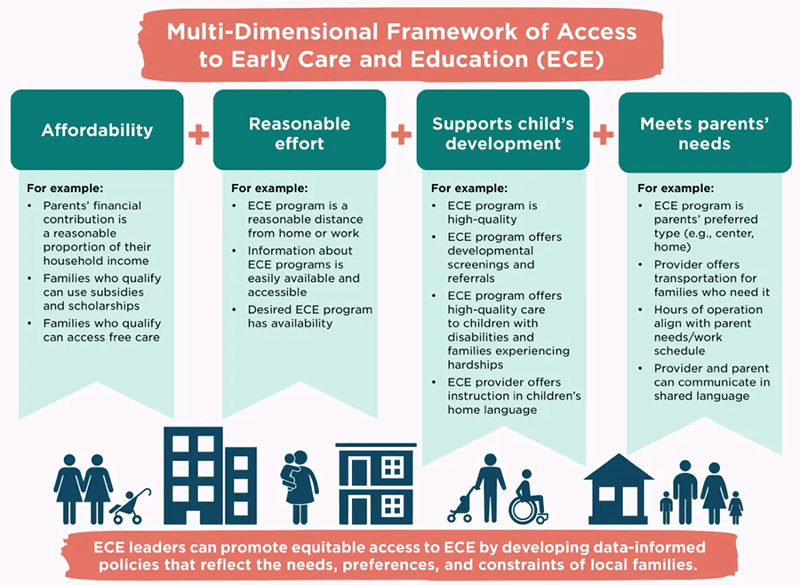
Families have a diverse range of circumstances, resources, and priorities that shape how they access and experience ECE. For some, proximity to work may be essential when searching for ECE; for others, a program that can administer a child’s medication may be a higher priority—and still other families may prioritize having both conditions met. Depending on their priorities and preferences, families may encounter different opportunities and barriers. For instance, families with limited transportation may depend on care located near their workplace, while families who speak a language other than English may find few programs equipped to meet their needs. By understanding access through these four dimensions, states and communities can build systems that are more equitable and family-centered, ensuring that every family has meaningful choices and every child can thrive.
Background on the Framework
In 2017, Child Trends launched a project to define what “access” to ECE means from families’ perspectives. With funding from the Office of Planning, Research and Evaluation in the Administration for Children and Families, the team reviewed existing research; convened an expert panel of researchers, state leaders, and policymakers to explore challenges and data gaps; and incorporated multiple rounds of feedback. The project culminated in a guidebook for policymakers and researchers, presenting the first iteration of the Framework. Since its inception, the Framework has been refined and strengthened over time.