

Purpose
Sexual cyberbullying is any sexually aggressive or coercive behavior facilitated by electronic media. Professionals who support youth experiencing the child welfare and/or juvenile justice system, homelessness, and/or disconnection from school and work (i.e., opportunity youth) identified a need for research-based information and resources to support their work with young people who may experience sexual cyberbullying. Sexual cyberbullying may have a detrimental effect on youth who have prior experiences with trauma,1-3 unstable living arrangements,4 and/or a lack of supportive adults in their lives.5,6 Furthermore, some of these youth may rely on digital platforms to stay connected with family and friends from whom they have been separated, increasing their risk for being victims of sexual cyberbullying.[a],7,8
This research summary:
- Defines various forms of sexual cyberbullying
- Reports what we know about the prevalence of these online behaviors
- Discusses the factors that increase the risk for or protect youth against sexual cyberbullying as well as the potential consequences of experiencing sexual cyberbullying
- Reviews what is known about preventing sexual cyberbullying
Shares information about relevant laws and resources for youth-supporting professionals who want to help youth who may experience sexual cyberbullying[b]
Overview and Implications
- Definitions of sexual cyberbullying are inconsistent. Youth-supporting professionals should be aware of the inconsistent definitions of sexual cyberbullying and the different forms that sexual cyberbullying can take.9
- The risk for and prevalence of sexual cyberbullying varies by youth’s sociodemographic characteristics.10-12 Youth-supporting professionals should keep sex- and age-related differences in sexual cyberbullying in mind when working with young people with diverse characteristics and experiences.
- Sexual cyberbullying involving minors is illegal in all jurisdictions; however, laws are inconsistent across jurisdictions.13 Youth-supporting professionals who want to help youth who have experienced or been accused of sexual cyberbullying should familiarize themselves with the laws in their state.
- Few sexual cyberbullying prevention programs are evidence-based.14 Because there are few prevention programs and/or curricula focused on sexual cyberbullying, youth-supporting professionals may need to rely on programs focused on cyberbullying broadly, in-person sexual harassment, or in-person stalking for information related to sexual cyberbullying. Evaluations of these types of prevention programs suggest that skill and knowledge-building components should be used to reduce sexual aggression.15,16
Here we define several of the terms found in the literature on sexual cyberbullying that are used in this research summary. In current research, practice, and public discourse, these terms are sometimes used interchangeably, and the distinctions between them are not always clear.17 Notably, the characteristics and dynamics of bullying, harassment, stalking, and dating abuse are similar regardless of whether they are perpetrated in person or facilitated by technology.
Sexual cyberbullying is an umbrella term for sexually aggressive or coercive behavior facilitated by using technology to intentionally harm, embarrass, threaten, or intimidate another person. Technology can include e-mail, instant messaging, social media, chat rooms, websites, blogs, text messaging, or videos or pictures posted on websites or sent electronically.
Online sexual harassment refers to unwanted sexual conduct on any digital platform. This includes non-consensual sharing of images, pressure to send sexual images (sextortion), threatening to publish sexual content, and inciting others to commit sexual violence.18
Sexting involves “sending sexually explicit (or sexually suggestive) text messages and photos, usually by cell phone.” Sexting becomes sexual cyberbullying when it is nonconsensual/unwanted.18
Sextortion involves forcing people to send sexually suggestive images which are then used to blackmail the sender with the threat of public exposure.20
Cyberstalking involves using technology to repeatedly threaten, harass, and intimidate another person, making them concerned about their safety.21
Cyberdating abuse involves using technology to direct aggression against or control an intimate partner. The abuse can include sextortion, non-consensual sexting, online sexual harassment, or cyberstalking.22
Prevalence of Cyberbullying
This section of the research summary focuses on what we know about the prevalence of cyberbullying in general and certain forms of sexual cyberbullying (sexting and cyberdating abuse). Unless otherwise specified, the prevalence rates are based on general population samples of U.S. teens. Hence, they may underestimate the prevalence of cyberbullying among populations likely to be at elevated risk such as youth who experience the child welfare and/or justice systems, homelessness, and/or disconnection from school and work.
Prevalence estimates of general cyberbullying vary due in part to differences in how the behavior has been defined and measured. A 2022 Pew Research Center study asked teens about different forms of cyberbullying using a definition of cyberbullying similar to the definition of cyberbullying we use in this brief. That study found that 46 percent of U.S. teens ages 13 to 17 reported ever experiencing at least one of the following cyberbullying behaviors: offensive name calling; being the subject of false rumors; receiving explicit images they did not ask for; having explicit images of them shared without their consent; physical threats; and/or persistent questioning about where they are, what they are doing, or who they are with by someone other than a parent.23
Sexting prevalence estimates vary depending on the age of young people, when the data were collected, the type of device being used, and whether the sext was consensual.24 For example, there has been an increase in the prevalence of sexting over time and estimates of sexting prevalence are higher when a mobile device is used.24 In one study, 20 percent of nearly 1,300 middle school students reported receiving a sext, and 5 percent reported sending a sext.25 Sexting may be more prevalent among certain subpopulations of youth. In another study, 30 percent of first-time juvenile offenders reported having sent, received, and/or forwarded a sexually suggestive text message or nude or semi-nude picture or video in the past year.26
Some studies have looked specifically at nonconsensual sharing of sexual images or messages.
- A meta-analysis of 39 studies examining the prevalence of multiple forms of sexting behavior among youth under 18 identified five studies that measured forwarding a sext without the sender’s consent. Across those five studies, the prevalence of forwarding a sext without consent was 12 percent of youth.27
- In one study, 25 percent of teen girls and 33 percent of teen boys (13 to 19 years old) reported receiving a sexual image without the original sender’s consent.28
- In another study, 17 percent of 13- to 17-year-olds reported being sent explicit images they did not ask for, and 7 percent reported having explicit images of themselves shared without their consent.29
- That same study found that older teens (15 to 17 years old) are twice as likely as younger teens (13 and 14 years old) to report being sent explicit images they did not ask for (22% vs. 11%) and having explicit images of themselves shared without their consent (8% vs. 4%).30
Cyberdating abuse is about as common among middle school students as among high school students who are in relationships, with roughly one in four students in relationships reporting being the victim of digital dating abuse (e.g., physical, sexual, or psychological/emotional violence that occurs between romantic partners using texting or social media).31 One form of cyberdating abuse is routinely checking on a partner's whereabouts. In one study, older teens (15 to 17 years old) were more likely than younger teens (13 and 14 years old) to report being persistently questioned online about their location and activities (17% vs. 12%).32
Risk and Protective Factors
Identifying risk and protective factors specific to sexual cyberbullying is challenging because research on sexual cyberbullying is limited and often fails to distinguish between (1) sexual cyberbullying and cyberbullying that is nonsexual in nature or (2) behaviors that occur in-person and those that occur online. Consequently, this section provides an overview of factors that increase young people’s risk for or protect them against cyberbullying in general (Figure 1) and specific forms of sexual cyberbullying.
Furthermore, little sexual cyberbullying research has focused on youth who have experienced the child welfare and/or juvenile justice system, homelessness, and/or disconnection from school and work. However, given their increased risk for in-person sexual violence,33-35 these youth may also be at increased risk for sexual cyberbullying. Therefore, youth-supporting professionals should be aware of the risk factors for sexual cyberbullying and in-person sexual violence.
When thinking about these risk and protective factors, it is important to consider other things that might be happening in young people’s lives, such as unstable living situations or unhealthy relationships that might play a contributing role, putting them at risk for cyberbullying.
Figure 1. Risk factors for being a victim of and perpetrating cyberbullying
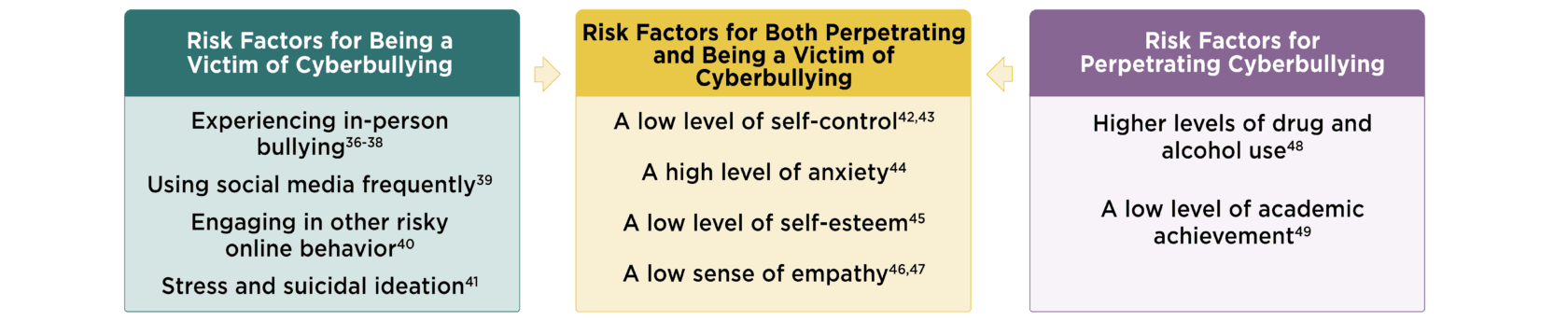
Cyberstalking and cyberdating abuse are two forms of sexual cyberbullying; girls are more likely than boys to be the victims of both.50 Youth-supporting professionals should be particularly attentive to supporting girls and young women who have experienced this type of violence. Youth-supporting professionals should consider the societal factors, such as sex-based violence, that contribute to girls and women being more at risk and be sure not to blame them or insinuate they did anything to elicit the behavior. Risk factors for being a victim of cyberstalking include using multiple social media accounts and engaging in other risky online behavior such as socializing with strangers.51,52 Risk factors for being a victim of cyberdating abuse include having a jealous romantic partner and engaging in sexting.53,54
In-person sexual violence and sexual cyberbullying are distinct experiences but youth who experience one may also experience the other, as has been found to be the case with traditional bullying and cyberbullying.55 Moreover, although in-person and cyberstalking victimization are related, the relationship may be different for women than for men.56 For example, females who are cyberstalked first are less likely to be subsequently stalked in-person, but males who are cyberstalked first are more likely to be subsequently stalked in-person. Lastly, females who are stalked in-person are more likely to be stalked online as well.57
Community, family, and individual protective factors may buffer youth against cyberbullying broadly. Furthermore, many of the factors that protect against cyberbullying broadly, such as parental monitoring and peer support, also protect against non-consensual sexting, a form of sexual cyberbullying.58 However, there is limited research on protective factors for specific forms of sexual cyberbullying beyond sexting.
Factors that protect against being a victim of cyberbullying include a positive and safe school climate,59,60 positive parental interactions and higher levels of parental monitoring,61,62 and higher levels of peer support and sense of “fitting in.”63,64
Prevention
The broader literature on preventing bullying and sexual violence has three implications for successful sexual cyberbullying prevention:
- Online child sexual violence is perpetrated by strangers (65%) and acquaintances (39%).65 Hence, youth-supporting professionals should talk with youth about ways to recognize cyberbullying involving sexual behaviors, and identifying adults they can go to for help.
- Preventing sexual cyberbullying requires an integrated approach. Youth-supporting professionals need to understand the ways different aspects of sexual cyberbullying and cyber and in-person sexual violence can occur in a young person’s life.66 For example, nonconsensual sexting can occur in the context of abusive dating relationships.67
- Sexual cyberbullying is most likely to occur during adolescence when young people begin dating and become involved in their first romantic relationships.68 Adolescent bullying perpetration predicts subsequent sexual victimization and dating abuse in adolescence and even adulthood.69 Thus, adolescent and early adulthood sexual cyberbullying prevention programs could be critical to preventing interpersonal and sexual violence later in life.70,71
Service providers can draw information from effective prevention programs that target bullying, child sexual violence, and dating violence to begin considering program components essential for preventing sexual cyberbullying. For example, systematic reviews have found that in-person bullying, sexual violence, and dating violence prevention programs that incorporate the following components can reduce in-person bullying, cyberbullying, and cyberdating violence:72
- Peer engagement and role-playing73
- Problem-solving skills74
- Assertiveness, self-efficacy, and resistance to peer pressure75
- Empathy, perspective-taking, and difference appreciation76
- Training to identify "trusted helpers" and overcome barriers to help-seeking77
- Parent/caretaker involvement78,79
Another core component of effective programs that target cyber violence against children and dating violence is providing young people with knowledge relevant to bullying and sexual violence. Knowledge may include (1) being able to identify warning signs of cyberbullying; (2) understanding norms of healthy relationships; (3) knowing their rights and responsibilities; and (4) laws pertaining to sexual cyberbullying.80-82
Comprehensive sexual education programs for young people can also reduce physical and sexual aggression — in particular, homophobic bullying and dating and partner violence.83-85 Comprehensive sexual education programs guide students in identity development, healthy self-esteem, and body confidence. These concepts significantly influence one’s sense of self, thereby decreasing the risk of students engaging in bullying or becoming victims of bullying.86 Finally, programs effective at preventing cyberbullying teach young people about the effects of drugs because intoxication can reduce inhibitions. A review found substance abuse education is one of the most reliable components of successful in-person and cyberbullying prevention programs.87
Evaluations of prevention programs have typically involved high-income or school-based samples and thus may not apply to all populations.88 However, a recent meta-analysis of studies that focus on young people at increased risk of domestic violence perpetration found that dating violence prevention programs can similarly reduce physical and sexual violence perpetration and physical domestic violence victimization.89 It is unclear if evaluated programs are equally effective for youth who have experienced the child welfare and/or juvenile justice systems, homelessness, and/or disconnection from school and work.
Laws on Sexual Cyberbullying
The legal landscape around sexual cyberbullying is complicated and evolving quickly. At the time of publication, we are unaware of any federal statutes that criminalize cyberbullying,90 but all states have various laws that apply to bullying behaviors, and the laws in all but two states include provisions related to “cyberbullying” or “online harassment.”91
Legislating what individuals are allowed to do with sexual images or content online is challenging because sharing sexual images and discussing sexual activities online are not inherently illegal. When legislating the sharing of sexual images, states must consider the age of the sender, the intentions of the sender, and the relationship between the sender and recipient.92 Additionally, legislation to protect victims of online sexual violence varies widely across states. This brief does not place value nor assess the effectiveness of any legislation intended to regulate any cyberbullying behavior. Rather, it encourages youth-supporting professionals and youth to be aware of the laws and understand that those behaviors can be illegal and carry potentially serious consequences.
- Sexting is generally legal unless it involves sexual harassment and/or a minor.93 Sexting is not covered by any federal laws, but as of 2022, 27 states [d] had “sexting” laws.94
- Disseminating sexual photos is not illegal unless it involves a minor or occurs without the sender’s consent.95 As of 2022, 47 states had laws against “image-based sexual abuse,” which involves sending explicit images without consent to cause emotional harm to the original sender.[e], 91 In some states, this is a misdemeanor; in other states, it is a felony.96
- Forty-seven states[f] have laws to address “electronic” or “digital” stalking, but only six use the term cyberstalking in their statutes.97
Summary and Resources
The information in this research brief is designed to help youth-supporting professionals familiarize themselves with research about sexual cyberbullying to better support youth, especially youth who may be more vulnerable to sexual cyberbullying such as youth who experience the child welfare and/or justice systems, homelessness, and/or disconnection from school and work. To supplement the research, Table 1 provides resources related to sexual cyberbullying that youth-supporting professionals can use to support youth. Table 1 includes state and national resources that are youth specific, such as hotlines, and that can be useful to youth-supporting professionals.
Table 1. Sexual cyberbullying resources
Organization and Contact Information
Mission
The Cyberbullying Research Centerhttps://cyberbullying.org
Provides current information, resources, research, and technical assistance about the nature, extent, causes, and consequences of cyberbullying among adolescents. The resource is intended for parents, educators, law enforcement personnel, and all youth-supporting professionals.
Trevor Projectwww.thetrevorproject.org
866-488-7386 Text START to 678-678
A 24/7/365 national hotline that provides crisis services, advocacy, peer support, public education, and research programs.
Without My Consenthttps://withoutmyconsent.org/resources/
A project under the Cyber Civil Rights Initiative protecting online privacy. Resources focus on supporting individuals who experience incidents of nonconsensual distribution of sexually explicit images. For example, there are criminal and civil solutions state by state.
Cyber Civil Rights Initiativewww.cybercivilrights.org
844-878-CCRI
A national hotline that provides support for nonconsensual pornography and online abuse with 24-hour hotline and one-on-one support for victims. Provides resources for lawmakers to draft legislation, educational resources, and a list of states with “revenge porn” laws with references to the applicable criminal statutes.
California Department of Justice Cyber-exploitationhttps://oag.ca.gov/cyberexploitation
Provides support during incidents of the nonconsensual sharing of intimate media with resources for victims for image removal, tools for law enforcement, and best practices.
Crisis Text Linehttps://www.crisistextline.org/
Text HOME to 741-741
A national hotline that provides free and confidential text-based mental health support and crisis intervention.
National Domestic Violence Hotlinewww.thehotline.org
1-800-799-7233
Provides community referrals for resources related to intimate partner violence, including teen dating violence.
Love is Respectwww.loveisrespect.org
1-866-331-9474 Text: loveis to 22522
A national hotline that is operated by the National Domestic Violence Hotline but tailored toward providing teens information about healthy relationships and resources for parents and educators.
Rape, Abuse & Incest National Networkwww.rainn.org
1-800-656-HOPE
A national hotline that responds to a wide range of sexual victimizations with referrals to local sexual assault services programs. Provides links to opportunities for volunteering and activism.
National Center for Victims: Stalking Resource Centerhttps://www.stalkingawareness.org
Provides resources to educate professionals on how to keep stalking victims safe and hold offenders accountable. These are not resources for victims/survivors of stalking.
Online Harassment Field Manualhttps://onlineharassmentfieldmanual.pen.org/ federal-laws-online-harassment/
Summarizes how to report federal crimes; key federal laws that may apply to online abuse; and how federal copyright law may be relevant for pursuing legal action against online abuse in civil court.
MaleSurvivorwww.malesurvivor.org
Provides therapists, support groups, and other resources for male survivors of sexual abuse.
National Center for Missing & Exploited Childrenhttp://www.missingkids.com/cybertipline/
1-800-843-5678
A national hotline for reporting child sexual exploitation, online solicitation of sexual images, and sextortion. National method of reviewing cases for law enforcement agencies.
StopCyberbullying.govhttps://www.stopbullying.gov/cyberbullying/what- is-it
Provides an overview of what cyberbullying is, laws and sanctions of cyberbullying, and prevalence of cyberbullying.
National Center for Youth Law: Commercial and Sexual Exploitationhttps://youthlaw.org/focus-areas/commercial- sexual-exploitation
Provides resources on human trafficking and sexual exploitation.
NetSmartzhttps://www.missingkids.org/netsmartz/home
Operates the CyberTipline where people can report suspicions of online and offline sexual exploitation of minors.
Sexual violence emerged as a priority topic during the 2023 Activate Needs Assessment. After identifying a need, we conducted a high-level literature scan to identify topics related to sexual violence. We summarized our findings and then engaged Research Alliance members to define the scope of the review. First, we had conversations with Research Alliance members to review the needs assessment findings and to understand which topics were relevant to their work and priorities for a research summary and Activate resource. Second, we shared the findings from the research review and solicited feedback during a Research Alliance meeting discussion group. These activities highlighted important considerations for this resource, including:
- Research Alliance members reported that cyberbullying and cyberdating abuse were the most common forms of sexual violence experienced by the young people with whom they work.
- Research Alliance members reported that young people often do not have the language to label their experiences as cyberbullying or cyberdating abuse.
- Research Alliance members reported that young people struggle with how to communicate appropriately about their romantic interactions and relationships with peers and partners.
- Research Alliance members reported that youth-supporting professionals need more concrete supports and resources to help young people process their feelings when sexual cyberbullying occurs.
- Research Alliance members reported that youth-supporting professionals need more information about a variety of topics including the laws on online sexual behavior, youth rights related to online sexual behavior, talking with youth about these topics safely, responding when youth report being victimized by these behaviors, and preventing revictimization.
After identifying the need we then conducted a supplemental literature scan focused on various forms of sexual cyberbullying. We searched research databases (Academic Search Complete and OmniFile Full Text Select) as well as Google Scholar using terms like cyberbullying, trolling, doxing, cyberdating abuse, and cyberstalking with population terms specific to Activate’s youth populations. Research articles needed to be published in English after 2013, and the research needed to be conducted using a sample from the United States. Ultimately, we exported 223 potentially relevant articles; we subsequently dropped 139 articles determined to be off-topic or based on data collected outside the United States. We identified an additional 103 articles by manually reviewing the articles and their reference lists. Altogether, our review included 156 articles.
Suggested citation: Schlecht, C., Griffin, A.M., & Rosenberg R. (2024). Sexual Cyberbullying Research Summary. Child Trends. https://activatecenter.org/resource/sexual-cyberbullying-research-summary/
Footnotes
[a] Sexual cyberbullying research does not, in general, focus on these youth. Therefore, this brief includes research about sexual cyberbullying among the overall population of adolescents as well as research on sexual cyberbullying specifically among youth who have experienced the child welfare and/or justice system, homelessness, and/or disconnection from school and work.
[b] The 2023 Activate Needs Assessment, discussions with Research Alliance members, and multiple literature scans led to the decision to focus this review on sexual cyberbullying.
[c] The term “cyber” may be outdated and not relevant to youth. However, we are using it here because it is still used in the literature. Youth-supporting professionals should consider using other terms such as online or electronic or just asking youth how they refer to cyberbullying.
[d] States with sexting laws: AZ, AR, CO, CT, FL, GA, HA, IL, IN, KS, LA, NE, NV, NJ, NM, NY, ND, OK, PA, RI, SD, TN, TX, UT, VT, WA, WV.
[e] States without revenge porn laws: ID, MA, SC
[f] States without cyberstalking laws: MO, NE, NY
References: The full list of references are included in the PDF of this report: https://activatecenter.org/wp-content/uploads/2025/02/AR2-25_Sexual-Cyberbullying-Research-Summary_R25final2.pdf
Acknowledgements and About the Authors:
The authors thank the many contributors to this resource. Experts who informed the resource include: Barbara Ball, PhD, Research Scientist, Texas Institute for Child & Family Wellbeing, University of Texas at Austin; Lindsay White, Clinical Services Assistant Director - LifeSet, Youth Villages; Sarah Gonzalez, MPP, Associate Director for Workplace and Economic Justice, FUTURES Without Violence; Amandalyn Stallings, Young Fellow, Jim Casey Initiative; Eddie Sumlin, First Place for Youth; Karla Vargas, BA, Young Fellow, Opportunity Youth United; Rebecca Gudeman, JD, Senior Director of Health, National Center for Youth Law. Thank you also to the several youth-supporting professionals and young people who contributed but are not named here. We also thank other Activate project team members who assisted in the development of this resource including (Mindy Scott, Principal Investigator, Jan DeCoursey, Project Director, Matthew Rivas-Koehl, project team member, and Dane Rivas-Koehl, design advisor). We are grateful for the contributions of other Child Trends and Chapin Hall staff who contributed to this resource including Amy Dworsky, Co-Principal Investigator. Finally, a special thank you to the Child Trends communications staff, especially Olga Morales, Catherine Nichols, Brent Franklin, Stephen Russ, and Ana Maria Pavic.
About the Authors
Colleen Schlecht, MPP, is a Senior Researcher at Chapin Hall at the University of Chicago.
Amanda M. Griffin, MS, PhD, PhD, is a Researcher at Chapin Hall at the University of Chicago.
Rachel Rosenberg, MSW, PhD, is a Senior Research Scientist at Child Trends.
This page was last updated in February 2025.