

Public school leaders are more supportive of teachers using artificial intelligence (AI) than students, according to data from the Institute of Education Sciences (IES). Nationally, 69 percent of school leaders had somewhat or very favorable views of teachers’ use of AI, compared to 42 percent viewing students’ use favorably.


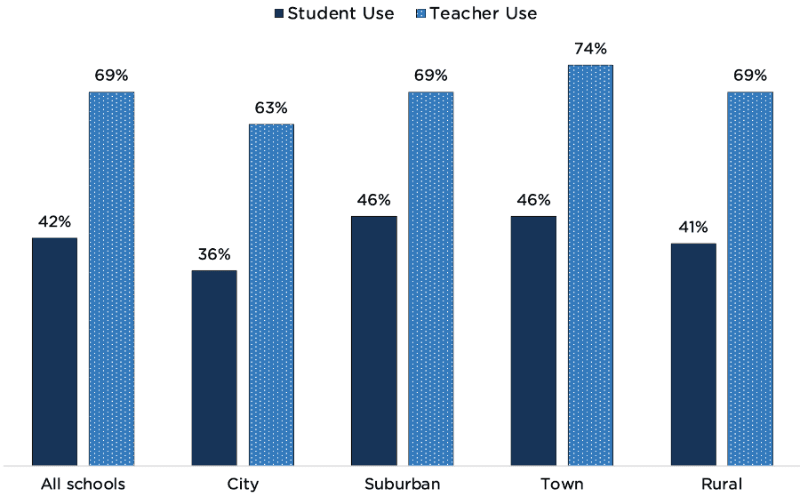
These data, released in December 2024, come from the School Pulse Panel, which surveys a nationally representative sample of public school leaders. The difference in support is consistent across all categories of school settings. These findings reflect ongoing questions about how to use AI in ways that promote learning while also addressing concerns about misuse.
Figure: School leaders’ support for teachers’ and students’ use of AI
Source: U.S. Department of Education, Institute of Education Sciences, National Center for Education Statistics, School Pulse Panel 2024–25.
What this means for schools and policymakers
As AI tools become more common in education, school leaders are trying to balance innovation with responsibility. Concerns about cheating and academic integrity may explain why many leaders are cautious about students’ use of AI. At the same time, AI can be used in productive ways to support learning. For example, AI can help students better understand math concepts and allow teachers to focus on student engagement and support.
To help schools make informed decisions, Child Trends has developed two practical tools. The AI-Class Framework is designed to help school administrators and teachers integrate AI into their daily education practices by providing guidance on choosing tools that are safe, equitable, and effective. The AI Risk Framework helps education leaders and policymakers assess potential AI risks, such as data privacy, algorithmic bias, and unintended consequences. Both frameworks are grounded in research and center the well-being of students, families, and educators.
Interested in working with Child Trends on AI use in education? Contact Samantha Holquist at sholquist@childtrends.org.