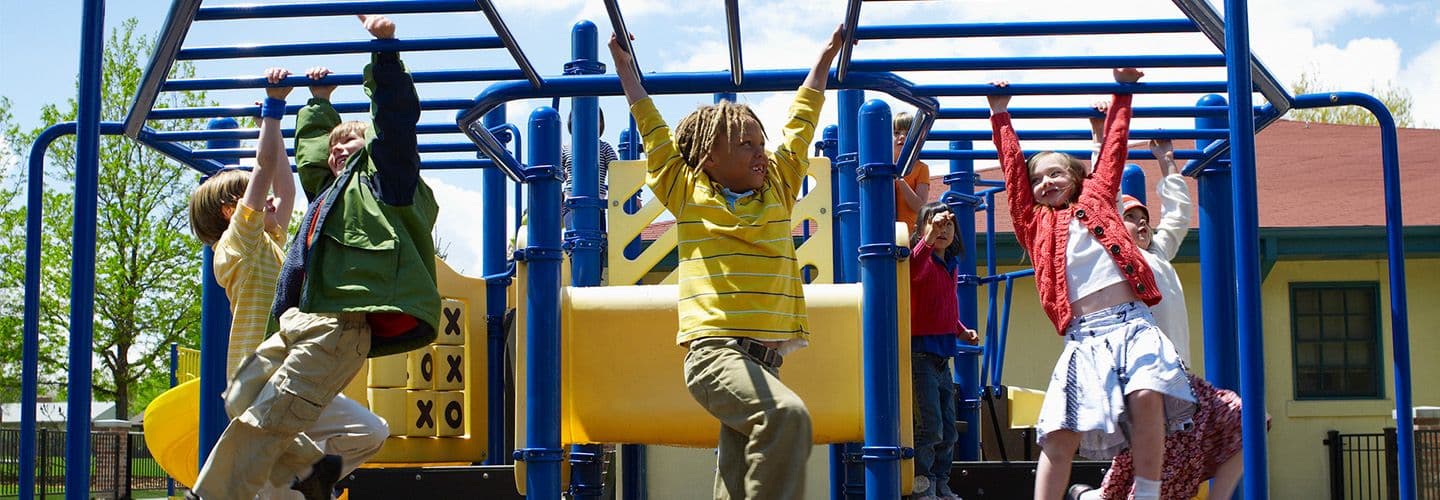


We know that playspaces offer children an opportunity for physical activity, but how exactly do they promote optimal physical development for young children? According to a recent literature review conducted by Child Trends to support KABOOM!, we found that playgrounds allow children to practice motor skills and encourage healthy physical activity—both of which are important for their physical development. In this blog, we share insights from our literature review to encourage greater investigations into specific ways playgrounds can foster these key skills.
Some studies have shown that well-equipped outdoor play environments are positively associated with improvements in motor skill competency, potentially because they offer opportunities to practice motor skills. For instance, although research on specific playground structures is limited, one study observed that outdoor environments that include high-quality play equipment (e.g., varied playspaces, paths for wheeled toy use) were positively correlated with motor skills scores in children ages 3 to 5. This implies that environments that encourage diverse forms of movement help children enhance their coordination and physical capabilities.
Additionally, the design of playgrounds can affect children’s level of physical activity. Play areas that allow a variety of active play behaviors, such as running, jumping, and climbing, tend to promote vigorous physical activity, which has been linked to accelerated motor skill development. Studies also suggest that the availability of portable play equipment—like balls and portable slides—can enhance physical activity by offering movable play options. This adaptability encourages children to engage dynamically with play structures to promote various aspects of physical development. Moreover, playgrounds with a blend of natural elements and creative structures can increase children's physical activity levels. For example, playground features such as hilly terrains and spacious pathways have been associated with higher levels of engagement and activity. By providing diverse design elements, children are more likely to explore different physical challenges at various levels of activity.
Playground activities can also build a child’s sense of where they belong in space. How playgrounds are built can promote movements that enhance a concept known as proprioception—or the body's ability to perceive its own position in physical space—a critical aspect of motor control. One study noted that playground use among both typically developing children and those with developmental delays frequently includes activities that enhance proprioception, such as hanging from bars. Such activities are helpful for developing a child’s balance, coordination, and agility, which are foundational for lifelong physical fitness and athletic skills.
Because physical activity is a key part of healthy development for young children, we offer design recommendations to maximize the physical development benefits of playgrounds:
- Incorporate a range of equipment: Include a mix of fixed and portable equipment to encourage a variety of movements to develop different aspects of physical development.
- Allow for a variety of movement: Provide opportunities for balancing as well as running and jumping, such as balance beams and hills.
- Include natural elements: Integrate creative structures with natural features like grass, trees, and hills to enhance physical activity and provide a richer sensory experience.
Playgrounds are much more than recreational spaces; they can also foster physical development. By offering varied and challenging play environments, playgrounds can contribute significantly to a child's physical fitness and overall physical health. As such, prioritizing playground design and equipment that promote active play is key to supporting children’s well-being, growth, and physical development in ways that are enjoyable.
Methods
The authors for this Child Trends series used GPT-4o to generate initial drafts of blogs that synthesized an original literature review conducted by Child Trends researchers for KABOOM! on how playgrounds benefit children’s social-emotional and physical health. We want to acknowledge Kristen Darling, Gabriella Guerra, Tamara Halle, and Vanessa Sacks for their contributions to the original literature review. Child Trends experts fully vetted the veracity of these outputs, conclusions, and works cited. The authors and Child Trends communications staff fully revised the initial draft to produce the current version and ensure that it conformed to Child Trends’ standards for scientific rigor and writing style. (OpenAI, 2025).
Suggested citation
Schaefer, C., & Lin, V. (2025). Playgrounds represent opportunities for children’s physical development. Child Trends. DOI: 10.56417/9602e6740e