
Authors





* The last three authors contributed equally.
This June, Child Trends celebrates the important role fathers play in the lives of their children. Our analysis of new nationally representative data using the AmeriSpeak® panel (see Methods below) shows that fathers who live with their children (or “resident fathers”) are positively involved in their children’s lives: Many spend quality time providing nurturing support, engage in physical activity, and establish family routines with both younger and older children in their homes.
While fathers and father figures inside and outside the home play an important role in shaping children’s development and well-being, this blog focuses only on resident fathers (78% of fathers nationally) due to available data.
The vast majority of resident fathers report engaging in nurturing activities with their children multiple times a week or daily.
Showing love
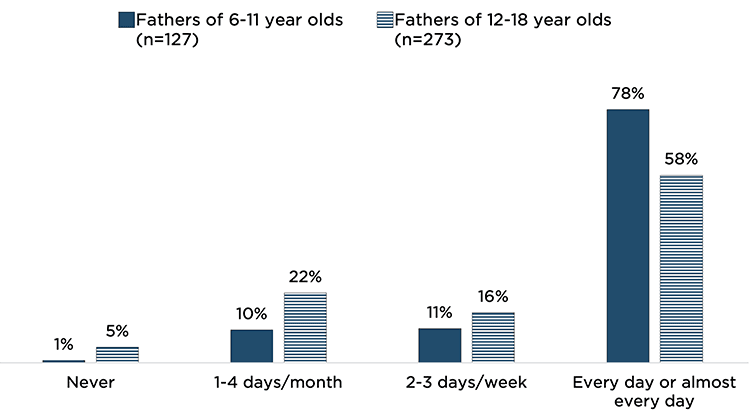
Parental expressions of love, such as giving hugs, are supportive of children’s self-esteem, emotional stability, and mental health. Among our sample of fathers who live with their child, over half reported showing their child they loved them every day or almost every day in the past month (Figure 1). Among fathers with children ages 6 to 11, over three quarters (78%) did so daily and another 11 percent did so two to three days per week. Among fathers whose oldest child was ages 12 to 18, the frequency was slightly lower, with 58 percent showing love to their child daily and another 16 percent doing so two to three days per week.
Figure 1: Most fathers show their child love every day, or nearly every day
Percentage of resident fathers reporting this activity, by frequency and child’s age
Source: Child Trends analysis of data collected through the AmeriSpeak® panel, a nationally representative, probability-based survey panel of U.S. households. Weighted data are aligned with Current Population Survey benchmarks from the U.S. Census Bureau.
Encouraging good decisions
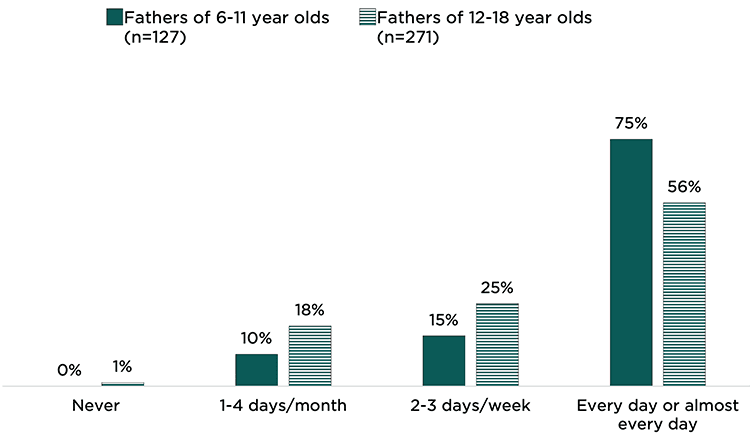
Fathers are important role models who shape children’s social development during early childhood and through adolescence and adulthood. Almost all resident fathers of children ages 6 to 11 (90%) and most fathers of 12- to 18-year-olds (81%) reported encouraging their child to make good choices at least 2 to 3 days a week (Figure 2). Fathers living with younger children were more likely than fathers with older children to report encouraging good decisions every day or almost every day (75% versus 56%). No resident fathers of younger children and just 1 percent of fathers of older children reported never encouraging their child to make good choices.
Figure 2: Resident fathers regularly encourage their child to make good choices
Percentage of resident fathers reporting this activity, by frequency and child’s age
Source: Child Trends analysis of data collected through the AmeriSpeak® panel, a nationally representative, probability-based survey panel of U.S. households. Weighted data are aligned with Current Population Survey benchmarks from the U.S. Census Bureau.
Offering praise
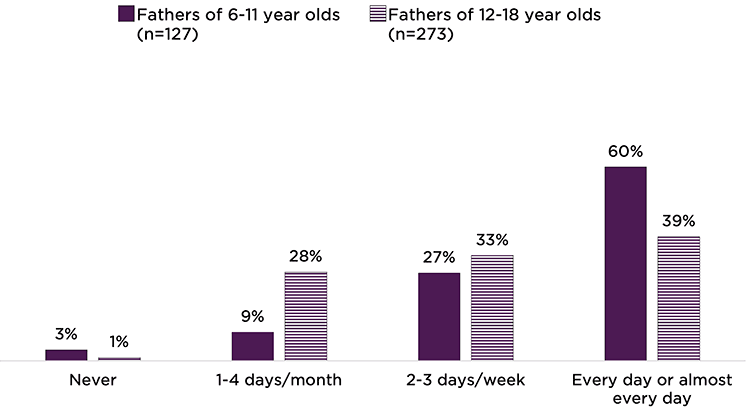
Offering positive reinforcement to children in the form of intentional and genuine praise can benefit children’s self-confidence and motivation. Among resident fathers of children ages 6 to 11, 60 percent reported praising their child every day or almost every day and another 27 percent reported praising their child two to three days per week (Figure 3). The frequency of this type of emotional support declines somewhat as the child ages: 39 percent of fathers of children ages 12 to 18 reported praising their child every day or almost every day, but nearly all (99%) reported praising their child at least once per month.
Figure 3: Most resident fathers praise their child multiple times a week
Percentage of resident fathers reporting this activity, by frequency and child’s age
Source: Child Trends analysis of data collected through the AmeriSpeak® panel, a nationally representative, probability-based survey panel of U.S. households. Weighted data are aligned with Current Population Survey benchmarks from the U.S. Census Bureau.
Resident fathers also regularly engage in activities that promote children’s health and well-being.
Going for walks
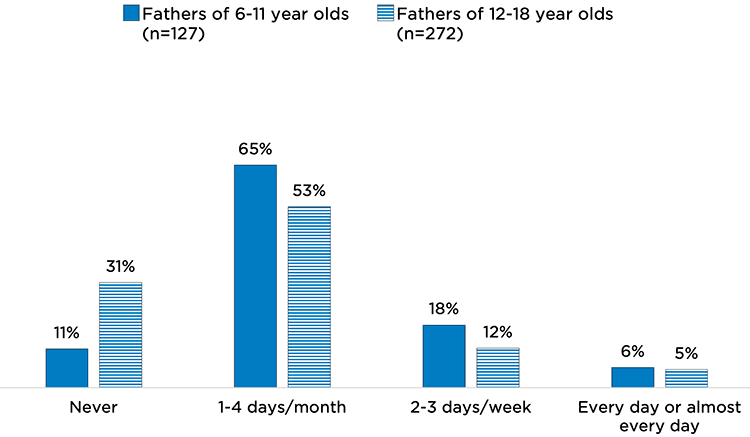
Going for walks together or engaging in other physical activities can benefit fathers’ and children’s physical health and well-being. Most fathers who live with their child reported taking walks with their oldest child at least once a month and almost one quarter of fathers whose oldest child was 6 to 11 years old reported taking a walk multiple times a week (Figure 4). Although fathers with older children reported less frequent walks, only one third whose oldest child was 12 to18 years old never took a walk together in the past month.
Figure 4: Most resident fathers take at least one walk per month with their oldest child
Percentage of resident fathers reporting this activity, by frequency and child’s age
Source: Child Trends analysis of data collected through the AmeriSpeak® panel, a nationally representative, probability-based survey panel of U.S. households. Weighted data are aligned with Current Population Survey benchmarks from the U.S. Census Bureau.
Sharing family meals
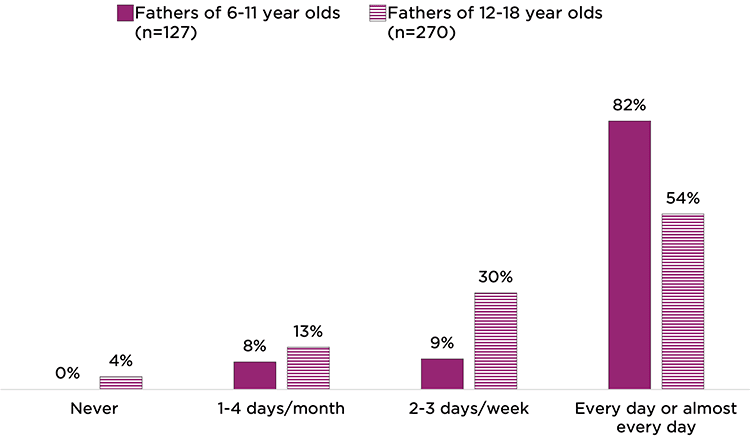
Sharing family meals together is a strong indicator of father engagement associated with a host of benefits for children, such as better diet quality, lower likelihood of disordered eating, and more family time for conversation. The vast majority (82%) of fathers living with children ages 6 to11 ate a meal with their child every day or almost every day in the past month (Figure 5). This pattern also declines as children get older: 54 percent of fathers with children ages 12 to 18 shared a meal with their child every day or almost every day and another 30 percent did so 2-3 days per week.
Figure 5: Nearly all resident fathers share a meal with their child multiple days per week
Percentage of resident fathers reporting this activity, by frequency and child’s age
Source: Child Trends analysis of data collected through the AmeriSpeak® panel, a nationally representative, probability-based survey panel of U.S. households. Weighted data are aligned with Current Population Survey benchmarks from the U.S. Census Bureau.
Take time this Father’s Day to celebrate the many positive and meaningful ways that fathers connect with their children—including not just the activities described here but also things like playing games or getting involved in children’s activities like sports or music. Fathers in our sample were actively involved with their resident children, although we saw some expected declines in the frequency of these activities among fathers with older children. Additional analyses found that these positive patterns of involvement are similar for fathers with sons and those with daughters.
Finally, we recognize that many nonresident fathers may also engage in positive activities with their children, despite not being present in the home. Importantly, all fathers can engage in ordinary but very meaningful actions—like taking walks or telling their child they love them—to lend support and model behaviors that promote the child’s health and well-being.
This survey was administered through AmeriSpeak®, a nationally representative survey panel of U.S. households, created and operated by NORC at the University of Chicago. AmeriSpeak® uses probability-based sampling methods in which households are randomly selected with a known chance of inclusion, rather than relying on self-selected or convenience samples. The survey was designed to provide scientifically rigorous and representative insights into the experiences and opinions of U.S. parents and caregivers of children from birth to age 18. Data were collected in December 2025 using both an online survey and telephone interviews. The final weighted sample included 1,040 parents and caregivers. This analysis used a subsample of 417 biological/adoptive/legal fathers whose oldest child living with them was 6-18 years old. Survey weights were applied to align the sample with demographic characteristics of the Current Population Survey from the U.S. Census Bureau, including sex, age, education, race/ethnicity, and region. Chi-square tests were conducted to assess whether the distribution of frequencies for each measure of father engagement differed by child age and child sex. For all activities reported, the distributions based on child age were statistically significant using a 95% confidence level. We found no statistically significant differences for engagement with sons versus daughters.
Suggested citation: Scott, M.E., Briggs, S., Halle, T., Malm, K., & Moore, K. A. (2026). How fathers spend time with their children. Child Trends. DOI: 10.56417/4448r3829c