

The transition to adulthood is a critical developmental milestone for all young adults, marked by identity exploration, increased autonomy, and growth and learning as youth finish school and enter the workforce. During emerging adulthood, many young people continue to receive monetary and emotional support from their families, with some young adults continuing to live with their parents into their 30s. However, this transition can look very different for youth in foster care as they lose access to services or supports provided through the foster care system. To prevent this sudden shift at age 18, extended foster care provides ongoing services and supports to youth ages 18 to 21, with the goal of easing the transition to adulthood and increasing positive outcomes such as educational attainment, employment, and housing stability.
The 2008 Fostering Connections to Success and Increasing Adoptions Act allowed states to offer foster care services to youth ages 18 to 21 and be reimbursed by the federal government, referred to as Title IV-E extended foster care. Since 2008, utilization of extended foster care has increased considerably, and research consistently shows that young people who participate in extended foster care experience better young adult outcomes than those who do not. As of July 2025, 36 states, the District of Columbia, Puerto Rico, and nine Tribes have approved Title-IV E extended foster care, and many other states offer it using state funds. The supports offered include financial aid to pursue post-secondary education; housing subsidies or payments; independent living classes to learn how to create a budget, cook, and perform other essential life skills; and ongoing connections to supportive adults and peers.
It has, however, been challenging to track utilization of extended foster care due to limitations in federal data collection requirements and guidance to states. To address this challenge, in federal fiscal year 2023, guidance to states—through the Adoption and Foster Care Analysis and Reporting System (AFCARS) revised Technical Bulletin 22—was clarified to instruct that states should report on all young people in extended foster care regardless of whether the services are federally or state funded. This clarification can already be seen in data from federal fiscal year 2023. For example, in 2022, 44 percent of young people living in foster care on their 18th birthday in 2022 remained in care on their 19th birthday in 2023—an increase over the 24 percent of youth living in care on their 18th birthday in 2019 who remained in care on their 19th birthday in 2020.
Young people who are in extended foster care at age 19 had better young adult outcomes relative to youth who were not, and relative to young people in foster care at age 17 who exited to permanency (i.e., reunification, adoption, guardianship, living with relatives) at ages 17 or 18.[1] As shown in the figure, even a short tenure in extended foster care has measurable benefits for young people.
Figure: Young people in foster care at age 19 experience better outcomes than their counterparts who were not in extended foster care
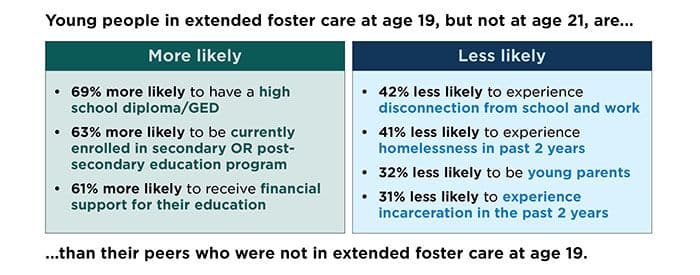
Data source: Child Trends analysis of the National Youth in Transition Database Outcomes file cohort 4.
While extended foster care is associated with better young adult outcomes, there are barriers for young people to access the program. For example, states have eligibility requirements that young people must be working or in school. Further, some approved living placements have additional requirements, such as restrictive curfews or limitations on guests, that may exclude young people who otherwise would benefit from the additional support. Other programmatic limitations include a lack of consistent information on extended foster care, lack of information (or misinformation) about how to enroll and stay enrolled, and missing information on re-enrollment for youth who opt out of extended foster care but want to return before age 21. Child welfare professionals should ensure that all young people have the information and resources they need to make informed decisions about participating in extended foster care.
For more information on extended foster care, please see our other blogs in this series. One blog, “Most Youth in Extended Foster Care Live in Supervised Independent Living Placements,” explores types of placements among youth in extended foster care. The other, “Extended Foster Care Policies and Practices That Boost Young Adults’ Participation,” describes some young adult-centered policies and practices for extended foster care implementation.
Acknowledgement
This research was based on previous analysis and research funded by the Annie E. Casey Foundation, and we thank them for their support; however, the findings and conclusions presented in this report are those of the author alone, and do not necessarily reflect the opinions of the Foundation.
Footnote
[1] Child Trends analysis of the National Youth in Transition Database Outcomes file cohort 4 and the Adoption and Foster Care Analysis and Reporting System 2023 file
Suggested citation
Rosenberg, R. (2025). Increased use of extended foster care allows more young people to benefit. Child Trends. DOI: 10.56417/2832d7133c