


The new Preschool Development Grant Birth Through Five (PDG B-5) SMART Grant: Strategic Measurement, Analytics, and Results using Technology provides an opportunity for states and territories to make targeted, one-year investments in early childhood technology and analytic capacity. This blog offers five considerations for states to help them turn this funding opportunity into a strategic and sustainable investment.
For more than 15 years, the Early Childhood Data Collaborative (ECDC) at Child Trends has helped states strengthen early childhood data systems and, importantly, use those systems to answer questions that matter to policymakers, programs, and families. One lesson has consistently emerged: The strongest, most effective data investments begin when they are driven by states’ needs and critical decisions, not by the technology itself.
1 - Start with a state goal, assess current capacity, and then determine technology and analytic needs.
Before deciding what to build, connect, or test, ask, “What early childhood goal or outcome are we trying to achieve? What data do we need, or what approach do we need to test, to make progress?”
States can draw from existing needs assessments, strategic plans, prior PDG B-5 work, gubernatorial priorities, evaluations, and other analyses to establish a priority. From there, identify which questions decision makers need to answer and assess whether your state currently has the needed data and infrastructure. If your state’s existing data infrastructure can support the identified priority, consider how you could leverage your infrastructure to test strategies, assess investments, and track progress; alternately, identify the data, analytic, or technology investments needed to fill any gaps.
Unsure of how or where to begin? First identify an early childhood priority in your state where better data could strengthen decisions. In a recent ECDC webinar, experts highlighted interconnected state priorities such as child care access and affordability, early childhood governance and coordination, and workforce stability—all of which depend on strong data infrastructure. More recently, ECDC’s STEP Forward with Data in Action webinar showed how communities (Philadelphia, Denver, and the state of Illinois) are using data to address specific system priorities, inform decisions, and support continuous improvement.
2 - If considering SMART Grant Option 1, identify the infrastructure problem before selecting the solution.
Be able to articulate specific limitations in your current infrastructure that prevent you from answering an important question or taking action. Perhaps you have disconnected systems, limited data access, insufficient data quality, missing linkages, outdated technology, or limited analytic capacity. Identifying the gap is only one piece, though: To successfully meet the short, one-year timeframe, states should already understand why the gap exists and what infrastructure will be needed to address it sustainably.
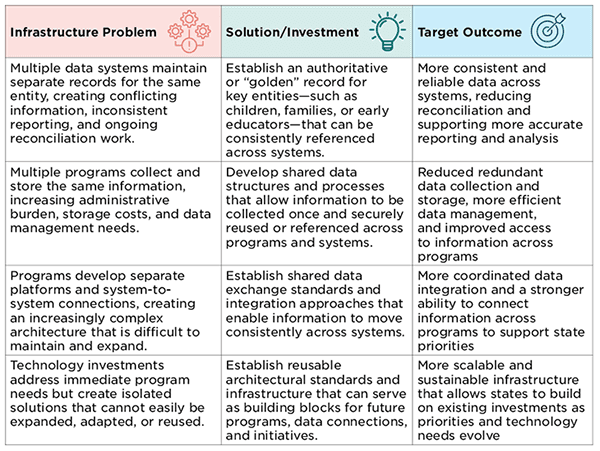
For example, a state seeking to increase access to high-quality early learning may want to understand which children are receiving which services across programs to get an unduplicated count of children served. This state should first assess whether its current infrastructure can answer that question; if it can’t, determine what technological barriers exist to identify what investments are needed to address gaps. The table below illustrates how common infrastructure problems can be addressed by potential investments and what outcomes those investments are intended to support.
Table. Connecting Data Infrastructure Problems, Investments, and Intended Outcomes
3 - If considering SMART Grant Option 2, use existing infrastructure to learn what works.
States with strong data and analytic infrastructure have a different opportunity: Use current capacity to test an intervention and generate information to guide decisions and continuous improvement. Again, start with your state’s identified goal. For example, consider a state seeking to increase access to high-quality early care and education that already features integrated data systems, coordinated enrollment technology, a workforce registry, or other infrastructure. Rather than invest in new infrastructure, use existing capacity to test an innovation designed to address a documented barrier to access.
This state might test changes to a coordinated application or enrollment process to determine whether they make it easier for families to access programs, use rapid-cycle testing to improve a child care search or referral tool, use linked cross-program data to test strategies for reaching eligible families not participating in services, or use provider and supply data to test strategies to expand high-quality care where supply does not meet family needs.
Alternately, consider a state where documented workforce shortages and turnover act as barriers to accessing high-quality care:
- Goal: Increase access to high-quality early care and education by stabilizing the workforce.
- Existing capacity: A statewide workforce registry with sufficient participation and high-quality data to identify and track educators
- Problem: Workforce instability is contributing to challenges maintaining or expanding the supply of high-quality care.
- Innovation/Test: Provide a targeted monthly wage supplement to eligible educators and use existing data to identify eligible recipients, track implementation and participation, and assess short-term outcomes during the grant year (e.g., educators’ experiences with the supplement, perceived effects on their employment decisions, and employment status or other feasible workforce outcomes).
4 - Design around what you can learn in one year.
For an infrastructure project (Option 1), meaningful outputs might include successful linkage of previously disconnected data, improved completeness or timeliness of information, establishment of a repeatable data exchange, or providing intended users access to previously unobtainable information. When identifying your desired outcomes, make sure those outcomes can be achieved by the end of the year and align with your state’s goal.
For an innovation project (Option 2), meaningful outputs might include participation numbers and/or implementation activities. States need to identify and track progress toward short-term outcomes, such as user experience, changes in perception, or perceived effectiveness—even when longer-term outcomes will take years to emerge.
Ultimately, you should be able to clearly articulate not only what you accomplished in one year, but also what you learned and how those lessons can inform future decisions and next steps.
State spotlight: Transition to Kindergarten: Lessons from North Carolina’s Statewide Efforts | Child Trends
North Carolina wished to improve its transition to kindergarten process for children, families, and educators. Under previous PDG B-5 funding, the state developed and piloted a multi-pronged activity that included launching an electronic transition report for sharing data and information between pre-K and kindergarten teachers. In partnership with Child Trends, North Carolina learned that, while pre-K teachers created and used the transition reports at high rates, access and usage of reports was low among kindergarten teachers due to lack of knowledge. The state was then able to use these evaluation findings to increase awareness and accessibility of the reports for kindergarten teachers.
5 - Show how the investment will lead to action.
Remember: A dashboard, linked dataset, or evaluation finding is not the endpoint. Applications should explain who will use the resulting information, what decisions it will inform, and how those decisions connect back to the state goal. States might use what they learned during the year of funding to identify gaps in access, target resources, improve program implementation, strengthen workforce supports, or determine whether to expand or change an intervention.
Building these uses into the project from the beginning can help ensure that the SMART Grant produces more than a new technology asset. It can strengthen the state’s ongoing capacity to use data for decision making and continuous improvement.
Partnering to Design, Test, and Learn
Child Trends staff are available to partner with states as they design, implement, and evaluate PDG B-5 investments. We can help states apply research-based frameworks—including the 10 Fundamentals of Coordinated State ECE Data Systems, ECE Access Framework, and Workforce System Change Framework—to define desired outcomes, assess progress, and test whether investments produce intended changes. We can also serve as an evaluation and research partner to help states develop and implement program performance evaluation plans (PPEP) that measure, track, and assess progress and use findings to inform continuous improvement, sustainability, and future investments.
Learn more about ECDC resources
Resources to Support Your SMART Grant Investment
Disclaimer: The information and recommendations presented in this blog reflect the authors’ interpretation of the PDG B-5 SMART Grant funding opportunity and are intended for informational purposes only. Applicants should refer to the official ACF Notice of Funding Opportunity (NOFO) for complete requirements, eligibility criteria, application instructions, and official guidance.
Suggested citation: King, C., Richards, D., & Li, W. (2026). Five considerations for states and territories applying for PDG SMART Grants. Child Trends. DOI: 10.56417/936c2388h