
This brief reports findings from a virtual community mapping study on protective community resources (PCRs). Participants included 12 Black “emerging adults”: seven women and five men, all ages 18 to 25. The study highlights:
- The holistic way in which Black emerging adults perceived “well-being,” including social and mental, physical, economic, and cultural dimensions
- The PCRs that helped these young people achieve the key developmental tasks of emerging adulthood (i.e., identity, autonomy, and intimacy)
- Implications for research and practice on how to better understand and leverage PCRs to promote the holistic well-being of Black emerging adults
Emerging adulthood is a period of development between late adolescence and adulthood, typically from the ages of 18 to 25 (although this period is often extended to age 29). According to Jeffrey Arnett, who coined the term in 2000, emerging adulthood is characterized by “identity explorations, feeling ‘in-between,’ instability, self-focus, and possibilities” as young people move toward greater independence and responsibility. For young Black people, though, systemic racism can make navigating these aspects of emerging adulthood more complex and risky.
For example, research suggests that racial discrimination in emerging adulthood may contribute to increased anxiety, depression, and alcohol use across the transition to adulthood among young Black men and women. Other research suggests that stressors grounded in racism are often gendered, creating distinct challenges for Black emerging adults. For example, young Black men face greater exposure to racial profiling, community violence, and employment barriers that may impact their resilience and well-being. Young Black women face racial stereotypes that may affect their self-identity, romantic relationship development, and sexual decision making and health. Among young Black sexual minorities, racial and sexual discrimination presents unique challenges to identity formation during emerging adulthood, which may affect the ways in which they seek help and their mental health outcomes.
The potential effects of racial inequities on Black emerging adults’ welfare and successful transition to adulthood underscore the need to examine their access to protective community resources (PCRs)—defined as the people, places, and things that promote their well-being. This work begins to address this need.
About this study
In 2023, our research team systematically reviewed 172 studies on PCRs for children and youth, all published from 2012 to 2022, finding eight articles focused exclusively on the experiences of Black youth within the age span of emerging adulthood. These studies highlight the importance of strong family networks; safe, culturally affirming schools and caring educators; mentorship; positive peer associations and perceptions of neighborhood conditions; and social support—resources that can affect the coping behaviors and positive development of Black emerging adults. While contributing to the knowledge base on PCRs for this population, these studies also highlight limitations in the existing literature and the need for more in-depth research. Specifically, all but one of the studies is quantitative, limiting opportunities to center participants’ voices and experiences. Additionally, all but two focus on individuals facing poverty, low academic performance, neighborhood violence, or bullying victimization, thus limiting the opportunity to examine PCRs for Black emerging adults who are not experiencing such risk factors. Finally, most of these studies include young adults ages 18 to 21, limiting our understanding of PCRs for older emerging adults.
To address these limitations in the research, we partnered with Cities United (CU),[1] a national organization promoting a holistic public health approach to building safe, healthy, and hopeful communities for those most impacted by community violence—Black men and boys and their families. Drawing on the organization’s extensive network of young leaders, we conducted a virtual community mapping study with 12 Black emerging adults (7 women and 5 men), ages 18 to 25, to better understand how participants defined PCRs that promote their well-being and the PCRs they desired but perceived as largely inaccessible. Through this study, we sought to amplify the voices of Black emerging adults and identify areas for policy, practice, and continued research that can contribute to their successful transition to adulthood.
Methods
This study was designed to address gaps in the current literature on PCRs by centering the perspectives and experiences of Black emerging adults, ages 18 to 25, in ways that traditional research methods have not. Using a community mapping strategy (i.e., a participatory method that focuses on community assets), we aimed to understand how Black emerging adults define PCRs, exploring both the benefits they derive from these resources and the PCRs they find desirable but largely inaccessible. We engaged CU in the planning stage of the study design and collected information directly from community members as described in Table 1.
Table 1: List of study partners and the nature of their engagement
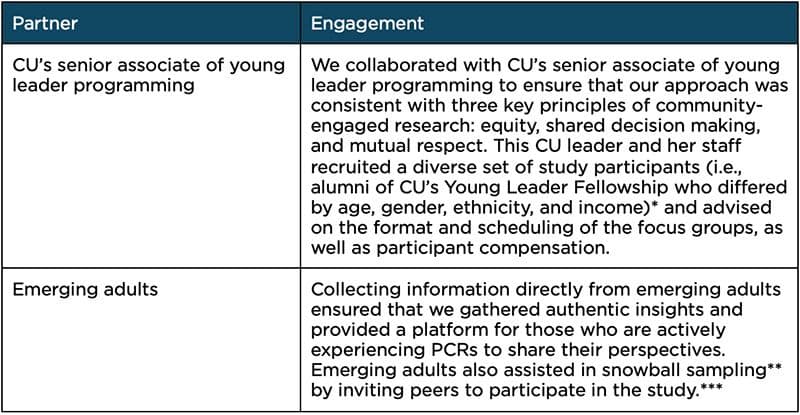
* Before the study began, CU’s senior associate of young leader programming attended a training session led by Child Trends staff that covered the principles of ethical research and emphasized the role of CU staff in upholding these principles throughout the study.
** For more information on snowball sampling, refer to this article.
*** Three participants during focus group 3 were recruited through snowball sampling to increase the representation of male participants in the study.
In May and June 2024, we collected information directly from 12 emerging adults via three Microsoft Teams focus groups. Each virtual session involved three to five participants who joined the Microsoft Teams call anonymously, using self-selected pseudonyms as their display names. Participants received a $150 Amazon gift card as compensation for their participation. The two-hour sessions began with an overview of the study’s aims, after which we obtained informed consent. Participants were then asked to complete a short online survey to gather data on age, income, and other demographic characteristics.
Following the survey, participants engaged in a three-part mapping activity where they 1) depicted existing PCRs within their communities using Sketchpad, an online drawing and design tool; 2) identified additional resources that could enhance their well-being but are currently missing in their communities; and 3) shared experiences of joy related to a protective resource in their communities. A follow-up focus group discussion accompanied each part of the mapping activity, allowing participants to share their experiences, insights, and ideas; these virtual discussions were audio recorded and later downloaded and transcribed for analysis using Microsoft Word. After each data collection session, we wrote a focus group summary to reflect on the data, capture initial impressions, and identify emergent themes.

Figure 1: Example of clipart selected by a participant to depict a wanted (desired) but largely inaccessible PCR (W = wanted)
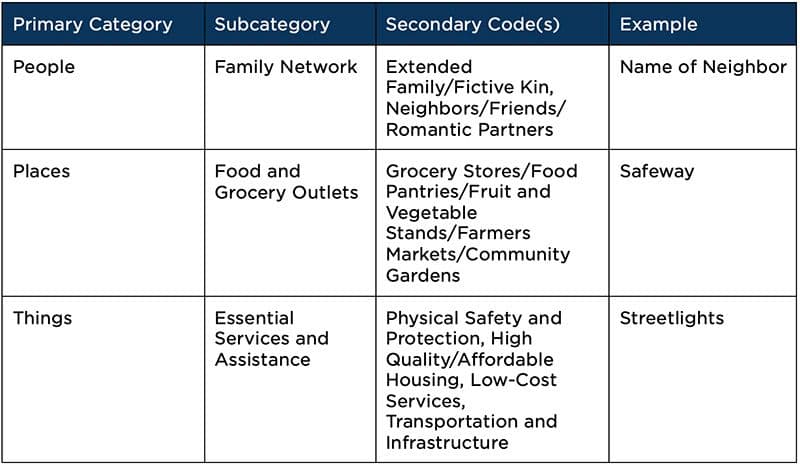
Community map analysis. We used a map coding framework organized by three primary categories: people, places, and things. Each primary category was divided into subcategories and specific secondary codes: Table 2 provides examples of subcategory and secondary codes for the “people,” “places,” and “things” primary codes. One team member independently coded each participant’s community map, and coding decisions were discussed and finalized during weekly research team meetings. The data were then uploaded to Microsoft Forms.

Figure 2: Example of clipart selected by a participant to depict a PCR facilitating joy (J = joy)
Table 2: Examples of coding framework for community map analysis
Focus group analysis. The team employed thematic analysis to analyze focus group transcription data. Our analysis focused on 1) the benefits and joys of existing PCRs, as well as areas of contention among participants; and 2) the PCRs that were commonly desired but largely inaccessible to participants, along with the risks associated with their absence. We used a transcript coding tool using Microsoft Excel to document key themes and organize sample quotes. One coder used the tool to independently analyze two transcriptions, while another independently coded the third. Any questions that arose during individual analyses were discussed and resolved in weekly research meetings. We shared an early draft of this brief with CU’s senior associate of young leader programming for review and used the feedback to make final edits.
Survey analysis. Demographic surveys were uploaded to Microsoft Forms and exported to Microsoft Excel for descriptive analysis by one team member. We present information on participant age; household income; number and age of children, if any; relationship to children, if any; race, sex, and gender identity; ZIP code; and number of years in the community.
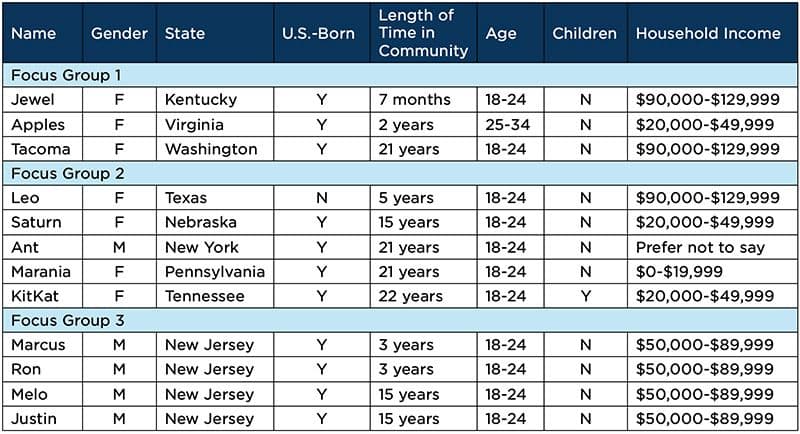
Study participants (n=12) represented a diverse cross-section of Black emerging adults ages 18 to 25. Fifty eight percent of participants were Black women, and one had a child under age 6 and identified as the child’s birth mother. All but one participant was born in the United States. Participants were economically diverse, with about half (58%) reporting a household income above $50,000 and one third reporting a household income of $50,000 or lower (33%). Participants resided in 11 distinct ZIP code areas in the four Census regions of the United States: North (New York, Pennsylvania, and New Jersey), South (Kentucky, Virginia, Texas, Tennessee), West (Washington), and Midwest (Nebraska). The primary cities represented were Louisville, Newport News, Austin, New York City, Philadelphia, Knoxville, Omaha, Burlington, and Tacoma. Participants lived in their communities for a median of 15 years, with a range of seven months to 22 years.
Table 3: Participant demographics
Findings
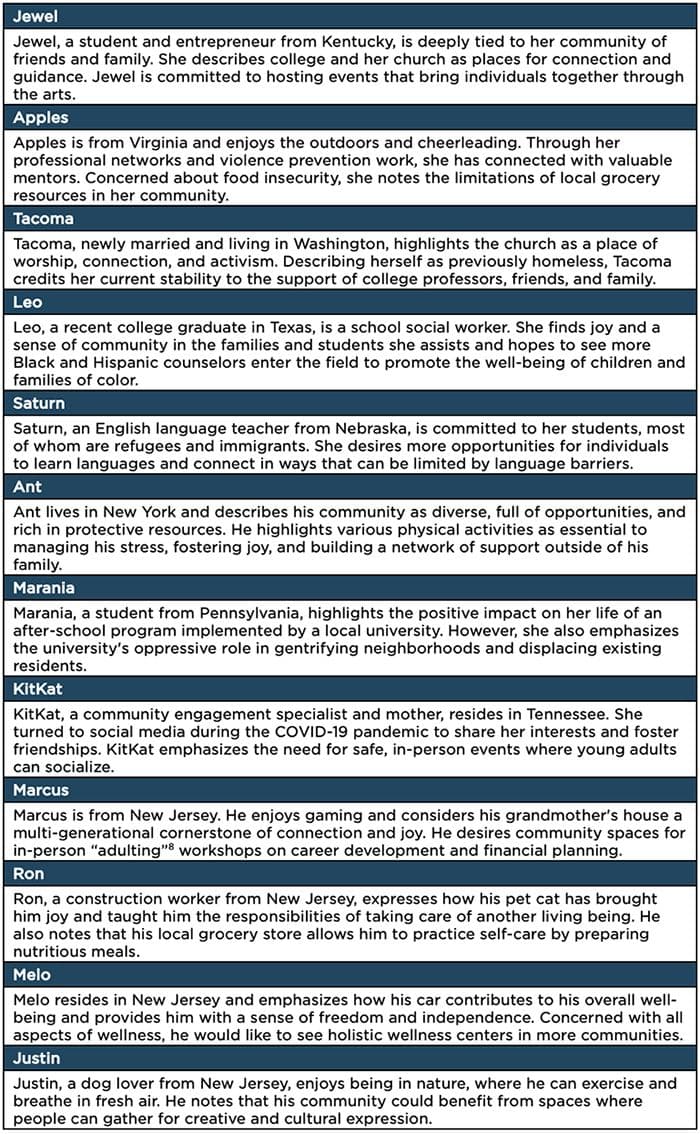
Through online maps and virtual focus group discussions, Black emerging adults identified PCRs supporting their well-being. Below, we first provide brief profiles of each participant and then summarize how they described the importance of these resources—both those presently in their lives and those that they desire.
Table 4: Participant profiles
PCRs and well-being
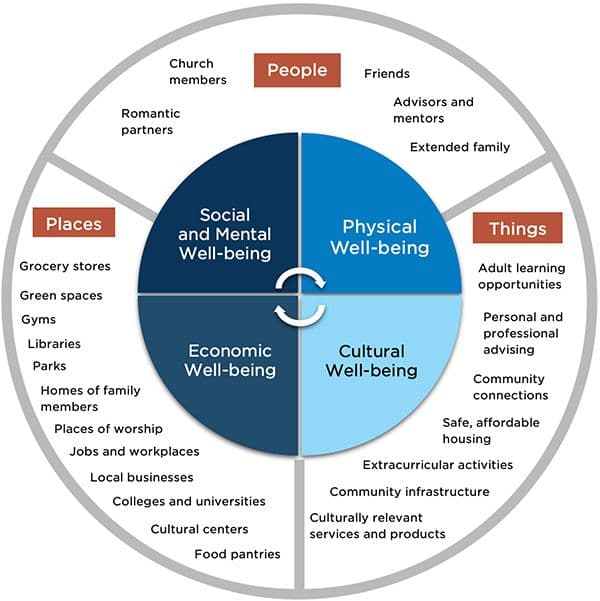
When discussing the people, places, and things in their communities that supported their well-being, participants described well-being in holistic terms, emphasizing four distinct yet related dimensions: social and mental, physical, economic, and cultural (see Figure 3). Below, we summarize findings for each dimension, individually, while recognizing their interconnectedness in promoting the well-being of the emerging adults featured in this study.
Figure 3: PCRs and the well-being of Black emerging adults
Social and mental well-being is closely linked to the quality and variety of relationships that participants have in their communities, both in-person and online. When discussing these relationships, participants emphasized the role of protective people (e.g., romantic partners), places (e.g., homes of family members), and things (e.g., personal and professional advising) in supporting their social and mental health. Relationships with romantic partners were identified as particularly protective, providing emotional security, safety, and stability as participants developed their individual and professional identities. For example, Melo discussed a time when he was feeling down; after spending time with his girlfriend at a rooftop restaurant, though, he began to feel more hopeful, reflecting that "Maybe life is worth living." Similarly, Jewel described her current partner as providing the emotional foundation for her to “shoot for the stars.”
Participants also acknowledged that non-romantic relationships can be critical for managing mental health challenges. Apples described how her youth church group, which provides both spiritual and emotional support, helps her feel more comfortable speaking in social situations despite her anxiety: “It's hard for me to speak, but there, it helps me speak a little bit more because they're more community.” Marcus discussed how hanging out with friends through gaming and sports helped him both relax and maintain important social ties. Participants also emphasized the importance of family networks and the homes of family members and friends as central to their mental well-being. For Marcus, family relationships were strengthened at his “nana’s house,” where they celebrated holidays and special occasions.
Other participants described intergenerational relationships with advisors and mentors found in churches and colleges as crucial for navigating the milestones and challenges of young adulthood. Mentors and advisors were particularly important in offering guidance and support. Tacoma, the only married participant, valued the “elderly wisdom” provided by older members at the Black Baptist church she attends, calling it her “sanctuary.” She also highlighted the importance of mentors and advisors at her college, who not only assisted her with housing and food during a difficult time but also supported her mental health by connecting her to professional therapy. Similarly, Jewel identified the National Panhellenic Council advisor at her college as someone she could “lean on for anything.”
Several participants also highlighted the importance of their relationships with themselves and the need for time alone to promote their mental well-being. One respondent, Ant, mentioned how exercise—especially going to the gym—is a great way to release energy and cope with stress. KitKat, the only participant with a child, described the benefits of taking short breaks outdoors for her mental health—“sitting outside for at least 10 minutes, taking a brain break from work and home.”
Physical well-being describes participants’ capacity to maintain a healthy lifestyle. Aspects might include preparing and eating nutritious foods, exercising regularly, and scheduling regular health check-ups. Participants underscored the people (e.g., friends), places (e.g., grocery stores), and things (e.g., sports) that reinforce their physical well-being while noting community wellness resources they lacked access to but desired (e.g., health and wellness centers). A key strategy that participants employed to promote their physical well-being was shopping for and preparing healthy meals. For example, Ron talked about his weekly stops at the grocery store, where he purchases nutritious items to “meal prep” his lunches for the week. He "[gets] everything at once” and “makes it a little thing," seeing it as an intentional self-care practice. Additionally, KitKat discussed the joy she derives from cooking vegetarian meals and sharing this "lifestyle" with her father and grandmother, fostering connection and well-being through food. Frustrated by the limited selections and locked up merchandise at her local grocery store, Tacoma described wanting a Black-owned (or a “by us for us”) option where she can purchase fresh, culturally relevant food and support healthy eating habits. Apples also described the need for food pantries that offer healthy food choices and allow for more frequent visits: “[D]epending on what time of the month you go, [the pantry] might not have much,” and it’s “a rule that you can only go to [a certain] pantry once a month.”
Participants also identified sports and extracurricular activities as supportive of their physical well-being. Marcus, Ant, and Apples, for instance, described how organized sports help them maintain their health and express themselves through movement. Eight participants identified parks, green spaces, and gyms as protective places that provide opportunities to decompress. However, Jewel and Marania noted the need for more parks and green spaces in their communities.
Participants also underscored the importance of community-based health and wellness centers for their physical well-being. For example, Marania noted the protective nature of a local clinic in her neighborhood. While other options are present, including a university-run clinic, she described her local clinic as “really welcoming,” “way more reliable than going [to the university clinic].” She also appreciated how “the staff there put in the effort to get to know you.” Similarly, Leo expressed wanting more clinics with additional availability to better meet community needs, while Melo desired a holistic wellness center in his neighborhood—one that is community-focused and concerned with all aspects of health.
Economic well-being refers to participants' ability to secure and retain stable employment and manage their finances to meet both their immediate needs and long-term financial goals. In describing the PCRs that promote their economic well-being, participants highlighted the people (e.g., mentors), places (e.g., workplaces), and things (e.g., transportation) in their lives, along with resources they wished were available but that they lacked access to (e.g., adult learning opportunities).
Workplaces were frequently mentioned as key community resources supporting economic well-being. For example, Ant emphasized the importance of his job not only for the financial support it provides, but also for the opportunities to meet people and expand his professional network through various internships. Other participants described how coworkers acted as advisors and mentors, helping them navigate workplace expectations and develop both hard and soft professional skills. Tacoma, for instance, shared how carpooling with coworkers created "adult relationships" that contributed to her performance and success at work. On the other hand, Marania pointed out that finding stable employment to build a solid foundation for economic well-being can be challenging. She described turning to social media (specifically Instagram) to connect with a wider social network that provides valuable information about job and career opportunities.
In addition to emphasizing the importance of supportive workplaces and coworkers for their economic well-being, participants also desired more community resources focused on long-term financial planning and stability. For example, Marcus highlighted the need for local, in-person financial literacy workshops to help emerging adults navigate "different workforce milestones" and better understand topics like job benefits and credit-building. While he found his high school personal finance course useful in covering topics such as "loans, mortgages, and interest rates," he stressed the importance of more detailed, timely information to help with the practical aspects of "adulting." Additionally, Saturn highlighted the need for investments in infrastructure and housing in under-resourced Black communities like those in North Omaha to help secure not only her own economic well-being but also that of other Black emerging adults.
Cultural well-being is the ability to engage in the arts, cultural expression, and community activities that foster a sense of identity and preserve cultural traditions.[9] Participants described the people (e.g., church members), places (e.g., local businesses such as theaters and arcades), and things (e.g., community connections) in their communities that support this unique aspect of their overall well-being. They also discussed the void created by the lack of local cultural resources.
For example, Melo loved outings to movie theaters and arcades as cultural outlets and opportunities to “not be on his phone or scrolling through TikTok.” For Leo, cultural organizations on her former college campus provided opportunities for her to explore her identity as a Black woman in safe spaces. She regularly visits the college to stay connected to these organizations, including the campus mosque, and remains in touch with her friends who are there pursuing graduate degrees. Saturn, on the other hand, described a local community organization as critical to her cultural well-being. This organization hosts events like poetry readings, art battles, and political activities—offering exposure to local artists and vendors and fostering community engagement. Marania identified her local library as a protective cultural space, where she learned to sew—a skill she described as “really important to me.” Marcus, who lives in a “relatively small town,” explained how his local main street is a focal point for community activities, where cultural festivals and holiday traditions are shared with family, neighbors, and friends.
However, several participants highlighted the absence of spaces for cultural expression and activities in their communities. Justin commented on the lack of “places around us [where] you can creatively express yourself,” and described needing to travel outside of his community for such opportunities. Ron agreed, noting that the absence of such spaces limited chances to connect with peers who shared similar cultural backgrounds and interests. Jewel also discussed the lack of safe cultural venues in her community and her efforts to create such spaces on her own, including organizing a community open-mic event to showcase the talents of young Black people.
Discussion and Implications
This study emphasizes the critical role of PCRs in fostering a holistic sense of well-being among Black emerging adults. Our sample of 12 young women and men highlights the people, places, and things that contribute to their well-being, as well as the protective resources they desire but find less accessible. While the findings cannot be generalized to the broader population of Black emerging adults in the United States, they have important implications for both research and practice, which we outline in the four key takeaways below.
1. Social media is an important source of social engagement for Black emerging adults, but they also place significant value on in-person connections.
Several participants reported using social media in ways that were beneficial—some to seek employment opportunities, others to engage in leisure activities, and still others to form or strengthen social relationships. For some, the shutdowns associated with the COVID-19 pandemic significantly increased social media use. These participants also described efforts to intentionally reduce and better manage their time spent on social media during this post-pandemic period to avoid the negative outcomes associated with its addictive use. Additionally, they desired more opportunities for in-person connections to ward off feelings of loneliness and isolation. Future studies could explore how PCRs can help Black young adults balance online and in-person connections to achieve the key developmental tasks of emerging adulthood.
2. Positive romantic relationships can serve as key stabilizing forces—socially, emotionally, and economically—in the lives of Black emerging adults.
Several participants described these relationships as providing safety, security, and stability during a phase of development often marked by uncertainty. The significance of positive romantic relationships in emerging adulthood is well-documented in existing research. However, the effects of institutional racism on Black emerging adults can limit their dating opportunities and romantic relationship development. Such challenges underscore the need to understand and leverage PCRs that can support this important milestone in these young people’s transition to adulthood.
3. Employment opportunities and support systems play a crucial role in shaping the identity development and economic futures of Black emerging adults.
Participants from diverse professions, ranging from construction workers to school social workers, consistently described jobs and workplaces as PCRs that provide financial stability and support personal and entrepreneurial goals. Many also highlighted the importance of coworkers in helping them meet job expectations. However, others spoke about the challenges of securing stable, well-compensated employment—a particularly significant issue for Black emerging adults, especially those without post-secondary credentials. Research shows that Black emerging adults are more than twice as likely to experience unemployment as their White counterparts, and are less likely to have access to high-quality jobs that offer benefits such as health care, retirement plans, paid vacation, and sick leave. Given these disparities, Black emerging adults can uniquely benefit from the implementation and evaluation of workforce development programs like Generation Work that are specifically designed to address the needs of young adults facing the greatest barriers to high-quality employment.
4. Third places—defined as spaces outside of work and home that foster informal social interaction—are particularly important for the well-being of youth and emerging adults.
Third place environments offer opportunities for physical activity, cultural and creative expression, and inter- and intra-generational personal connections that participants described as important for navigating the transition to adulthood. Notably, participants emphasized the importance of churches, mosques, and religious groups as important third places—even as surveys show a decline in religious affiliation among young adults. This finding underscores the need for more in-depth studies on the intersection of religion, race, and ethnicity among emerging adults in the United States. Further, several participants highlighted the lack of diverse, safe, and inclusive cultural and creative third places in their communities, while also noting ongoing efforts to create such spaces. Expanding research on and access to these third places—as PCRs—is important for enhancing the well-being of Black emerging adults and supporting their successful transition to adulthood.
Suggested citation
Sanders, M., Martinez, D.N., & Winston, J. (2024). Black emerging adults identify protective community resources that promote their well-being. Child Trends. DOI: 10.56417/9456j9286y
Footnotes
[1] The authors would like to thank CU’s senior associate of young leader programming, Rachel Askew, for her invaluable support in completing the study.
[2] The study was designed to include five participants during each virtual session. However, due to scheduling conflicts, some participants were unable to make the scheduled sessions. There were three participants in our first focus group, five in our second, and four in our third.
[3] We established inter-rater reliability for the map coding framework used in this study during a previous project on PCRs for Black families with children ages 17 and under. See: https://www.childtrends.org/publications/black-families-protective-community-resources.
[4] One participant’s map was not submitted and, therefore, was not included in the analysis.
[5] During the project referenced in Footnote #3, we also established inter-rater reliability for the transcript coding tool used in this study.
[6] Approximately 9 percent of participants preferred not to share their annual household incomes.
[7] While participants differed in several ways—including by age, income, and geographic location—they were similar in other respects. Most resided in urban and suburban neighborhoods, identified as cisgender men and women, and were born in the United States. This highlights the need for more intentional efforts to examine PCRs for Black emerging adults, particularly those in rural areas and within LGBTQ+ and immigrant communities.
[8] “Adulting” is an informal term that describes the act or practice of attending to the ordinary tasks required of an adult.
[9] There is currently no singular definition of “cultural well-being,” largely due to the diverse ways in which culture is defined. However, for this study, we pull from definitions commonly used in Australia, as discussed in Sheridan (2023) and Williamson, et al. (2023).