



When many organizations think about authentic youth engagement in the policy process, they often, understandably, think first about how best to support youth themselves. Yet youth are not the only ones engaged in the policy process: Adults also play an important role as partners and mentors to youth throughout that process. This blog offers considerations, informed by examples and reflections from youth-serving organizations, for preparing adults to support youth in policy engagement.
Through two phases of the Authentic Youth Engagement in Policy project (see box), Child Trends has set out to learn more about adult training as one component of supporting authentic youth engagement. In the second phase, we found that, of 32 youth-serving organizations, one in three did not provide training to adults. Given that authentic youth engagement in policy depends on youth-adult partnerships, it is critical to consider how to prepare adults as well.
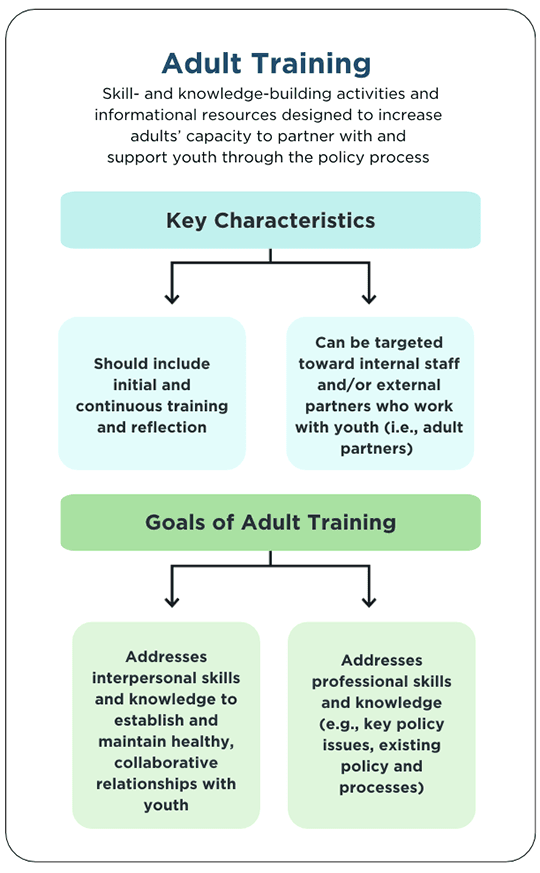
Throughout the project, our references to adult training encompass skill- and knowledge-building activities and informational resources designed to increase adults’ capacity to partner with and support youth throughout the policy process. This includes initial and continuous training, as well as ongoing reflection, to ensure that training and learning for adults are relevant and responsive to an organization’s efforts and youth partners’ needs. The figure below highlights key characteristics and goals adult training should aim to address.
Figure: Defining adult training, its characteristics, and its goals
The training given to adult partners can impact youths’ experiences while engaging in the policy process. For example, when one organization hired foster youth as paid consultants, they learned that many youth found the jargon in financial paperwork difficult to navigate. Following this revelation, youth and adult partners met with the organization’s financial team to discuss ways to improve their capacity to support youth consultants, including trauma-informed ways to talk about tax forms (e.g., using accessible language to describe what financial forms say and why they are required for compensation). By partnering with youth to educate the financial team, adult partners helped build trust in their relationships with youth and addressed an organizational barrier to youth participation. In this way, adult training—including opportunities for ongoing learning and reflection—can facilitate authentic youth engagement by shaping youth-adult partnerships, youth’s experiences, and how youth participate in the policy process.
Based on our phase 2 discussions with youth-serving organizations, we offer the following considerations for other organizations seeking to incorporate adult training into youth engagement efforts:
- Adult training should focus on supporting youth’s needs and developing relationships with youth. Some adult partners may share identities or lived experiences with the youth they collaborate with. This, in turn, may shape how they build relationships compared to adults without those shared experiences. Because of this variation, adult training should cover a broad range of content such as adultism, trauma-informed practices, cultural competence, and youth participatory principles. This would ensure that trainings meet adult partners where they are while equipping all partners—regardless of shared experiences—with the professional and relational skills to support youth in effective, collaborative ways.
- Adult-specific learning spaces paired with youth-adult spaces support vulnerability and build confidence. Dedicated spaces for adult learning can create space for adults themselves to be vulnerable and build their confidence to ask questions and reflect openly in ways that may not be possible in spaces they share with youth. However, these adult-specific spaces should work in tandem with youth-adult spaces to ensure that youth and adults can also learn together.
- If interested, young people can support adult training opportunities by developing and/or delivering trainings. Voluntary, appropriately compensated opportunities for youth to help develop and deliver trainings can ensure that adult training is informed by youth themselves. However, it is important to acknowledge that youth shouldn’t be solely responsible for training adult partners: Adults are responsible for learning how to engage.
- Adult training should happen at the organizational level. Because youth will sometimes interact with staff across an organization (e.g., in administrative or accounting roles), adult training should extend beyond those who directly interact with youth day-to-day. This broader approach builds organization-wide capacity to engage with and support youth (as in the organization that trained its accounting team on trauma-informed approaches for talking about tax forms).
These considerations represent a starting point for enhancing adult training related to supporting youth-adult partnerships. Continued collaboration across youth-serving organizations, researchers, and funders is needed to better understand how adult training opportunities (or a lack thereof) impact the youth-adult partnerships that underpin authentic youth engagement. Organizations can begin by preparing adult partners with the same intentionality they apply to helping youth engage in policy efforts. Funders, in turn, can ensure that organizations have dedicated time and resources for adult training that equips both adult and youth partners to establish and maintain strong partnerships.
Suggested citation: Ball, J., Scott, A., & McKlindon, A. (2026). How adult training enhances authentic youth engagement in the policy process. Child Trends. DOI: 10.56417/8733c4341f