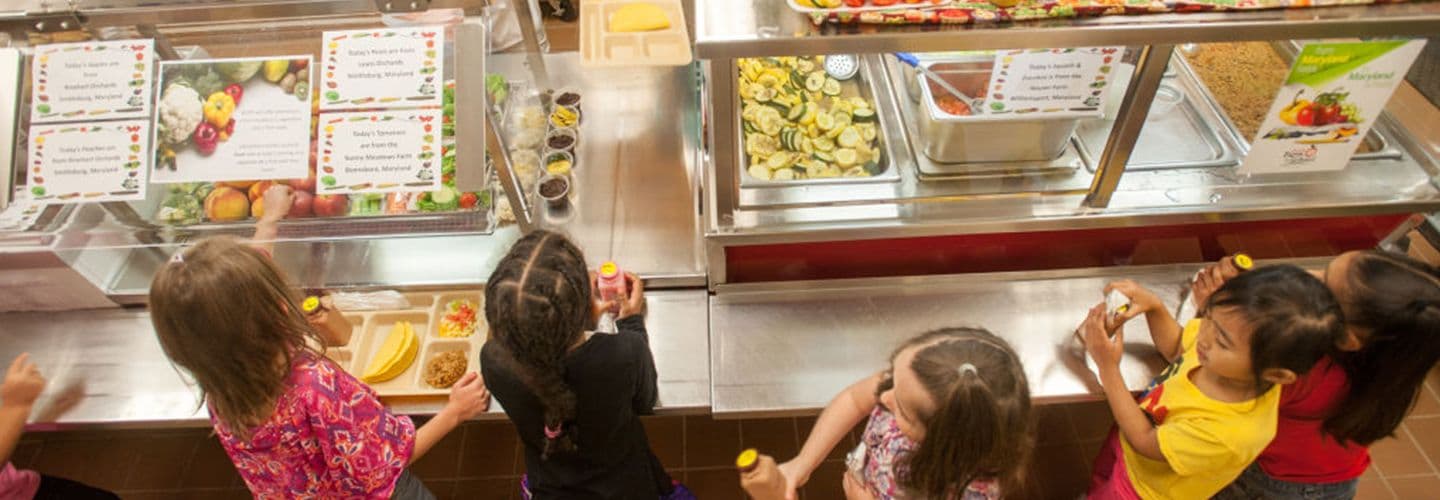
The Examining Implementation of Universal Free School Meals in Colorado project aims to examine the state’s implementation of Healthy School Meals for All (HSMA), with a focus on identifying school district strategies that reduce barriers to meal participation among student populations with high rates of food insecurity. Study findings will inform decisions on the design and implementation of effective and sustainable universal free school meals policies in Colorado and beyond.
This two-year study is being conducted in partnership with the School Nutrition Association and is supported by grant #82564 from Healthy Eating Research, a national program of the Robert Wood Johnson Foundation.
Background
In 2023, 7.2 million children in the United States lived in food-insecure households, leading several states—including California, Maine, Colorado, Minnesota, New Mexico, Vermont, Michigan, and Massachusetts—to implement universal free school meal (UFSM) programs. These programs, which make free breakfast and lunch available to all students regardless of family income, have the potential not only to address hunger and improve food security among children, but to improve diet quality, school attendance, and learning. However, the success of these programs varies depending on the effectiveness of their implementation.
Launched in school year 2023-2024, Colorado’s voter-approved HSMA saw participation from 100 percent of eligible school food authorities and higher than anticipated increases in meal participation rates, leading to a projected budget shortfall. Understanding how districts address these and other challenges can inform effective UFSM implementation in Colorado and beyond.
Research approach
The goals of this project are to describe how Colorado’s HSMA has been implemented across different district contexts; to identify implementation strategies that reduce barriers to meal participation for student populations with high rates of food insecurity and assess whether and how HSMA benefits them; and to explore perceptions of HSMA among state, district, and local stakeholders who have been involved in implementation or who are intended beneficiaries of the policy.
An advisory board of students and parents will help guide decision making throughout the study. We will use a mixed-methods approach to achieve our research goals, including the following:
- Interviews with state-level school nutrition representatives to understand their perspectives on HSMA policy implementation
- A survey of school food service directors around the state to gather insights about implementation successes and challenges and meal participation trends
- Focus groups in three school districts to hear directly from students, parents, and school staff about their experiences with UFSMs
- Analysis of existing school- and district-level administrative data to understand how school attendance, chronic absence, and standardized test scores are associated with recent adoption of UFSMs for student populations with high rates of food insecurity
Timeline
Overall timeframe: November 2024 – November 2026
- Fall 2024/Winter 2025 – Spring 2026: Primary data collection and analysis, including interviews, surveys, and focus groups
- Spring 2026 – Summer 2026: Analysis of state administrative data
- Fall 2026: Dissemination of study findings
Child Trends’ project team

Bonnie Solomon
Research Scientist II

Yosmary Rodriguez
Senior Research Analyst
Brandon Stratford
Senior Research Scientist II
External partners
- Donovan Lessard - School Nutrition Association, Survey Dissemination Lead
- Joël McClurg - The Colorado Blueprint to End Hunger, Consultant
- Student and Parent Advisory Board