
To enhance understanding of how juvenile justice systems are financed, the Annie E. Casey Foundation funded Child Trends to conduct a mixed-methods study of juvenile justice systems’ financing across select states and localities. By examining system structures within these states and local jurisdictions, along with their funding processes and expenditures, this project aims to empower advocates, policymakers, and system administrators to drive meaningful change.
Background
The juvenile justice system in the United States operates via complex and varied financial structures, with funding and administration differing significantly across states and localities. According to the Juvenile Justice Geography, Policy, Practice & Statistics project, in 2022, 11 states had state-administered juvenile justice systems, only one of which featured a centralized operating authority under a single state agency; 22 states were mostly administered at a state level and 18 were entirely locally operated. These systems are financed through a mix of state, local, and federal funds, as well as other sources like fines, fees, and philanthropic contributions. However, the lack of a uniform structure, along with limited information on juvenile justice financing synthesized across states and localities, creates challenges in understanding how resources are allocated and utilized. This difficulty hinders efforts to evaluate the effectiveness of different financial models in achieving key objectives, such as reducing recidivism, expanding community-based alternatives to incarceration, and providing access to rehabilitative services. Without a clear understanding of these financing mechanisms, it is difficult to strategize resource allocation effectively or improve program quality to better serve youth and their families.
To address the growing needs of youth and mitigate public safety concerns, jurisdictions must adopt innovative financial strategies that balance crime reduction, child development, and cost efficiency. Traditional punitive approaches such as incarceration are costly and often fail to improve long-term outcomes for youth or enhance public safety. For instance, the average annual cost of incarcerating a young person in 2020 was $214,620, whereas community-based alternatives are often more cost-effective and yield positive outcomes, including reduced recidivism rates and improved youth well-being. To advance positive change in and increase the effectiveness of the juvenile justice system, administrators, policymakers, advocates, and researchers need accurate, up-to-date information on state and local juvenile justice financing, and on agencies’ financing-related challenges and opportunities in serving youth and families.
Research approach
Child Trends leveraged its 13 years of experience conducting the Child Welfare Financing Survey to develop a Juvenile Justice Financing Survey. This survey of seven states and 11 localities—administered from January 2022 to April 2023 and covering state fiscal year 2019—was developed in partnership with the Annie E. Casey Foundation and an advisory panel to collect data on various topics, including details about how juvenile justice systems are administered, expenditures for services and programs, savings and reinvestment practices, and contextual information about the administration of the juvenile justice system. Following survey completion, we conducted semi-structured interviews with respondents to gather additional information on issues such as how funding decisions are made, the benefits and challenges of different funding streams, and how system context shapes juvenile justice financing.
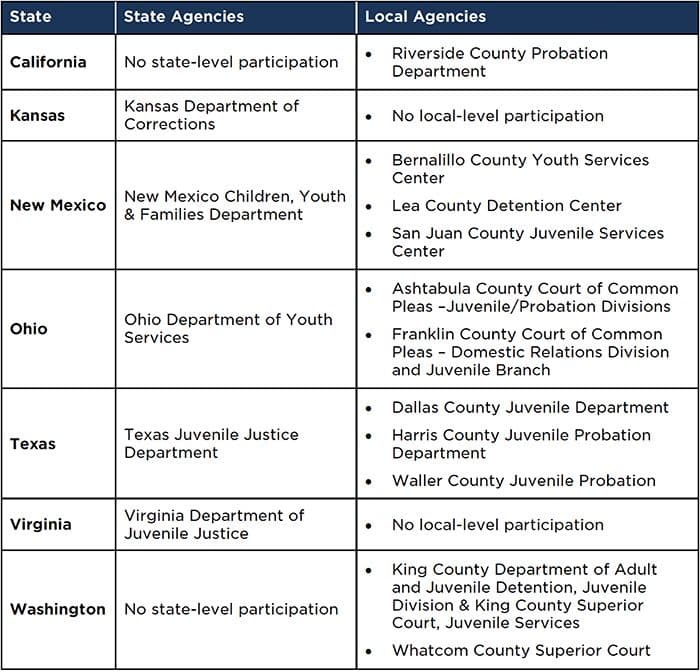
To paint a more comprehensive picture of juvenile justice financing, we purposefully selected state and local juvenile justice systems with varying administrative structures and youth populations across different regions of the United States. The following state and local agencies participated in the study.
Learnings
Learnings from this project are shared via two resources, which can be accessed here.
- A strategic brief offering a high-level overview of juvenile justice financing and a roadmap for crafting transformative strategies tailored to unique state and local system contexts
- Factsheets that provide comprehensive insights into the financing of select jurisdictions, highlighting funding streams, the appropriation process, and expenditure patterns
Funder
Research Team
- Principal investigators: Kelly Murphy, Kristine Chan
- Project directors: Julie Gilbertsen, Olivia Reyes
- Senior advisor: Kristen Harper, Kristina Rosinsky