
To better understand the needs of fathers and father figures returning from incarceration, Child Trends partnered with the Osborne Association to evaluate the impact and implementation of integrating Social Resilience Model (SRM) skills into the Osborne Association’s Pathways to Reentry, Employment, and Parenting (PREPARE) program. The key goals of the evaluation were to identify whether—and how—PREPARE and PREPARE Plus (the PREPARE program plus the addition of the SRM skills) impact the lives of formerly incarcerated fathers in four areas: 1) parenting, 2) healthy relationships, 3) employment readiness and financial education, and 4) reduced recidivism.
Context
Fathers returning from incarceration often face steep challenges to rebuilding healthy family relationships, securing stable employment, and navigating persistent stigma. As returning citizens, they also face:
- High rates of unemployment despite extraordinary efforts to find work
- Ten times the rate of homelessness as among the general population
- Challenges reconnecting with their children and families during the reentry period
- A heightened need for mental health services
About PREPARE and PREPARE Plus
The Osborne Association’s PREPARE program, grounded in more than 35 years of experience working with justice-impacted families, offers a holistic response to reentry. Designed to mitigate barriers to reentry and promote long-term success, PREPARE supports fathers in reentry, employment, and parenting by helping justice-involved fathers and their families build skills that promote stability, strong relationships, and successful reentry.
Designed for fathers with low incomes who have been impacted by incarceration, detention, probation, or parole, PREPARE offers a three-week core curriculum focused on parenting education, healthy relationship skills, job placement services, and workforce readiness. Participants engage with evidence-based content—such as 24/7 Dad and Ready, Set, Work!—to strengthen parenting practices, improve economic outcomes, and navigate co-parenting relationships. The program also connects families with referrals, child support and financial literacy workshops and supports, and industry-recognized credential training hard skills training (e.g., OSHA, Site and Safety Credentialing) to enhance well-being and long-term engagement. Through culturally responsive and father-centered approaches, PREPARE aims to foster safer communities and healthier family dynamics during fathers’ transition home.
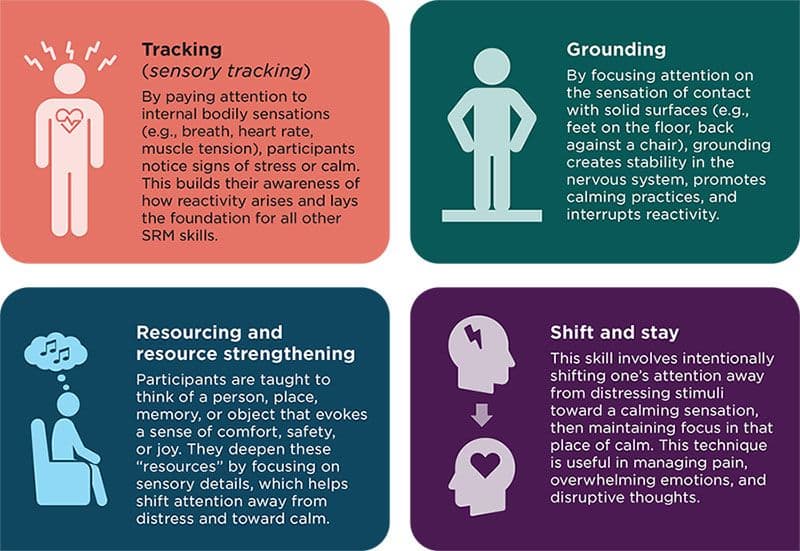
PREPARE Plus enhances the core PREPARE program by introducing fathers to the Social Resilience Model, or SRM. SRM uses neuroscience-based attention management skills to manage stress and trauma and build resilience. Over the course of three weeks, participants are provided educational practices that deepen resilience and promote attention management and self-regulation, while decreasing responsiveness to traumatic triggers. PREPARE Plus participants are provided opportunities to practice SRM skills in class using instructional videos that explain the skills; class facilitators also use Dan Siegel’s “Hand Model of the Brain” to demonstrate the impact of stress and triggers on the brain.
Figure. SRM Skills
About Our Evaluation
Evaluation design
Child Trends conducted a rigorous impact and implementation evaluation of the Osborne Association’s PREPARE and PREPARE Plus programs using a randomized control trial to assess how these programs influence outcomes for justice-involved fathers. Eligible participants were randomly assigned to either PREPARE or PREPARE Plus and the evaluation used surveys to measure their outcomes at program entry, exit, and three months post-completion. The impact evaluation focused on the outcomes of fathers’ perspectives, decisions, behaviors, and knowledge across four key areas (i.e., parenting, healthy relationships, financial stability, and reduced recidivism), with an eye toward understanding what meaningful change looks like for participants.
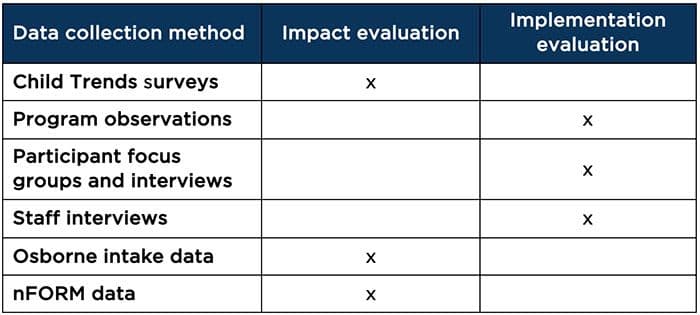
The implementation evaluation focused on the integration of SRM practices and content into the PREPARE program and on participant outcomes involving SRM uptake. The research team adapted the Consolidated Framework for Implementation Research (CFIR) to develop study protocols. We collected implementation data through virtual observations, staff interviews conducted once a year, focus groups conducted at the program exit, and follow-up interviews three months post completion.
Table. Data Collection Procedures
Strategies for authentic stakeholder partnership
When our research team designed the evaluation, we kept in mind both the study’s population and the impacts of the COVID-19 pandemic. To ensure that our study reflected the voices and experiences of reentering fathers and father figures, we engaged them as experts in the study design. This evaluation started in 2020, around the same time as the pandemic. As a result, the program—which had previously been delivered in-person at two sites in the Bronx and Brooklyn—moved to virtual delivery. Implementation data collection was most impacted by COVID-19, as all data collection was moved to be virtual. Finally, we utilized data shares to provide updates on data collection with our partner, the Osborne Association. Below is a list of strategies we used to authentically engage our partner:
- We conducted cognitive interviews with former program participants to ensure that we asked the correct questions in surveys, exit focus groups, and follow-up interviews.
- We also collaborated with Osborne Association staff to review the CFIR implementation framework and identify relevant components.
- Over the course of four years of data collection, we shared data to engage with our partner, keep them up to date with the project, share early findings, and improve implementation. We planned for two data share opportunities: first, halfway through the study to share what we were learning and seeing; and second, at the end of the study to engage the partner and program facilitators to interpret our findings.
- Finally, we co-presented with Osborne Association staff at the 2024 National Fatherhood Summit to share early findings.
Learnings
- Resilience in Reentry: An Implementation and Impact Evaluation of the Social Resilience Model in the PREPARE Program in New York City
- The final report of the study provides the outcomes of the impact and implementation outcomes, hypothesizing that SRM-enhanced programming (PREPARE Plus) will yield stronger improvements across a number of outcome areas.
Previous Osborne Evaluations
- Returning Home: A Descriptive Evaluation of Prepare in New York City Final Descriptive Evaluation Report for the Osborne Association
- The Osborne Association Prepare Program: Recidivism Analysis - John Jay College Research and Evaluation Center
- Inside The Osborne Association’s Prepare Program - John Jay College Research and Evaluation Center
Funder
This study was funded by the Office of Family Assistance within the Administration for Children and Families (ACF), U.S. Department of Health & Human Services (HHS). Grant Number 90ZJ0022-01-00.
Acknowledgements
Osborne Association team members
We wish to express our heartfelt thanks to current and former staff at The Osborne Association for their tireless efforts in supporting program implementation and providing critical insights throughout the evaluation process. We are especially grateful to Michelle Portlock, Steuben Vega, Sharon Livingston, Petal Fogenay-Foster, Gyasi Hedden, Jenny Santiago, Dwight Stephenson, Darryl Ojeda, and Steve Nesselroth. Your commitment to serving returning citizens and fostering positive change laid the foundation for this work. Special appreciation is extended to Laurie Leitch, creator of the Social Resilience Model, whose thoughtful insights were instrumental to the success of both the program and evaluation teams.
Child Trends team members
Over the past five years, many Child Trends team members have contributed to the evaluation.
Victor St. John, principal investigator
Fadumo M. Abdi, project director
Hannah Rackers
Emma Pliskin
Opiaah A. Jeffers
Tyler Chandler
Lisa Kim
Sunny Sun
Catherine Schaefer
Abigail Wulah
Mindy E. Scott
Elizabeth Karberg
Zabryna Balén
Elizabeth Cook