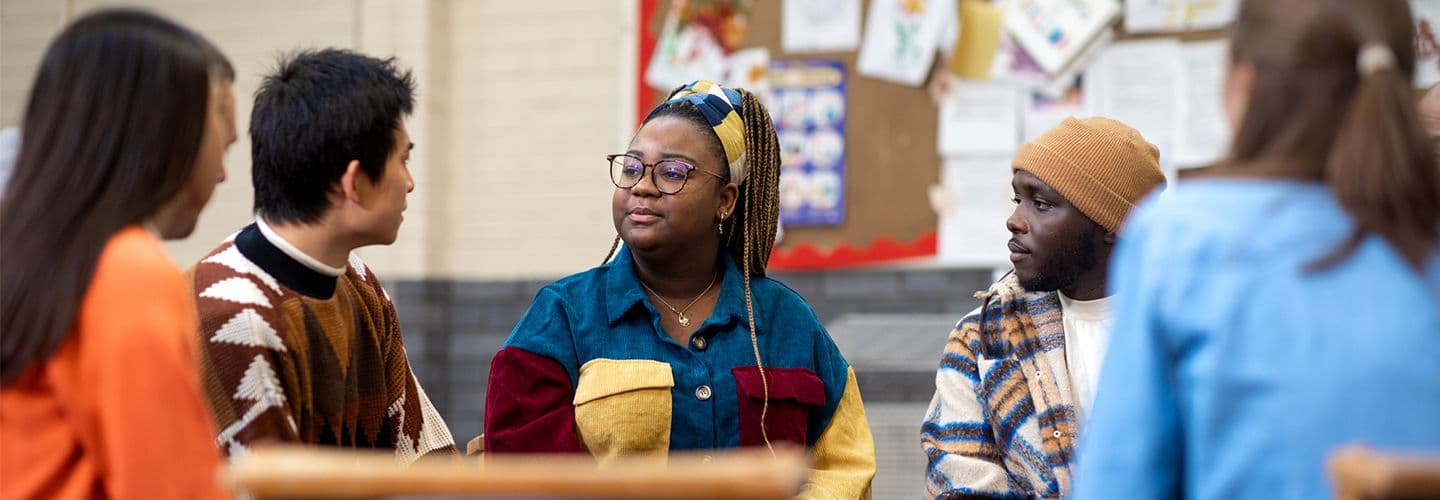

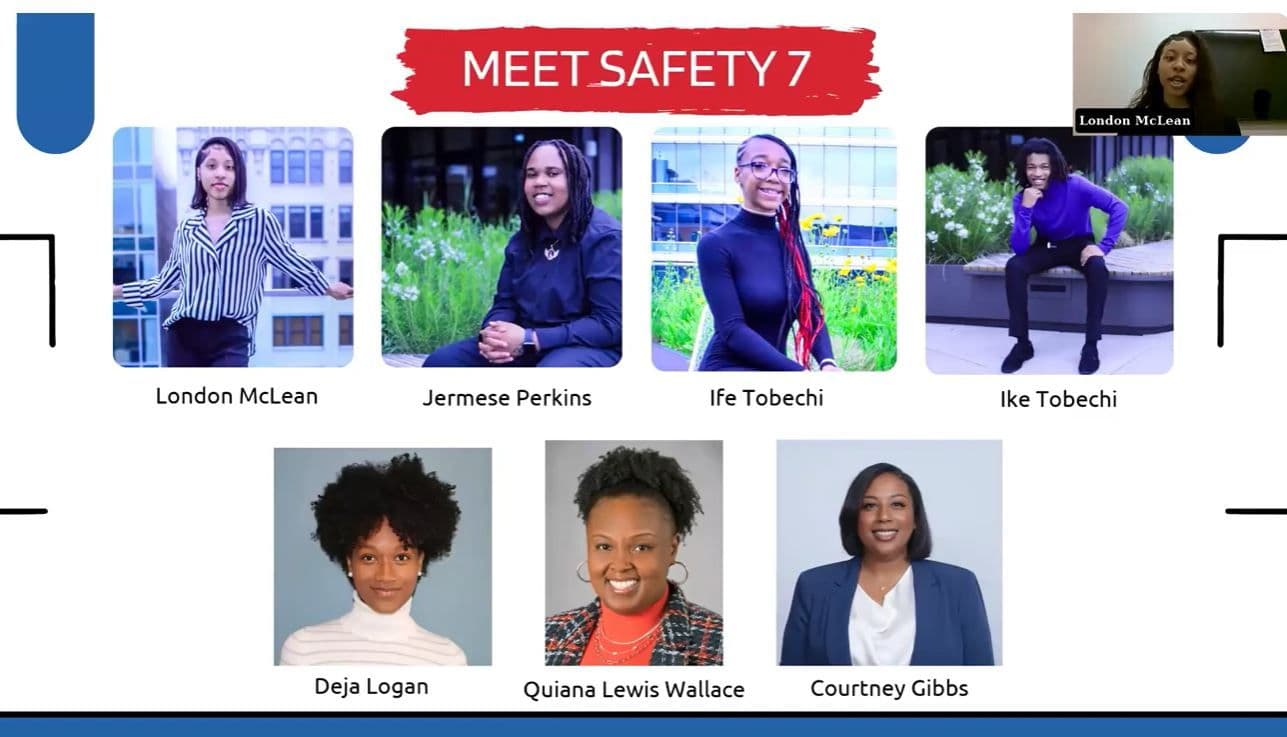
We are Safety 7, a team of young adult researchers from Wards 7 and 8 in Washington, DC. For the past 16 months, we have led a Youth Participatory Action Research (YPAR) study focused on one of the biggest challenges facing our neighborhoods: community violence. This work is personal.
With support from Sasha Bruce Youthwork and Child Trends, we designed the study from the ground up, collected the data, and analyzed what we found. We heard from 157 people via surveys, conducted 31 in-depth interviews, and held 16 focus group conversations with youth and adults ages 14 to 70.
This blog shares four of the most important things we have learned so far based on the patterns, stories, and realities that came through most clearly. You can also find out more in the video below, drawn from our virtual community data walk (an interactive method of facilitating community dialogue and input around data).
Safety 7 Community Data Walk Webinar
 Play video
1People create their own sense of safety when systems fall short.
Most people we talked to don’t feel safe in their neighborhoods. Nearly half of our study’s participants (46%) said they had stayed home at least once in the last month because they felt unsafe. Many described keeping their “head on a swivel,” avoiding certain areas, or only going out when necessary.
One message we heard frequently was a mistrust of police. As one youth participant said, “I feel like the police are supposed to be a support system … [but] they’re more of a controlling force instead.” Even when people face threats, they often worry that calling for help could put them at greater risk.
And because of that lack of protection, many people feel they need to protect themselves. In fact, 60 percent of people we surveyed said they know at least three people who carry guns. The choice to carry a weapon is often inspired by fear.
“We feel safest with our weapons … I know people that’s not going to come outside if they don’t have one.” — Youth participant
2Community violence has a personal toll.
Violence in the community doesn’t just hurt people physically. It also leaves lasting emotional wounds. More than half of our participating youth reported feeling stressed (51%), anxious (80%), or depressed (56%) due to exposure to violence.
A lot of us have lost people we love. For example, 80 percent of adults and 50 percent of youth in our surveys and focus groups had experienced the death of a friend or sibling. These losses aren’t just statistics; they’re real stories of grief.
“Losing my best friend … That situation was very traumatizing.” — Youth participant
Many people feel numb. Gunshots outside are part of everyday life. Some kids don’t even flinch anymore. Others cope through video games, music, or—sometimes—through substance use. We also heard over and over that people, whether young people or adults, need someone they can talk to who really gets it—a mentor, a therapist, or just someone who listens without judgment.
“They were shooting. My little brother was playing Fortnite. He said, ‘Oh, they shooting?’ and went back to the game … That’s how bad it is.” — Youth participant
3Violence is a symptom with deeper causes.
When we asked people about the causes of violence, they didn’t just talk about gangs or personal fights. They talked about access to guns, financial stress, social media, and parenting.
People told us how easy it is for youth to get a gun on the internet.
“It’s easy to get your hands on a gun … Go online, buy the parts, and someone will put it together. Even YouTube teaches them how.” — Youth participant
But even deeper than that, as a cause of violence, is poverty. People told us they’re struggling to meet basic needs. Two thirds of adults (68%) said they’d had trouble affording food or housing recently.
“People being broke, not having money … They feel like their back [is] against the wall.” — Youth participant
4Young people know what’s happening and what needs to change.
We didn’t just participate in this research—we led it. As young adults from Wards 7 and 8, we designed the study, asked the questions, ran the interviews and focus groups, and analyzed the data. We met multiple times a week for training and to reflect on what we were learning. What we heard often confirmed that which we already see and experience in our daily lives. This wasn’t just about studying the problem: It was about using research as a tool for change.
At the community data walk, we shared our findings and people added their own ideas for changing our community. They talked about the need for good jobs, safe places to spend time, mental health care, and programs created in partnership with youth—not just for us. One person said that if they had a billion dollars, they would build more third spaces[1]—and not just recreational centers, but other places where young people feel safe coming and going.
That comment stuck with us; real change starts with ideas like that. We’re not saying we have every answer, but we do know this: If you want to understand what’s going on and what could actually make a difference in communities, you need to listen to young people—not just when it’s easy, but all the time.
Where do we go from here?
These insights come from phase one of our project. In phase two, younger youth will join the next cohort of researchers and focus more on solutions. They’ll keep the momentum going, build off what we’ve found, and push the work forward.
If you’re reading this, you’re part of this work, too. Whether you’re a parent, teacher, policymaker, or just someone who cares, we hope you take the time to watch the webinar and hear more about these stories.
This work is about safety, but it’s also about power. And when young people lead, change is possible.
The Safety 7 research team includes London McLean, Jermese Perkins, Ifeanyichukwu Tobechi, Ikechukwu Tobechi, Courtney Gibbs, Deja Logan, and Quiana Lewis Wallace. Safety 7 was supported by Samantha Holquist, Jennifer Widstrand, and Bianca Faccio.
This project was supported by Award No. 15PNIJ-22-GG-01420-RESS, awarded by the National Institute of Justice, Office of Justice Programs, U.S. Department of Justice. The opinions, findings, and conclusions or recommendations expressed in this publication are those of the author(s) and do not necessarily reflect those of the Department of Justice.
Footnote
[1] A third space is a collaborative environment in which people from different backgrounds, roles, or systems come together to share power, challenge dominant norms, and co-create new knowledge or practices.
Suggested citation
Safety 7 Research Team. (2025). What youth researchers learned about safety and violence in Washington, DC. Child Trends. DOI: 10.56417/4859k4395f