

This tool is part of a larger resource library from Child Trends designed for practitioners, policymakers, and researchers who want to transform K-12 school systems to better meet the needs of students, families, and communities. This tool contains steps and strategies for developing student experience surveys to transform school systems.
Introduction
Developing a student experience survey can be a daunting task, especially when you do not know where to start. In school transformation work, surveys are a great tool to implement because they’re a strategic way to measure changes happening in your school. And while there are many ways to measure change, a student experience survey can help you collect information about gaps or needs within your school. Survey development for school transformation starts with establishing key steps and gathering essential information. We outline these steps below.
Steps for Developing a Survey
Figure 1. Steps for Developing and Launching Your Student Survey
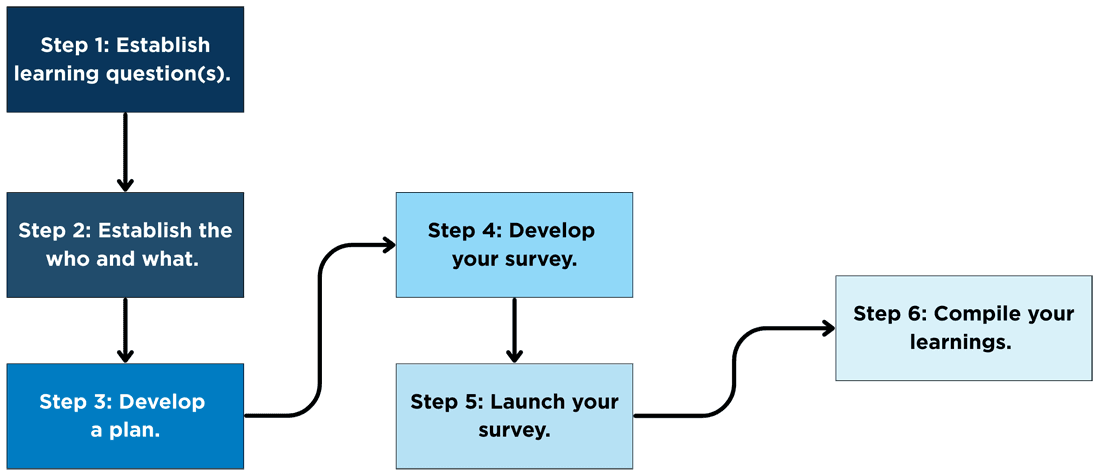
Step 1: Establish learning question(s). The first step is to establish the purpose of the survey. What learning do you want to take away from conducting a survey? Do you want to learn about your students’ experiences? Do you want to improve educators’ interactions with students? Do you want to learn how administrators engage with school systems and students?
Once you determine the leading question of interest, you can move onto step two.
Step 2: Establish the who and what. Step two involves determining who you need to engage and what type of information you want to collect. For instance, if your learning will focus on students, you’ll need to develop a survey that is appropriate for students. Once you determine your audience or your target population, you’ll need to spend time identifying the themes you want to focus on. What are the ideas or topics you want to learn about from your survey? These can include topics such as student voice, engagement with educators, school leadership decision making, student classroom engagement, etc. These ideas and topics will guide the questions in your learning survey.
Step 3: Develop a plan. Once you know what your learning questions will be and decide who you want to engage in your survey and what topics and ideas and topics you’d like to address, the next step is to develop a plan of action. To begin planning, determine who needs to be involved to ensure a successful survey. For instance, your team can include students, educators, leaders, and researchers. Next, meet with your team to develop a plan and timeline for administering the survey; these should include information like key dates and details on individuals’ involvement (e.g., recruiting students, tracking survey responses). Finally, once you have set your plan and timeline, get ready to develop your survey!
Step 4: Develop your survey. This step of the process is crucial. Child Trends has created a detailed guide to help ensure that your survey is successful. Access it here.
Step 5: Launch your survey. Once everything is set, it’s time to launch the survey. Ensure that any platforms (e.g., Google Forms, SurveyMonkey) needed for the survey launch are ready to go and test your survey with a few people or your internal team to ensure that there are no issues with accessing the survey or collecting data. Good luck with the survey launch!
Step 6: Compile your learnings. Once you have conducted the survey and collected your data, convene your team to talk about the information you learned—and discuss whether it’s enough to implement changes or whether you need more information. At this point, you can begin creating a plan to act on some of your learning or repeat this entire process again to gather additional information.
Conclusions
A student experience survey is a great tool to learn about needs and develop ways to improve your school system. Remember, you can adapt the steps discussed above to best suit your needs and school system.
Suggested citation: Guros, C., & Aceves, L. (2025). Tool for developing a student experience survey. Child Trends. DOI: 10.56417/8925w5982l