


As of August 2026, 39 states and the District of Columbia require school districts to restrict students’ use of cellphones and other smart devices. While these policies are spreading quickly, it remains possible that two schools operating under the same state mandate will provide different experiences for students and staff, depending on choices made at the district and school levels. Beneath all the variation, though, every cellphone policy is set up to answer two questions: When are students restricted from their devices, and where do the phones physically stay?
In this blog, we offer a simple framework for using these two questions to understand cellphone ban policies and implementation approaches. We also include considerations—based on Child Trends’ established expertise in youth engagement strategies—for schools, districts, and states as they develop, revise, and implement policies, along with a set of best practices.
Question 1: When can students use their phone?
Cellphone policies sit on a spectrum from no formal ban to a full-day ban.
Policy type | What the policy entails |
|---|---|
No formal policy | No formal policy is mandated, but states may require or encourage districts to set limits on cellphone use in classrooms. Phones are allowed in class and individual teachers may set their own cellphone rules. |
Instructional time only | Policies aim to ban cellphone use in classrooms. Phones must be off or stowed away during class, but are usable between classes, at lunch, and/or during free periods. |
Bell-to-bell | Policies mandate no cellphone use from the first bell of the school day until the last bell dismisses students, with no exceptions for lunch or during breaks. Bell-to-bell is the most common state law mandate. |
Note: Exemptions are allowed for special populations such as English learners and students with accessibility needs, emergency situations, and teacher discretion.
Question 2: Where is the phone stored?
How a phone is stored determines the degree to which a student retains control over it during the school day. These decisions are usually made locally rather than in state statute.
Approach | What it asks of the student | What it asks of schools |
|---|---|---|
Student keeps the device | Students have their phones powered off and kept out of sight in a pocket or backpack; often described as an "off and away" or "no-see" rule. | No purchase or infrastructure required; enforcement is left to individual teachers and staff. |
Classroom collection | Students deposit phones in a caddy, pocket chart, or bin upon entering a classroom and retrieve them when the period ends; sometimes described as a "cell hotel.” | Low-cost storage containers for classrooms; schools may consider liability for lost or damaged devices. |
Individual locked storage | Students place phones in a magnetic pouch or locker; phones are completely inaccessible. | High upfront cost for individual storage pouches or lockers; staff time is required to lock and unlock pouches; however, school-time monitoring of phones is reduced. |
Illustrating how these questions intersect
Together, these two questions show how the experience of a cellphone ban policy can differ from school to school, as illustrated in the figure below. Reading across a row tells you when phones may be used, or how strict the timing is. Reading down a column tells you where the phone is stored, or how much control the student retains over the device.
Figure. Student Experience Matrix
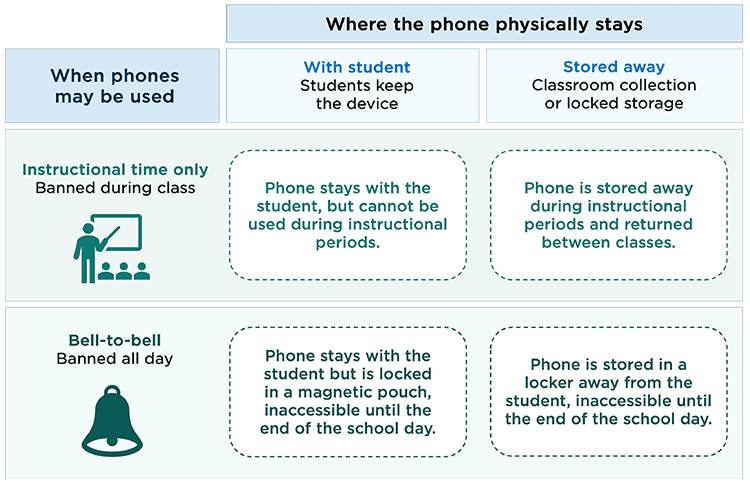
Further, school districts operating under similar cellphone ban policies may nevertheless implement the policy in substantially different ways. For example, a student in one school who keeps their phone in a backpack all day and a student in another school who stores theirs in a locked pouch may be subject to the same policy on paper but different conditions in practice.
Considerations and best practices
While bell-to-bell bans are now the most common policy approach, research shows that students like them the least. In 2026, the Pew Research Center found that just 17 percent of teens supported bell-to-bell bans, compared with 41 percent of teens who supported instructional-time bans. While bans have raised important questions about student compliance, discipline, and opportunities to develop digital literacy, this discourse has largely overlooked options to provide students greater choice and agency as schools promote smoother implementation.
As more states implement or consider bans, decision makers should consider the following questions:
- Communication: How are policymakers and schools communicating the reasons for the ban to students, and will students understand that rationale? Is there room to revisit how, or how often, the rationale is communicated?
- Student voice: What concerns have students raised about the policy and have those concerns been addressed? Is there a structured way for students to weigh in when the policy is revised?
- Measurement: What is being tracked beyond compliance? Are there indicators of academic engagement, interpersonal skills, belonging, stress, or safety that would show whether the policy is landing as intended?
- Discipline: How is the policy being enforced, and are disciplinary actions being reported and disaggregated by student group?
Child Trends’ expertise in youth engagement and outcome measurement can help schools and districts throughout the implementation process. For example, our research has pointed to best practice in similar areas that could be applied in creating or revising cellphone ban policies:
- Establish a process to evaluate the effects of the ban. Districts should build evaluations to assess how restrictions affect students’ academic engagement, interpersonal skills, and mental and emotional health.
- Monitor enforcement for unintended consequences. Schools should develop a system to track how policies are enforced and examine data by student group to ensure the policy is not applied disproportionately.
- Integrate student voice. State policymakers, district administrators, and school leaders should incorporate ways to include students in evaluating outcomes and revising both the policies and how they are implemented.
Suggested citation: Chan, K. & Lewis Wallace, Q. (2026). Student cellphone bans differ by time of ban and place of storage. Child Trends. DOI: 10.56417/2819d6139p