




This series is for practitioners, policymakers, and researchers who want to transform K-12 school systems to better meet the needs of students, families, and communities. This practice guide focuses on helping school teams update or develop their vision, mission, values, and goals to guide systems change.
Setting the foundation for education systems change begins with something called “strategic building.” Strategic building refers to the process of intentionally designing and implementing educational programs, structures, and practices within a school or district to operationalize the espoused vision, mission, values, and goals.
The strategic building process specifically focuses on building upon a clear vision, mission, values, and goals that together drive the intended education system change. These intentional and clear foundational elements (i.e., vision, mission, values, and goals) encourage a shared understanding of purpose, direction, and priorities so that all administrators, educators, staff, students, families, and community members are aligned and working together toward a common vision of systems change. Foundational elements improve coherence across education systems, helping teams engage in cycles of meaningful change.
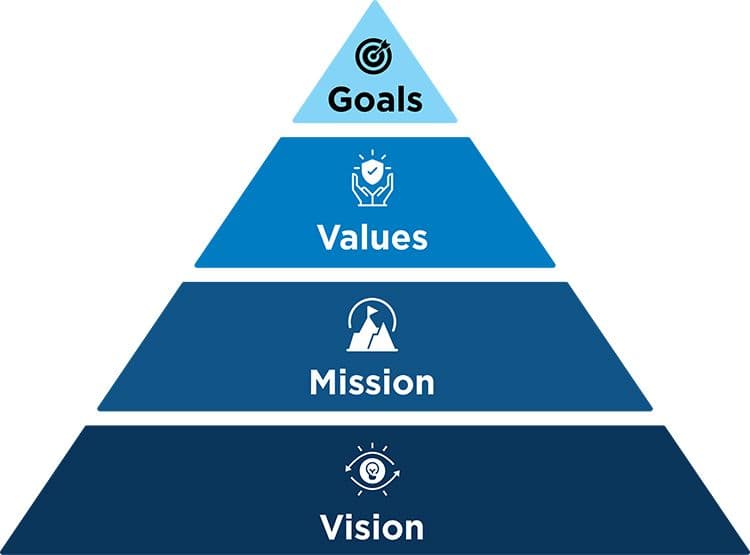
This guide can help your team through the process of developing or refining your system’s 1) vision, 2) mission, 3) values, and 4) goals. The figure below illustrates how these elements build upon each other to drive education systems change.
The vision serves as the foundation at the base of the pyramid, representing the hopes and dreams that school systems strive to achieve in their schools. Next up is the mission, or the element that (if already in place) should guide how school systems operate. Above the mission come values, which are more concrete guiding posts that ensure alignment between school systems change and mission; examples of values in schools include academic excellence, passion, and accountability. Finally, goals sit at the top of the pyramid. Goals are benchmarks for whether your team is on track with your school transformation vision and mission.
Figure: A school system’s vision is the base for other elements that drive education systems change
The next section defines all these elements and includes implementation examples to inform your education systems change journey. Throughout the section, “Learning Pause” boxes demonstrate each element in action using a fictionalized example.
Setting Your Vision, Mission, Values, and Goals
As you dive into strategic building, you should ask yourself some questions to ensure intentionality in your school transformation journey:
- What are our current vision, mission, values, and goals?
- How are these foundational elements aligned with one another?
- How do they align with the current needs of students, families, and communities served by our school system?
- What perspectives might be missing that could strengthen our vision, mission, values, and goals?
- What data should be considered in creating (or refining) our vision, mission, values, and goals?
Learning Pause 1
Superintendent Dr. Cambio has recently decided to evaluate her school district’s initiatives regarding teacher workforce development. Dr. Cambio has noticed (both anecdotally and with data) a lot of teacher turnover compared to five years ago. Due to this decline in teacher retention, Dr. Cambio is invested in helping her school district retain more teachers. Dr. Cambio reflects on the overall state of the teacher workforce as she begins her journey to transform engagement and retention of teachers.
[audio m4a="https://media.childtrends.org/media/LP-1.m4a"][/audio]
1Vision
A strong, shared vision aligns change efforts and ensures that everyone is moving toward the same future, sustaining momentum for long-term change. In other words, the vision is the aspirational future you aim to create. It describes where you want your education system to go and what success will look like when your mission is fully realized. A compelling vision provides the motivation and inspiration your team needs to move toward that shared future.
Examples of school district visions
- Anaheim Union High School District aims “to create a better world through Unlimited You.”
- “At Gilbert Public Schools we believe that every child can learn and grow in supportive school communities, built on strong relationships, with highly qualified caring adults committed to seeing them succeed.”
- Harris County Schools is “one community committed to the well-being and preparation of every student for life-long success in a global society.”
2Mission
A well-defined mission helps everyone in a system understand its purpose and align all efforts toward meaningful change. The mission is the driving force behind a system: It clearly defines why the system exists and what it seeks to accomplish. A well-defined mission statement provides focus and clarity. When a mission statement drives school systems, it can improve the likelihood that every decision, initiative, and action support the core purpose of the system’s work.
Examples of school district mission statements
- Buford City Schools’ purpose is “to empower all students to become globally competitive critical thinkers, innovative problem solvers, responsible individuals, and productive citizens.”
- Cajon Valley Mission-Vision-Promise (MVP): “These letters stand for our Mission, to make Cajon Valley the best place to live, work, play and raise a family; our Vision, to develop happy kids, living in healthy relationships on a path to gainful employment; and the 8 Promises that unify our efforts to deliver the best service to anyone that calls Cajon Valley home, whether as an employee, student, family or community member.”
- “Huerfano School District Re-1 provides a safe-learning environment and exceptional educational opportunities for all students to succeed in an ever changing world.”
Learning Pause 2
After reflecting with the school district team on the state of the educator workforce, Dr. Cambio works with them to create a plan of action. This process begins with reflection on the school district’s current vision and mission and how these incorporate educator engagement and retainment in the district. The current school vision and mission are as follows:
- Vision: At Interchange School District, we envision hands-on experiential learning experiences for students that propel students’ self-discovery and path to fulfilling careers.
- Mission: Interchange School District provides high-quality education and experiences to students in the city that prepare them to be engaged individuals in our schools and in the world.
After close review and reflection, the team realizes there is a gap in their school district’s vision and mission because these elements overlook educators’ roles in helping the district achieve its vision and mission. Educators’ roles in supporting students may be implied in the current vision and mission, but they are not explicitly stated. Dr. Cambio and the team work to refine these elements by examining vision and mission statements in districts where teacher retention is high and using these as examples.
[audio m4a="https://media.childtrends.org/media/LP-2-v2.m4a"][/audio]
3Values
Values are the principles that shape every decision in your education system. They reflect what is most important to you, your team, and the community you serve and influence how decisions are made and how people are treated. In other words, values are guides to making decisions. By grounding actions in their values with integrity and fairness, leaders can develop trust across the system with educators, students, families, and community members.
Examples of values from school districts
- Laramie County School District 1's values include:
- High expectations
- Shared responsibility
- Maximizing learning opportunities
- Human connection
- Comal Independent School District’s values include:
- Academic excellence
- Building partnerships between parents, guardians, and schools that create a strong community
- Fiscal responsibility while achieving academic excellence
- Traditions and pride that bring high expectations for all
- Keystone Oaks School District’s values include:
- Learning: Acquiring, processing, and retaining information for lifelong use
- Motivation: Achieving goals through personal drive
- Ownership: Having pride and taking responsibility for one’s actions and outcomes
- Passion: Sparking the emotional connection that ignites one’s passions
Learning Pause 3
Once Dr. Cambio’s district team settled on its refined vision and mission to include educators, they shared new language with educators, staff, families, and students throughout the district to get feedback and reactions. The refined vision and mission are as follows:
- Vision: At Interchange School District, we envision hands-on experiential learning experiences for students by equipping our educators to be change-makers who propel a spirit of self-discovery for themselves and their students and establish a path to fulfilling careers for students.
- Mission: Interchange School District provides high-quality education and experiences through supported educators who help the city’s students prepare to be engaged individuals in our schools and in the world.
Based on feedback and reactions, the team planned to finalize its refined vision and mission. After settling on final language, the district team began developing and setting values and goals. To establish values, the district team solicited feedback via a survey from educators across the school district, asking them what they find important in their students’ educational experiences and how they like to be engaged. This process ensures that the district’s decisions are representative of what educators need.
[audio m4a="https://media.childtrends.org/media/LP-3-v2.m4a"][/audio]
4Goals
Well-defined goals give your team clear benchmarks for success, helping everyone stay aligned and adjust as needed to drive continuous improvement. Goals turn your vision and mission into action: They are specific, measurable, and time-bound outcomes that give your team a clear path to follow. By setting clear, achievable goals, your team can stay focused, accountable, and on track to deliver meaningful improvements. It is important to note that goals can change or expand.
Examples of goals
- Increase the number of students reading at grade level by 15 percent within three years.
- Increase proficiency rates in math by 10 percent across all grade levels within two years.
- Increase family engagement by 20 percent by the end of the next school year.
- Implement a schoolwide social-emotional learning program in all grades within two years.
- Provide at least 20 hours of professional development per year focused on differentiated instruction.
- Increase teacher retention rates by 10 percent over the next three years.
Learning Pause 4
After finalizing the district’s educator workforce values—which include shared responsibility, maximizing professional development opportunities, and human connection—the district team joined a team of educators recruited via the feedback process to develop district goals around educator workforce development. The team is now focused on developing concrete and achievable goals to begin the district’s journey. Their goals include increasing educator workforce retention by 25 percent and involving educators in a range of committees across the district and schools to ensure that educator voices are included in important decision making. This journey spearheaded by Dr. Cambio will hopefully change the state of educator retention in the district.
[audio m4a="https://media.childtrends.org/media/LP-4.m4a"][/audio]
Conclusion
Strategic building and its foundational elements of vision, mission, values, and goals are critical to examine when beginning your school transformation journey. The main goal of strategic building is to help teams be intentional and use effective practices in their journeys. We hope this practice guide serves as an initial starting point for being strategic in your systems change journey.
Resources
- How to Make Mission Matter at Your School (developed by Danny Mucinskas & Shelby Clark at Harvard Graduate School of Education, 2022)
- Common Mission and Vision Strategy Guide v1 (developed by Colorado Department of Education)
- Co-Creating Your School's Core Values (developed by Robyn Jackson at ACSD, 2020)
- PELP Coherence Framework (developed by Stacey Childress, Richard Elmore, Allen Grossman, and Caroline King at Harvard Graduate School of Education, 2011)
Suggested citation
Aceves, L., Holquist, S., Schanfield, M., & Reyes, O. (2025). Strategically defining a school system’s vision, mission, values, and goals. Child Trends. DOI: 10.56417/1537n3765x