
State Tracking of Kinship Diversion Can Inform the Field
Child Trends interviewed 14 states to learn how they collect data on and track the practice of kinship diversion in their child welfare systems. Several states track kinship diversion, but vary in what data they track, how these data are tracked, and how usable these data are. While some states generate actionable information about kinship diversion practices, addressing the remaining data collection gaps will require coordinated action and sustained investment to make consistent data collection possible.
For over two decades, researchers, practitioners, and advocates have attempted to learn more about the practice of kinship diversion (see below) and its implications for the children and families who come to the attention of child welfare agencies. Little data are available about the practice, essentially creating a practice “black box” that makes it difficult to answer even the simplest questions, such as “What are the experiences of children and families who experience kinship diversion? What are their service and support needs? What are their outcomes and overall well-being?”
In 2022, Child Trends, with support from the Annie E. Casey Foundation, conducted a survey of state child welfare administrators (a follow-up to a 2007 survey) to understand the full landscape of kinship policies across states, including kinship diversion. Building off our findings from the 2022 survey, we interviewed 14 states that reported both engaging in kinship diversion practices and tracking these arrangements in their administrative data systems. With the right infrastructure and investment, data from these states could begin to fill critical knowledge gaps.
This brief presents what we learned about the data states collect that can identify and track kinship diversion arrangements, and explores the types of questions that such data can be used to answer. We also present data collection recommendations useful to researchers, practitioners, policymakers, and advocates.
Defining “kinship diversion”
While kinship diversion is a common practice,[1] there is no uniform definition of the practice across child welfare agencies. In our conversations with state child welfare administrators, we used the definition from our 2022 survey: a “facilitated kinship caregiving arrangement” in which, during a maltreatment investigation or while providing in-home services, a child cannot safely remain with their parent or guardian, in response to which the agency facilitates the child’s move to a relative or fictive kin while the parent retains legal custody. As we found in earlier studies, states use different terms when referring to this practice (e.g., voluntary kinship arrangements, temporary voluntary agreements, safety plans, temporary alternative placement agreement);[2] throughout this brief, we refer to these arrangements as kinship diversion.
There are varying views on the appropriateness of this practice, with discussions around elements such as lack of judicial oversight, the voluntary nature of kinship diversion, legal representation for kin and parents, and overall burden on kin.[3] Because the child welfare agency does not assume legal custody of the child in these arrangements, there is no judicial oversight; instead, decisions on who will care for the child(ren) rely on voluntary coordination among parents, kin, and the agency. In addition, there is no formal legal relationship between the kin caregiver and child and kin often lack legal representation to advocate for their role or for the child’s needs; they are often expected to meet children’s needs with varying levels of support. Although these arrangements preserve family decision making autonomy and children’s connections to family and community while limiting potentially intrusive system involvement,[4] they also limit agencies’ ability to monitor safety, create ambiguity for parents, and shift substantial caregiving and financial burdens onto kin without adequate support. [5],[6]
Persistent lack of data and information about diverted children and families
Across existing literature on kinship diversion (summarized in the text box below), there is a recurring theme of limited and inconsistent data tracking and monitoring.[7],[8] This limitation stems from a structural gap: Because parents retain legal custody in kinship diversion arrangements, federal reporting requirements do not mandate that jurisdictions track diverted children and families. Findings from interviews with public agency leaders and staff in 2013 found that few jurisdictions systematically track and examine the outcomes for children and families experiencing diversion.[9] As a result, there is wide variation (and incomplete data) in what is known about the prevalence of these arrangements, the services families receive, and families’ outcomes. Thus, child welfare advocates have increasingly promoted legislation that would require states to measure and publicly report on these arrangements[10] and highlighted the need to better understand what states already collect and how best to improve experiences and outcomes for diverted children and families. We address these needs in this brief by drawing on our conversations with states that already track kinship diversion arrangements, examining current data practices, and offering recommendations and research questions that states can answer using data already being collected.
What we know about kinship diversion practices and policies
While research is limited on kinship diversion practices and policies, three key themes emerge in the literature: 1) Kinship diversion is a common but varied practice; 2) limited system involvement does not equate to limited family needs; and 3) kinship diversion comes with a lack of legal clarity that may create uncertainty for kin caregivers, parents, and children.
Kinship diversion is common, but implementation varies.
While kinship diversion is described as a common practice in the field, studies that examine the actual number of children and families diverted are limited, leaving the field to rely on estimates. One earlier study found that an estimated 100,000 to 300,000 children each year are diverted.[11] Another found that, “in some jurisdictions for every 10 children entering foster care, an additional 7 were diverted, while in other jurisdictions estimates were as high as a one-to-one ratio of youth entering foster care to those diverted.”[12] Another estimate, based on a 2013 survey, found that “out of 2.2 million children in kinship care, 32% of children (approximately 700,000) were in some form of voluntary kinship care/kinship diversion.”[13]
Studies conducted over the past decade have found that kinship diversion practice—including its structure and implementation—varies widely across states. Our 2022 survey found variation in whether investigations are conducted or completed, cases are opened, case monitoring occurs, time limits are imposed, and court oversight is required or provided for diversion cases.[14] Similarly, other research has found differences in practices such as family meetings related to diversion, assessments of kin’s suitability as caregivers,[15] whether arrangements are tracked in state data systems,[16] and what supports are available to caregivers.[17]
Limited system involvement does not equate to limited needs.
Broadly, kinship care has been found to positively impact child well-being and development, including via stronger familial and cultural connections and greater placement stability.[18] However, for children in kinship diversion arrangements specifically, the informal nature of these placements creates significant challenges for kin, youth, and parents. Research shows that diverted children often have similar levels of need and risk as those in formal foster care,[19] yet diverted families receive less financial support and limited access to services (e.g., mental health and social supports and case management).[20] While diversion means parents retain legal custody of their children, without adequate resources and legal decision-making authority on behalf of the youth in their care, kin caregivers face additional barriers and challenges in navigating the best way(s) to meet the child’s needs and balance the new family dynamic(s) created by these arrangements, which can impact child and family outcomes.
Lack of legal clarity creates uncertainty for kin caregivers, parents, and children.
Because kinship diversion arrangements are informal at the outset, kin often lack both legal custody and decision-making authority on behalf of the child (e.g., medical and educational). As a result, child welfare agencies have no obligation to support family reunification—potentially leaving families in long-term temporary arrangements without the supports needed for permanency.[21],[22] The lack of formal involvement and monitoring also makes it difficult to assess child safety and physical and emotional well-being,[23] raising legal concerns for agencies given their limited duties to children not in state custody and exposing them to liability if diversion occurs without adequate preparation or scrutiny. [24]
Methods
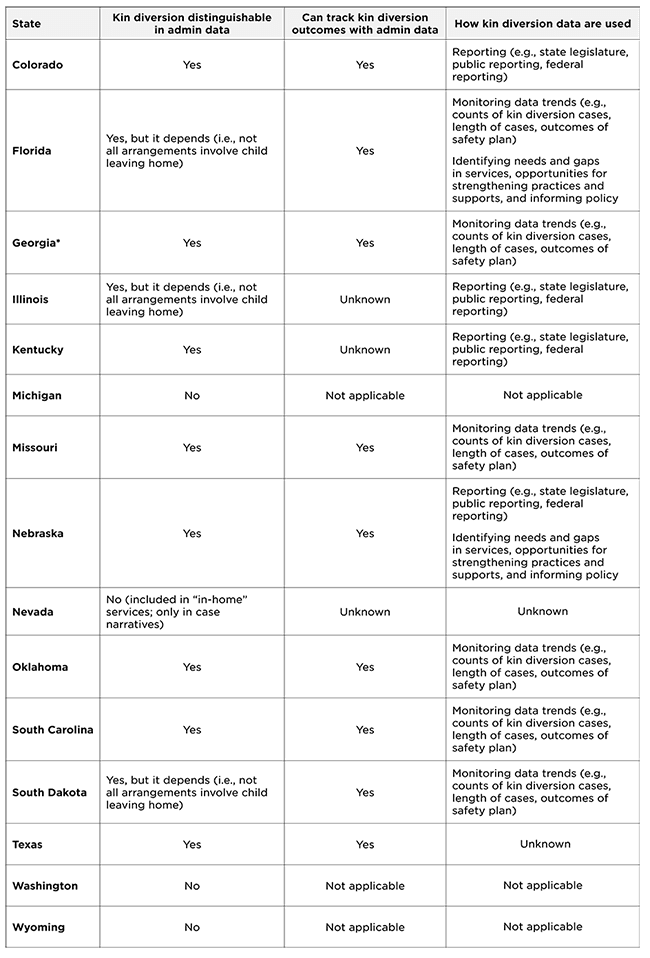
Fourteen states reported on the 2022 Kinship Policy Survey that they track kinship diversion arrangements in their administrative data systems, with an additional three states reporting that “It depends” whether they track or not. In August 2025, we reached out to these 17 states and conducted interviews with 14 from August to October 2025.[a] One additional state provided responses via email for a total of 15 conversations or email exchanges. Our sample was geographically and politically diverse, varied by system structure (e.g., county- and state-administered systems), and included urban and rural states. We provide a table presenting select state-level responses at the end of this brief. As discussed in the Family Ties: Analysis from a State-By-State Survey of Kinship Care Policies brief on state kinship diversion policies, specifics of kinship diversion arrangements vary across states.[25] We confirmed during our 2025 discussions that 14 of the 15 states[b] have some sort of kinship diversion arrangement where a parent is offered support from the agency yet retains legal custody of the child (e.g., safety plans, informal arrangements, voluntary placement arrangements). Please see Appendix 1 for a summary of state responses to our interview questions.
Overarching Themes
Distinguishing between kinship diversion and placements involving custody
Eleven states reported that their data systems can distinguish between diversion arrangements and placements wherein the agency takes custody of the child. In three of the states we spoke with, diversion arrangements are nested within broader categories of alternative arrangements that may not always involve the child leaving the home. For example, a safety plan could involve a child going to stay with a relative until safety issues in the home are resolved, or it could involve a relative or other supportive adult kin moving into the child’s home or being present during times of high stress or need (e.g., after-school time). These states are unable to capture this degree of specificity in their data systems and spoke to the fluidity of these arrangements, with children sometimes moving back and forth between their parents and kin.
The remaining eight states specifically reported that their data capture whether the child leaves the home. These eight states vary in whether they track if, at some point, the agency takes custody of the child. For example, Colorado tracks each case through service authorization categories (e.g., non-DHS custody kinship versus DHS custody kinship). If the diversion arrangement results in the child entering foster care, the existing service authorization would close and a new one (of a different type) would be created/opened. In Kentucky, diversion cases are distinguishable through the type of custody (e.g., safety plan placement, temporary custody, power of attorney) field. In other states, it may be necessary to look across data tables or datasets to determine a diversion arrangement versus child welfare custody-involved placement. For example, in Nebraska, diversion arrangements are tracked in different “screens” or modules in the state’s SACWIS system. For a child moving from a diversion arrangement to formal placement, the child’s “program type” would change from an assessment case to a court program case, which requires the case worker to enter a placement type in the placement screen. In Oklahoma, these cases are distinguishable by looking at both the family’s case type and status.
Tracking kinship diversion as an in-home service
Ten states reported tracking kinship diversion arrangements within their in-home services caseload, indicating that children and/or their parents in such arrangements may be receiving services. However, the intensity or dosage of these services varies; further, as discussed above, not all data systems can distinguish whether the child leaves the home. For example, in our interviews we learned that Illinois negotiated with the Administration for Children and Families (ACF) to remove Extended Family Support Program cases—which include but are not limited to diversion arrangements—from the in-home services population as part of the state’s Round 4 Child and Family Services Review (CFSR). The rationale for removing them from the in-home services population was that families were receiving minimal, short-term services that were not intensive enough to affect CFSR outcomes. In South Dakota, Present Danger Plans—short-term plans to keep children safe when they have been identified through an assessment as at-risk of harm or danger—are considered in-home cases, but not all children with these plans are living with kin and their data cannot distinguish these situations. Furthermore, this information is captured in narrative case planning documents, which can be difficult to extract for analysis.
Data quality concerns
While not a question in our interview protocol, two states specifically mentioned concerns about data quality. These concerns commonly stem from the fact that the fields that capture data on kinship diversion are not required-entry fields or because the way in which information is entered into the state’s SACWIS/CCWIS system does not allow for capturing some of the nuance necessary to distinguish the diversion arrangements. For example, in Nebraska, a child may only remain in a diversion arrangement for two weeks while the data show that children were in these arrangements for three months because the case is not closed in the system until the assessment period closes. Kentucky reported that it may have data quality issues because information on kinship diversion is not monitored as closely as formal out-of-home placements, which are tied to financial payments. On the other hand, Missouri said it has specific policy language pursuant to Section 210.123 of the Revised Statutes of Missouri that directs how Temporary Alternative Placement Agreements (TAPA) are tracked and entered in its SACWIS system.
The length of time that states have tracked diversion arrangements was also discussed as a factor impacting data quality. For example, Colorado expects the quality of its data to improve as it continues to implement new legislation related to kinship care and diversion arrangements. In other states, it has taken time for case workers to be trained on entering kinship diversion-related information into their SACWIS/CCWIS system.
States’ varied use, or potential use, of data on kinship diversion
Several states produce data reports on kinship diversion for their legislature, while other state agencies use the reports internally for monitoring purposes. Both types of reporting are intended to track the number of diversion arrangements, monitor outcomes (e.g., duration, reunification rates, removal rates), or identify gaps in children’s and families’ needs. Legislative reports monitor implementation of new policies, as in Colorado, where the Department of Human Services (DHS) is mandated by SB24-008 (passed in 2024) to report “data on the permanency outcomes, length of stay, re-entry into care, and all other outcomes collected for children/youth in out-of-home placements.” This mandate was due, in part, to a temporary program (now rescinded) that offered financial assistance to caregivers in diversion arrangements and the need to track financial disbursements. Kentucky officials said that they began reporting to their legislature in 2018 on how many kin in diversion arrangements become approved foster parents versus seeking temporary guardianship.
Spotlight on Colorado
Colorado demonstrates what we can learn when administrative data systems track diversion arrangements in a way that allows us to distinguish between kinship diversion and formal custody placements. Under SB24-008, the Department of Human Services (DHS) is required to collect and report data on children placed with kin (certified and non-certified kin placements) through a dependency and neglect case, regardless of who has custody of the child.
DHS distinguishes between three types of kinship care: Non-Certified Kinship Care (non-DHS custody), Non-Certified Kinship Care (DHS custody), and Kinship Family Foster Care (DHS custody). The first type, Non-DHS custody kinship care, is what we consider a diversion arrangement in which the kinship caregiver has not been certified as a foster parent and the child is in the legal custody of someone other than the county department—typically either the parent(s) or kinship caregiver. There may be an open dependency and neglect case or there may be a non-court-involved case open.
DHS’ 2024-2025 legislative report provides valuable insights into the types of questions we can answer about children in kinship diversion arrangements and their outcomes. For example, during the reporting period, children in diversion arrangements had the highest return home rate (41%) of all three types of kinship placements (see Table 1), a reunification rate comparable to the national average of 47 percent for all children in care, regardless of placement type.[c] DHS also reports on length of stay for children living with kin (see Table 2). While most children in kinship diversion arrangements are in those arrangements for less than 90 days (60%), almost 1 in 4 remain with their relatives for more than six months.
Table 1. Placement outcomes among children whose placement ended during the reporting period (September 2024–June 2025), by type of kinship placement
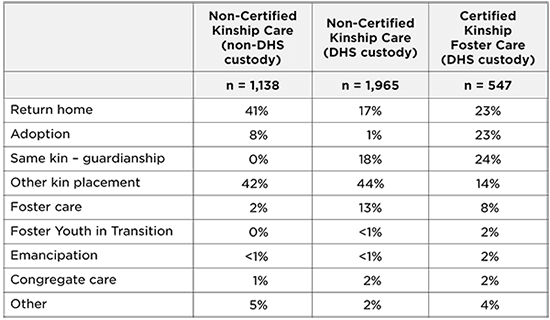
Source: From Kinship Placement Related Data State Fiscal Year 2024-2025 report, Colorado Office of Children, Youth & Families Division of Child Welfare, 2025.
Table 2. Length of stay among children whose placement ended during the reporting period (September 2024–June 2025), by type of kinship placement
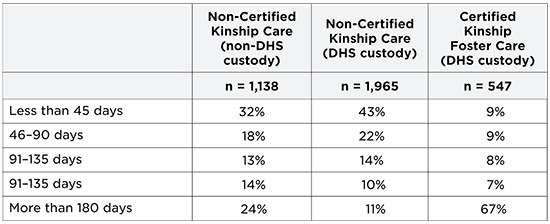
Source: From Kinship Placement Related Data State Fiscal Year 2024-2025 report, Colorado Office of Children, Youth & Families Division of Child Welfare, 2025.
Recommendations for Using Data to Learn About Kinship Diversion
Our findings reveal that several states track kinship diversion, but with variation in what data they track, how they track these data, and the usability of these data. At the same time, a core group of states have built data infrastructure that is already generating actionable information about kinship diversion outcomes, demonstrating what is possible with the right systems and policy supports in place. Addressing the remaining gaps will require coordinated action across multiple levels (e.g., federal policy, state administrative data systems, the research community) and sustained investment in the tools and supports that make consistent data collection possible. The following recommendations are grounded in our interview findings and directed at researchers, practitioners, policymakers, and advocates working to strengthen the evidence base on kinship diversion and improve outcomes for children and families.
Research recommendations
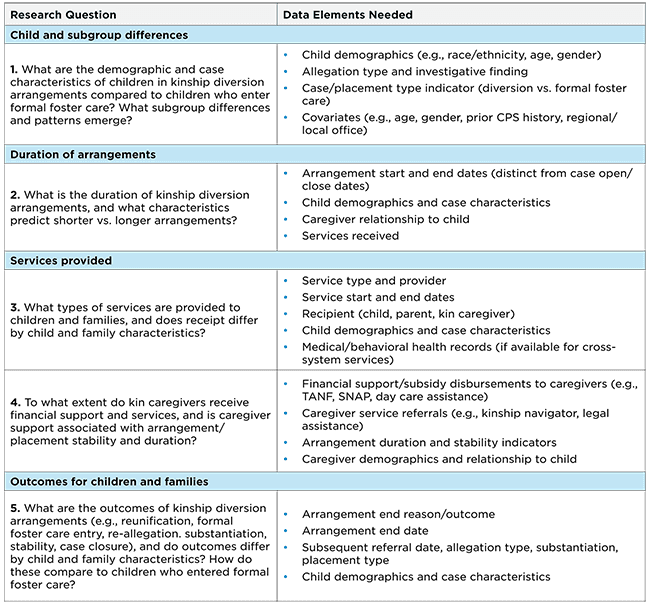
Despite child welfare agencies’ use of kinship diversion, the research base on the practice remains thin, due in large part to the lack of administrative data. Our findings suggest that a small number of states now have sufficient data infrastructure to begin answering foundational questions about kinship diversion. Researchers can answer the following research questions using currently collected data and could begin to generate the evidence base needed to better understand kinship diversion practices and outcomes. Such evidence can then be used by policymakers and advocates to inform the implementation of the policy and technical assistance recommendations discussed below.
Table 3. Recommended research questions
Policy recommendations
Our interviews reveal that the absence of consistent definitions, required data fields, and standardized reporting requirements have produced a fragmented and incomplete understanding of kinship diversion practices. Policy direction at the federal and state levels could establish accountability structures that make kinship diversion arrangements visible and measurable. Below, we present recommendations to advance consistent data collection that facilitates a better understanding of kinship diversion practice(s).
Potential actions for ACF/Children’s Bureau
- Develop and issue an Information Memorandum that clarifies how kinship diversion arrangements could be classified for purposes of reporting and encourage states to report the number of children in diversion arrangements, the duration of arrangements, allegation type and any applicable case finding that led to the arrangement (e.g., substantiated, unfounded), case outcomes (e.g., reunification, custody to kin), and subsequent child welfare involvement (e.g., repeat allegations). Our interviews found inconsistent capturing of these data elements, even among states that track diversion. Federal guidance can help even out these inconsistencies.
- Commission or support a study of kinship diversion prevalence and outcomes. Given that we identified states with the data infrastructure to support research on kinship diversion practices and outcomes experienced by children and families, we think such a study is both feasible and timely.
Potential actions for states
- Establish a clear, written administrative definition of kinship diversion that distinguishes it from both formal foster care and standard in-home services cases or other voluntary placement agreements. Definitional ambiguity was the single most common source of inconsistency across our interviews, and a documented administrative definition is a low-cost step states can take to establish clear policy boundaries and enhance data quality.
- Configure administrative data systems to document the child’s living arrangement along with start and end dates—in a way that is distinct from case open and close dates—to allow for more accurate tracking and reporting. This recommendation responds directly to a situation we documented in Nebraska, where a child's two-week diversion arrangement appeared in the state’s administrative data system as lasting three months because the case was not closed until the broader assessment period ended.
- Designate kinship diversion as a distinct case type or service category in administrative data systems with required fields to improve data quality for monitoring, research, and evaluation purposes. Collection of services data for kinship diversion arrangements would allow for a better understanding of the effects of different services on outcomes for children in these arrangements. However, this information is only useful if collected consistently: Our interviews found that data quality problems regularly trace back to optional fields. Kentucky officials reported this directly, noting that diversion data are not monitored as closely as formal placements, which are tied to financial payments.
- To enable comparison and monitoring of case outcomes, produce regular internal reports on kinship diversion that mirror the reports produced for children in formal foster care. Several states in our sample already use diversion data this way, suggesting this is an achievable near-term step for states with at least some existing tracking infrastructure.
Technical assistance (TA) recommendations
The following recommendations identify areas where investment in tools, training, and peer learning resources would yield improvements in states' ability to track and report on kinship diversion.
- Create a "readiness assessment" tool that states can use to evaluate their current capacity to track and report on kinship diversion that would serve as a roadmap for needed infrastructure investments. Such an assessment—for which our interview questions provide a starting point—could be a structured self-evaluation that walks an agency through the specific capacities we identified in our interviews as necessary to track kinship diversion.[d] For example, based on factors that differentiated capable from less capable states in our interviews, the assessment could be structured around definitional clarity, case identification and classification, required versus optional data fields, duration and timeline accuracy, and outcome and longitudinal tracking.
- Provide targeted TA to states that can track diversion but cannot yet distinguish it from other placements. This is a “low-hanging fruit” approach that could make existing unusable data usable, easily expanding the number of states able to monitor the outcomes of children and families in diversion arrangements. TA could focus on helping states implement the data-related policy recommendations above. For example, TA could help a state diagram their data systems to identify the best way (or place) in which to capture all possible living arrangements, as well as arrangement start and end dates.
- Establish communities of practice or peer learning groups in which states can learn from one another how to begin or improve existing tracking of kinship diversion arrangements. Our interviews surfaced a natural set of peer leaders—Colorado, Missouri, Nebraska, and South Carolina—whose data systems and reporting practices could offer concrete starting points for other states interested in building out their data tracking capabilities.
- Develop profiles of states with strong tracking infrastructure that can serve as peer learning resources. The eight states we identified as having distinguishable diversion data each took a different technical approach (e.g., service authorization categories in Colorado, custody-type fields in Kentucky, separate system screens in Nebraska). Detailed profiles of these approaches would give other states concrete models rather than abstract guidance.
Conclusion
Results from the 2022 Kinship Policy Survey indicate that kinship diversion is occurring in many states, some of which are tracking such arrangements. In the follow-on work discussed in this brief, we learned more about states that have built the data infrastructure and capacity needed to identify children in these arrangements and report on their outcomes. With the right investments in data infrastructure, federal and state policy alignment, and peer learning across states, the field can begin to fill gaps in knowledge about kinship diversion to the benefit of the children and families being served.
2007
Child Trends conducts the first-ever Kinship Policy Survey of state child welfare agencies. The survey includes a series of questions about kinship diversion. Child Trends publishes a report highlighting the findings.
https://www.childtrends.org/publications/state-kinship-care-policies-for-children-that-come-to-the-attention-of-child-welfare-agencies
2010
Child Trends conducts interviews with practitioners working with kin, public child welfare officials, judges and attorneys, researchers, and advocates to learn more about kinship diversion practice and perspectives on the practice.
2013
The Annie E. Casey Foundation publishes The Kinship Diversion Debate: Policy and Practice Implications for Children, Families and Child Welfare Agencies. (The report includes findings from interviews conducted in 2010 by Child Trends).
https://www.aecf.org/resources/the-kinship-diversion-debate
2013
The Annie E. Casey Foundation publishes Kinship Process Mapping: A Guide to Improving Practice in Kinship Care.
https://www.aecf.org/resources/kinship-process-mapping-full
2013
The Annie E. Casey publishes a User’s Guide to Essential Kinship Data.
https://www.aecf.org/resources/users-guide-to-essential-kinship-data
2016
Child Trends conducts a qualitative study of kinship diversion in one state. Child Trends publishes a research brief presenting the study’s findings.
https://www.childtrends.org/publications/a-qualitative-research-study-of-kinship-diversion-practices-2-2
2019
Child Trends develops a tool for child welfare agencies to use to determine the extent to which kinship diversion is occurring. Child Trends publishes the Kinship Estimation Tool (and accompanying Guide) for agencies.
https://www.childtrends.org/publications/does-your-child-welfare-agency-divert-children-to-kin-guide-using-kinship-diversion-estimation-tool
2019
Child Trends administers the kinship diversion estimation tool and analyzes child welfare administrative data in multiple jurisdictions. Child Trends publishes a research brief which highlights the findings.
https://www.childtrends.org/publications/variations-use-kinship-diversion-among-child-welfare-agencies-early-answers-important-questions
2022
Child Trends conducts the second Kinship Policy Survey of state child welfare agencies. The survey covers a wide array of topics related to kinship care policies including a series of questions specific to kinship diversion.
2024
The Annie E. Casey Foundation publishes Family Ties: Analysis from a State-by-State Survey of Kinship Care Policies, a six-part series of briefs, one of which presents kinship diversion findings from the 2022 Kinship Policy Survey.
https://www.aecf.org/resources/new-insights-on-state-kinship-diversion-policies
2025
Child Trends conducts discussions with the subset of states responding to the Kinship Policy Survey that their state tracks kinship diversion. Child Trends shares findings from the discussions with Annie E. Casey.
2026
Child Trends publishes State Tracking of Kinship Diversion Can Inform the Field, a brief highlighting findings from the discussions with state officials about tracking kinship diversion. Recommendations are presented to inform future research, policy, and technical assistance to states related to how to collect and report data on kinship diversion.
Suggested citation: Williams, S.C., Malm, K., & Ball, J. (2026). State tracking of kinship diversion can inform the field. Child Trends. 10.56417/7638m8071z
References
[a] Alabama and Louisiana did not respond to our request for an interview.
[b] On the 2022 Kinship Policy survey, Wyoming responded that it tracks kinship diversion in its administrative data system as in-home services cases. In the state’s response to our request for an interview, it clarified that while the arrangements are tracked, the information is not captured in a way that is easily reportable; the state further indicated that the 2022 survey responses may not have been accurate.
[c] This report does not include a comparison to children in non-kinship care placements.
[d] Please contact Sarah Catherine Williams at swilliams@childtrends.org for more information.
[1] Casanueva, C.C., Smith, K.E., Ringeisen, H., Testa, M., Dolan, M. & Burfeind, C. (2023). Services to support children involved with the child welfare system. OPRE Report #2023-039. Office of Planning, Research and Evaluation, Administration for Children and Families, U.S. Department of Health and Human Services.
[2] Malm, K., Sepulveda, K., & Abbott, S. (2019). Variations in the use of kinship diversion among child welfare agencies: Early answers to important questions (2019-34). Child Trends. https://www.childtrends.org/publications/variations-use-kinship-diversion-among-child-welfare-agencies-early-answers-important-questions
[3] Annie E. Casey Foundation. (2013). The kinship diversion debate: Policy and practice implications for children, families and child welfare agencies. https://assets.aecf.org/m/resourcedoc/KinshipDiversionDebate.pdf
[4] Malm, K., Sepulveda, K., & Abbott, S. (2019). Variations in the use of kinship diversion among child welfare agencies: Early answers to important questions (2019-34). Child Trends. https://www.childtrends.org/publications/variations-use-kinship-diversion-among-child-welfare-agencies-early-answers-important-questions
[5] Schwartz, A. & Krebs, C.E. (2020). Addressing hidden foster care: The human impact and ideas for solutions. American Bar Association. https://www.americanbar.org/groups/litigation/resources/newsletters/childrens-rights/addressing-hidden-foster-care-the-human-impact-and-ideas-for-solutions/
[6] Gupta-Kagan, J. (2020). America's hidden foster care system, Stanford Law Review, 72, 841-913. https://scholarship.law.columbia.edu/faculty_scholarship/3588
[7] Spindel, M. P., Stekler, B. A., & McClellan, S. R. (2018). Kinship diversion in the District of Columbia: A review of local practice to inform national policy. GrandFamilies: The Contemporary Journal of Research, Practice and Policy, 5(1). DOI: https://doi.org/10.15453/3067-3674.1067
[8] Gupta-Kagan, J. (2020). America's Hidden Foster Care System, Stanford Law Review, 72, 841-913. https://scholarship.law.columbia.edu/faculty_scholarship/3588
[9] The Annie E. Casey Foundation. (2013). The kinship diversion debate: Policy and practice implications for children, families, and child welfare agencies. https://assets.aecf.org/m/resourcedoc/KinshipDiversionDebate.pdf
[10] Tiano, S., Suggs, B. (2024). Federal lawmakers want to track hidden foster care. The Imprint. https://imprintnews.org/top-stories/federal-lawmakers-want-to-track-hidden-foster-care/255390
[11] Walsh, W. (2013). Informal kinship care most common out-of-home placement after an investigation of child maltreatment. Carsey Institute.
[12] Malm, K., Sepulveda, K., & Abbott, S. (2019). Variations in the use of kinship diversion among child welfare agencies: Early answers to important questions (2019-34). Child Trends. https://www.childtrends.org/publications/variations-use-kinship-diversion-among-child-welfare-agencies-early-answers-important-questions
[13] Casanueva, C.C., Smith, K.E., Ringeisen, H., Testa, M., Dolan, M. & Burfeind, C. (2023). Services to support children involved with the child welfare system. OPRE Report #2023-039. Office of Planning, Research and Evaluation, Administration for Children and Families, U.S. Department of Health and Human Services.
[14] The Annie E. Casey Foundation. (2024). New insights on state kinship diversion policies. https://www.aecf.org/resources/new-insights-on-state-kinship-diversion-policies
[15] Malm, K., Sepulveda, K., & Abbott, S. (2019). Variations in the use of kinship diversion among child welfare agencies: Early answers to important questions (2019-34). Child Trends. https://www.childtrends.org/publications/variations-use-kinship-diversion-among-child-welfare-agencies-early-answers-important-questions
[16] The Annie E. Casey Foundation. (2024). New insights on state kinship diversion policies. https://www.aecf.org/resources/new-insights-on-state-kinship-diversion-policies
[17] Malm, K., Sepulveda, K., & Abbott, S. (2019). Variations in the use of kinship diversion among child welfare agencies: Early answers to important questions (2019-34). Child Trends. https://www.childtrends.org/publications/variations-use-kinship-diversion-among-child-welfare-agencies-early-answers-important-questions
[18] Child Welfare Information Gateway. (2022). Kinship care and the child welfare system. U.S. Department of Health and Human Services, Administration for Children and Families, Children's Bureau. https://www.childwelfare.gov/resources/kinship-care-and-child-welfare-system/
[19] Ehrle, J., Geen, R., & Main, R. (2003) Kinship foster care: Custody, hardships, and services. The Urban Institute.
[20] Casanueva, C.C., Smith, K.E., Ringeisen, H., Testa, M., Dolan, M. & Burfeind, C. (2023). Services to support children involved with the child welfare system. OPRE Report #2023-039. Office of Planning, Research and Evaluation, Administration for Children and Families, U.S. Department of Health and Human Services.
[21] Alliance for Children’s Rights. (2020). The human impact of bypassing foster care for at-risk children: Building a continuum of support for families diverted. https://allianceforchildrensrights.org/wp-content/uploads/PolicyReport_HiddenFosterCare_2-2020.pdf
[22] Schmidt, M. (2022). The hidden foster care system: A parallel system in legal limbo during a deadly pandemic. University of Miami Race & Social Justice Law Review, 12(1). https://repository.law.miami.edu/umrsjlr/vol12/iss1/8
[23] Spindel, M. P., Stekler, B. A., & McClellan, S. R. (2018). Kinship diversion in the District of Columbia: A review of local practice to inform national policy. GrandFamilies: The Contemporary Journal of Research, Practice and Policy, 5(1). DOI: https://doi.org/10.15453/3067-3674.1067
[24] The Annie E. Casey Foundation. (2013). The kinship diversion debate: Policy and practice implications for children, families and child welfare agencies. https://assets.aecf.org/m/resourcedoc/KinshipDiversionDebate.pdf
[25] The Annie E. Casey Foundation. (2024). New insights on state kinship diversion policies: Part three of family ties: Analysis from a state-by-state survey of kinship care policies. https://www.aecf.org/resources/new-insights-on-state-kinship-diversion-policies