


Recent Child Trends analysis of new national survey data points to a clear takeaway: Parents are most likely to rely on and trust information about their child’s education when it comes directly from their school.
This finding is consistent with our earlier exploratory work that focused on how parents seek and use education research, which included a review of existing research, informal conversations with parents, and social listening across online platforms. In this initial work, we found that parents want credible, practical information to guide their decisions, but that research is often hard to find or interpret in ways that they feel is relevant to their day-to-day experiences.
The new survey data provide a quantitative look at these patterns. Nearly eight in 10 parents (78.3%) reported that they seek information about their child’s education at least monthly. When asked which sources they use, school-based communications were the most commonly used source by a substantial margin.
2 in 3 parents seeking information about their child’s education reported using communications from their school
Percentage of parents reporting that they access each source when looking for information to make a decision about their child’s education
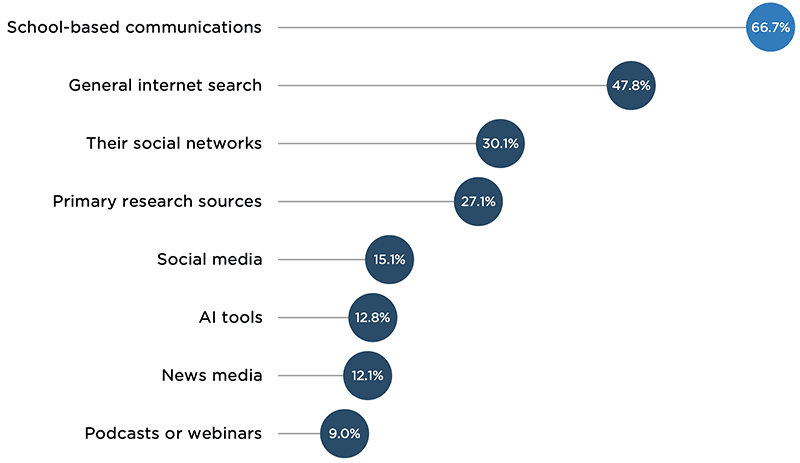
Source: Child Trends analysis of data collected through the AmeriSpeak® panel, a nationally representative, probability-based survey panel of U.S. households. Weighted data are aligned with Current Population Survey benchmarks from the U.S. Census Bureau (n=1,025).
Patterns of parents’ trust in information about their child’s education mirror these trends. Forty-three percent of parents identified school-based communications as the source they trust most—more than double any other category. Very small proportions selected social media, news, or artificial intelligence (AI) tools as their most-trusted source, and nearly half (42.9%) reported social media as the source they trust least.
These findings suggest that schools and districts are the primary communication channel through which families both access and trust education information. Although a meaningful share of parents reported using education research directly, many appear to prefer receiving information that has already been curated and contextualized by trusted school staff.
Schools are the bridge between research and parents: When researchers and schools work together, parents are more likely to receive information they trust and feel confident using to make decisions about their child’s education.
For researchers, these findings point to the importance of working alongside schools and districts as partners in sharing research with parents. When materials are co-created with school staff and designed to fit naturally within existing communication channels, parents are more likely to receive information that they recognize as trustworthy and connected to their real decisions.
In short, schools are the bridge between research and parents. When researchers and schools work together, parents are more likely to receive information they trust and feel confident using to make decisions about their child’s education.
To learn more about our research on how parents seek, interpret, and use information about their children’s education, contact Claire Kelley at ckelley@childtrends.org.
Methods
This survey was administered through AmeriSpeak®, a nationally representative survey panel of U.S. households, created and operated by NORC at the University of Chicago. AmeriSpeak uses probability-based sampling methods in which households are randomly selected with a known chance of inclusion, rather than relying on self-selected or convenience samples. This survey was designed to provide scientifically rigorous and representative insights into the experiences and opinions of U.S. parents and caregivers of children ages 5–18. Data were collected in December 2025 using both an online survey and telephone interviews. The final sample included 1,025 parents and caregivers. Survey weights were applied to align the sample with demographic benchmarks from the U.S. Census Bureau’s Current Population Survey including sex, age, education, race/ethnicity, and region. Results for this survey are presented as weighted descriptive statistics generated based on these probability weights.
Suggested citation
Kelley, C. & Holquist, S.E. (2026). Parents trust school communications about education far more than AI, social media, or news. Child Trends. DOI: 10.56417/8643p497c