



A new Child Trends analysis of federal data[1] shows that parental drug use is a factor in roughly one in three children’s entry into foster care, although the rate of children entering care for this reason is at its lowest since 2009. These findings update our 2019 analyses of trends in foster care entries associated with parental drug abuse from 2007-2017. Since then, we’ve seen changing trends related to drug use and overdoses, foster care entries, and state and federal child welfare policy. This blog explores recent trends in foster care entries associated with parental drug use and the broader policy and social contexts that may play a role.
Annual overdose deaths increased tenfold from 1998 (~9,800 deaths) to 2022 (~105,000 deaths), largely attributed to the opioid epidemic. Research has pointed to the opioid epidemic as a key driver of increased child welfare system caseloads and foster care entry rates. Overdose deaths were still rising as of our 2019 blog, but the number of fatal overdoses began decreasing slightly in 2021. The rate of children entering foster care for parental drug use had also trended upward from 2007 to 2017, but today we see a different pattern: This rate has now decreased each year since 2017 (Figure 1). The decrease mirrors the overall decline in the number of children entering foster care for any reason—from nearly 270,000 children in 2017 to around 170,000 in 2024.
However, looking at foster care entry data in another way offers a different perspective. Figure 1 shows that the proportion of children who entered foster care due to parental drug use increased from 22 to 36 percent from 2007-2017; that proportion has since fluctuated only slightly, from 33 to 36 percent from 2017-2023. In other words, while fewer children entered foster care in recent years, parental drug use continues to be a contributing factor for one in three children. As such, addressing challenges related to parental drug use remains a key task for the child welfare system.
Figure 1. Since 2017, parental drug use has remained a top reason for foster care entries, although the rate of entry for this reason has dropped
Rates and proportions of foster care entries due to parental drug use, 2007-2023
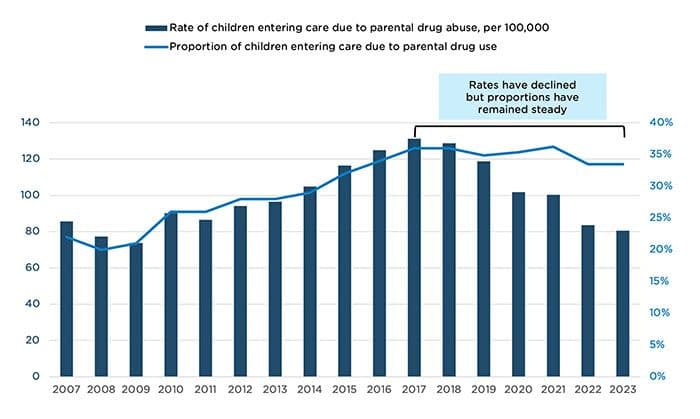
Source: Child Trends analysis of federal Adoption and Foster Care Analysis and Reporting System (AFCARS) data, representing children (ages 17 and under) who entered care during each federal fiscal year. Rate is per 100,000 children in the general population, calculated with U.S. Census Bureau data (publicly available via Kids Count Data Center).
At the state level, the proportion of children entering foster care in 2023 due to parental drug use varied widely (Figure 2), from under 1 percent to 60 percent. In five states (Utah, Texas, Indiana, Oregon, and Oklahoma), over half of foster care entries were related to parental drug use, compared to less than 3 percent in Louisiana and South Carolina. This variation not only reflects differing levels of parental drug use, but also state-level variation in policies and practices at the intersection of child welfare and drug use, as well as data reporting practices (e.g., some states categorize parental drug use as “neglect”).
Figure 2. The percentage of foster care entries due to parental drug use varies considerably by state (FY2023)
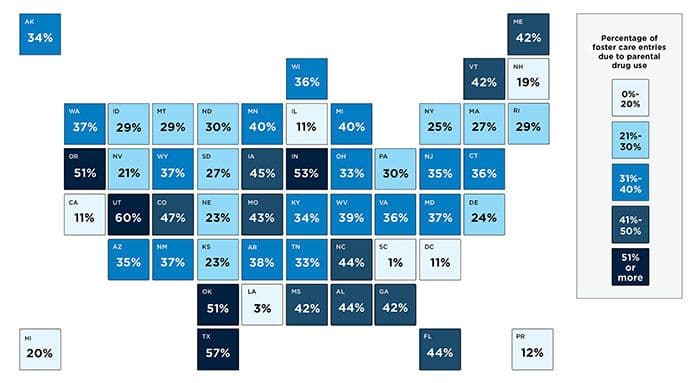
Source: Child Trends analysis of FY2023 AFCARS data; see note under Figure 1 for details.
Parental drug use is just part of the puzzle, though. States also vary on several indicators of population-level drug use, including the percentage of adults who report recent illicit drug use, past-year substance use disorders, and both fatal and nonfatal overdoses (find your state’s data here). There are no clear and immediately apparent patterns between states’ levels of adult drug use and foster care entries for parental drug use, which reflects two complicated realities. First, parental drug use is often one of many challenges that lead to child welfare system involvement. Our analysis of 2023 AFCARS data finds that, among children entering foster care due to parental drug use, just 27 percent had no other listed reasons for entering care; among children who did have additional reasons listed, neglect (81%), inadequate housing (25%), and parental incarceration (13%) were common. Second, state-level variation also results from differences in states’ legal definitions of maltreatment and in reporting, screening, and assessment policies. Further, studies find that states with more punitive policies related to prenatal drug use have higher rates of substantiated maltreatment reports and foster care entries—and that such policies may discourage parents from seeking help.
Many of the challenges facing families affected by substance use that we described in 2019 remain relevant today. While research shows that parental substance use treatment can promote reunification, treatment can be difficult to access and recovery timelines may be incompatible with reunification timelines set by the child welfare system. The 2018 Family First Prevention Services Act (FFPSA) aimed to help states prevent child removals by offering federal reimbursement for prevention services, including substance use treatment; however, FFPSA implementation is not without challenges. For instance, FFPSA only allows states to seek reimbursement for programs that are reviewed and rated by the Title IV-E Prevention Services Clearinghouse; as of late 2025, only 15 substance use treatment programs are eligible (compared to 31 eligible mental health programs), demonstrating a disconnect between the child welfare and substance use fields.
Fortunately, researchers and policymakers continue to explore safe, feasible, and innovative options for treating parental drug use while keeping families together. Researchers, practitioners, and people with lived experience are working together to understand parents’ experiences navigating recovery and child welfare systems simultaneously, and to holistically address risk factors for maltreatment and foster care entry (e.g., Family Treatment Courts; Family Resource Centers; coordination among child welfare and other systems). Research confirms that most parents—even those who struggle with drug use, fear the repercussions of seeking help, or find themselves in the child welfare system—want to be the best parents they can be. Thoughtful data collection and analysis can help researchers and policymakers support parents in doing just that.
Footnote
[1] The authors analyzed federal Adoption and Foster Care Analysis and Reporting System (AFCARS) data, representing children (ages 17 and under) who entered care during each federal fiscal year.
Suggested Citation
Williams, S.C., Mihalec-Adkins, B.P., & Sepulveda Muñoz, K. (2026). Parental drug use remains a top reason for foster care entries. Child Trends. DOI: 10.56417/1525e9677w