

This product was partially developed with funding from the National Research Center on Hispanic Children & Families. It is being posted here following the end of federal funding to the Center.
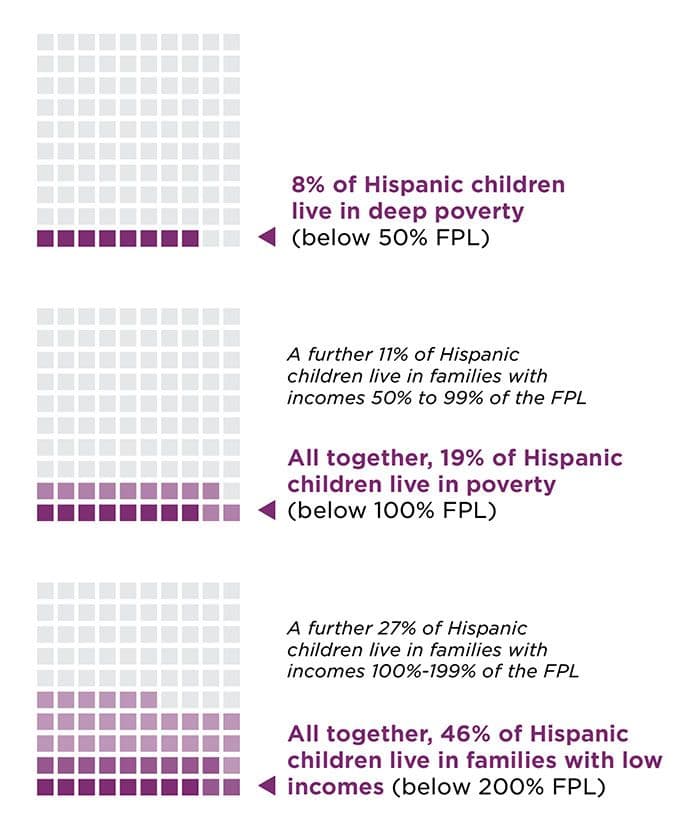
Just under half (46%) of Hispanic[1] children under age 18 live in families with low incomes, according to our new analysis of 2023 American Community Survey data (see figure). For this analysis, low-income families include those with earnings up to two times the official poverty threshold (i.e., 200% of the Federal Poverty Level, or FPL) as a general approximation of the income needed to meet a family’s basic needs. This translates to $60,000 per year for a family of four in 2023.
Nineteen percent of Hispanic children live in families whose income is below the official poverty threshold—$30,000 per year for a family of four in 2023. Eight percent live in deep poverty; that is, their family incomes are less than half of the official poverty threshold, or $15,000 per year for a family of four in 2023.
Just under half (46%) of Hispanic children live in families with low incomes
Low income, poverty, and deep poverty status among Hispanic families with children, 2023
Source: Authors' analysis of the Census Bureau's 2023 American Community Survey 1-year data obtained via IPUMS USA, University of Minnesota, www.ipums.org.
Notes: Sample includes Hispanic children who are not living in group quarters, and for whom data on poverty status and parents' country of birth were not missing. Low income, poverty, and deep poverty categories are not mutually exclusive.
Hispanic children living in families in which at least one parent was born outside of the United States are more likely to have low incomes (52%) or to live in poverty (21%) than those which include only U.S.-born parents (40% and 17%, respectively); however, they are very slightly less likely to experience deep poverty (7% vs. 8%, respectively; see Table A in Methods dropdown).
Hispanic children make up more than one in four children under age 18 in the United States and, by 2050, they are expected to make up more than one in three. How Latino children fare economically will play a large role in the country’s overall social and economic well-being. Children who experience poverty or low incomes are exposed to stressors and conditions that put them at increased risk of poor health and worse academic, social, and emotional outcomes—both as children and as adults. Children who experience the most severe financial hardships associated with deep poverty face the most disadvantageous health and well-being outcomes.
State and federal policies can—and do—lift children out of poverty. As has been well documented, the expansion of safety net programs during the COVID-19 pandemic helped bring levels of child poverty to record lows in 2021. Levels of child poverty are also impacted by changes in family income due to employment. However, the vast majority of Hispanic children in families with low incomes live with an employed adult. Thus, Hispanic families with low incomes would especially benefit from programmatic efforts—including job and skills training—that help make higher-wage jobs more attainable and provide access to jobs with stronger benefits that can reduce families’ financial burdens in caring for children; such benefits include health insurance and paid leave.
For this analysis, we used data from the U.S. Census Bureau’s 2023 nationally representative American Community Survey (ACS) 1-year samples, obtained from IPUMS USA. We define Hispanic children as children under age 18 for whom a Latino, Hispanic, or Spanish origin was reported, regardless of their race. Our analytic sample includes Hispanic children under age 18 who are not living in group quarters, and for whom data on poverty status and parental nativity were not missing, resulting in a full unweighted sample of 133,326 Hispanic children.
We created the category of families with low incomes using the IPUMS-constructed poverty variable, which calculates each person’s family income as a percentage of their family’s poverty threshold (see this summary of the poverty measure in IPUMS). Family incomes include pre-tax cash incomes from sources such as earnings, Social Security, Supplemental Security Income, Temporary Assistance for Needy Families (TANF) benefits, unemployment insurance, and workers’ compensation; and exclude non-cash benefits (e.g., Medicaid and Supplemental Nutrition Assistance Program benefits) and tax credits (e.g., the Earned Income Tax Credit ).
We show estimates according to whether children’s co-residential parents were born in the United States, using two categories: 1) at least one parent in the household is non-U.S.-born or 2) all parents in the household are U.S.-born. For children with only one parent in the household, parental country of birth was assigned based on that parent alone. We applied the ACS person-level sampling weights provided by IPUMS for all estimates, and the person-level replicate weights for all statistical tests. Only statically significant differences of p < 0.05 are reported in this analysis.
Table A. Family poverty status among Hispanic children, for all children and by whether parents were born in the United States, 2023
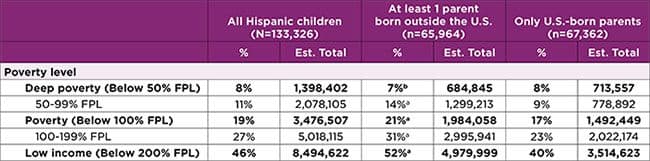
Source: Authors' analysis of the Census Bureau's 2023 American Community Survey 1-year data obtained via IPUMS USA, University of Minnesota, www.ipums.org.
Notes: Sample includes Hispanic children who are not living in group quarters, and for whom data on poverty status and parents' country of birth were not missing. Poverty level categories labeled "Low income," "Poverty," and "Deep poverty" are not mutually exclusive. Together with the deep poverty category, additional non-bolded categories of 50-99% FPL and 100-199% FPL provide a set of mutually exclusive FPL ranges below 200% FPL.
a Differences by country of birth are statistically significant at p<0.001.
b Differences by country of birth are statistically significant at p<0.01.
Suggested citation
Wildsmith, E., Alvira-Hammond, M., Guzman, L., and Chen, Y. (2025). Nearly Half of Hispanic Children Live in Families With Low Incomes. Child Trends. DOI: 10.56417/2359w8547w.
Footnote
[1] We use the terms “Hispanic” and “Latino” interchangeably throughout the brief. Consistent with the Office of Budget and Management’s (OMB) standards for data on race and ethnicity, these terms refer to individuals of Mexican, Puerto Rican, Salvadoran, Cuban, Dominican, Guatemalan, and other Central or South American or Spanish cultures or origins.