



Migrant and Seasonal Head Start (MSHS) offers a range of supports and services to which families can opt in, including education and job training for parents (and other primary caregivers) who do agricultural work as migrant farm workers. Farm workers and their families often face poor working conditions, work instability, frequent moves, separation from family support networks, cultural and linguistic barriers, limited community resources in rural areas, and low wages. To better serve farm workers and their families, MSHS programs should offer services that meet families where they are in their educational and professional journeys.
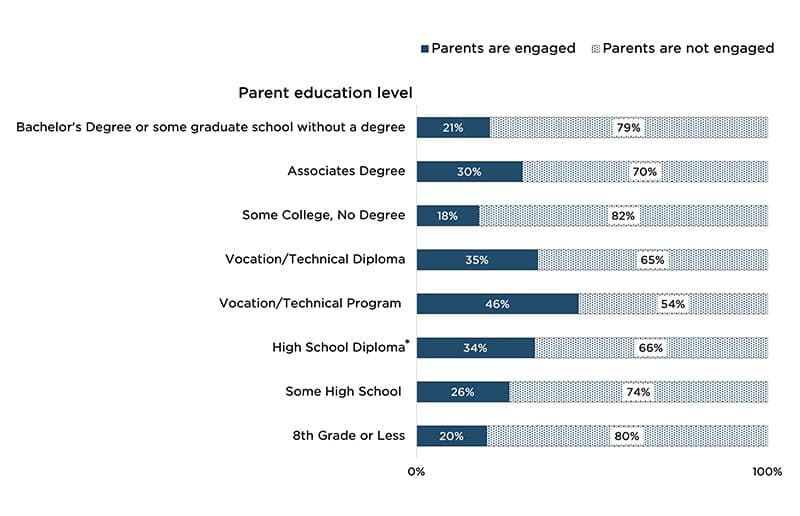
For this analysis, to explore the effect of parents’ education level on their likelihood of engaging in MSHS education and job training opportunities, Child Trends used secondary parent interview data from the Migrant and Seasonal Head Start Study 2017, the most recent nationally representative study of MSHS. We find that parents who completed high school are more likely to engage in MSHS education and job training compared to parents who completed the 8th grade or less (see Figure 1).
Figure 1. Parents who have completed a high school diploma are more likely to engage in MSHS education and job training services*
Percentage of engaged MSHS parents by education level (weighted)
Source: Migrant and Seasonal Head Start Study 2017
* Note: Percentages are only significant at the high school diploma level.
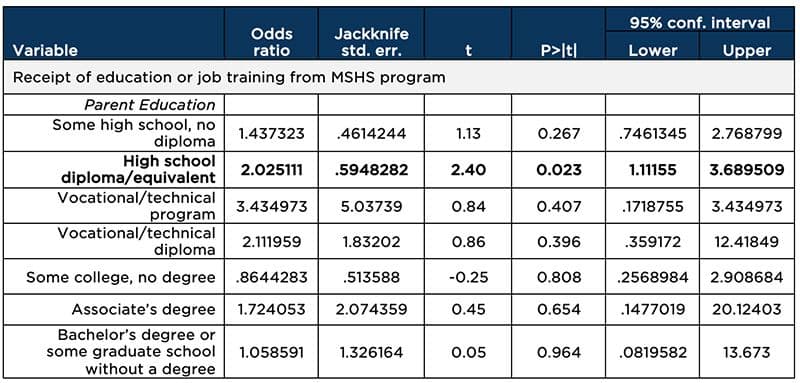
Our data indicate that, of all parents participating in MSHS who were interviewed,[1] most have achieved an education level of high school diploma or less (see Figure 1A in the Appendix). Our team used a weighted logistic regression analysis to understand whether parent education level was associated with their engagement with MSHS education and job training supports. After adjusting for survey design, MSHS families were 2.03 times more likely[2] to engage in job and education training supports when parents had earned a high school diploma or equivalent, when compared to parents who have completed through the 8th grade or less. No other education levels were significantly associated with engagement in education and job training. (See Table 1 in the Appendix for the full model findings.)
These findings begin to shed light on how obtaining a high school diploma can be a catalyst for parents to enhance their education and job skills. The data also highlight that MSHS families who have achieved lower levels of education may need different types of support to foster their engagement than the supports currently offered by MSHS programs.
Appendices
Figure A1: Number of parents from our sample participating in MSHS programs, by education level (weighted)
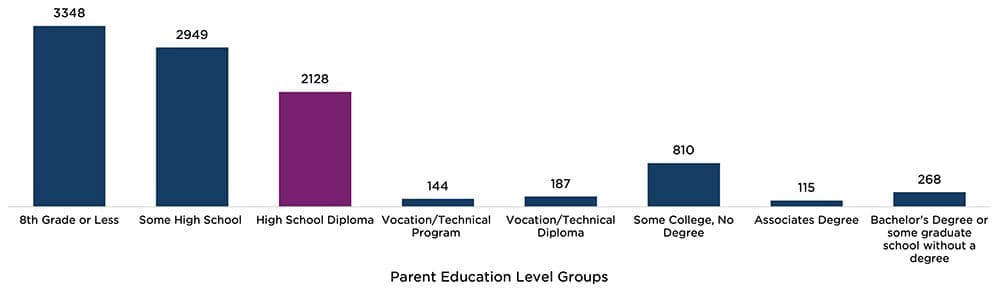
Table A1. Logistic regression predicting engagement with MSHS education and job training supports, by parent education level
Footnotes
[1] We limited our sample to parents who identified themselves as Hispanic or Latino during the interview (97.66% of the total sample). Parents in our sample ranged in age from 18 to 68.
[2] The 95 percent confidence interval from 1.11 to 3.68 and p-value of 0.02 (see Figure 1) mean we can be reasonably confident that MSHS parents with a high school diploma or equivalent are 1.11 to 3.68 times more likely to engage in education and job training supports than MSHS parents who have completed 8th grade or less.
This data point was supported by the Administration for Children and Families (ACF) of the United States (U.S.) Department of Health and Human Services (HHS) as part of a financial assistance award (Award #: 90YR018701) totaling $100,000 with 100 percent funded by ACF/HHS. The contents are those of the author(s) and do not necessarily represent the official views of, nor an endorsement, by ACF/HHS, or the U.S. Government. For more information, please visit the ACF website, Administrative and National Policy Requirements.
Suggested citation
Aceves, L., Connolly, K., & LaForett, D.R. (2025). Parent education levels affect Migrant and Seasonal Head Start families’ engagement with education and job training. Child Trends. DOI: 10.56417/7276b7979z