
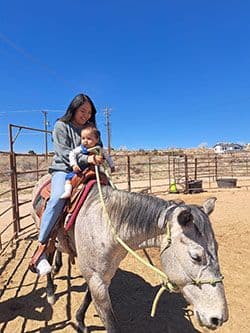
 LaShai Jake is a research analyst for Child Trends’ Indigenous Children, Youth, and Families team within the Population-Focused Research program area.
Can you briefly introduce yourself?
Ya’at’eeh shik’éí dóó shidine’é. Shí éí LaShai yinishyé. Kinlichii'nii dine'i nishłį́, Bit'ahnii dine'i bashishchiin, Hashtl'ishnii dashicheii, Naakaii dine'i dashinalí. Ákót’éego diné asdzáán nishłį́.
Hello, my family and friends. My name is LaShai. I am Red House clan-born for the Folded Arms Within His Cover clan. The Mud clan is my maternal grandfather’s clan, and the Mexican clan is my paternal grandfather’s clan. In this way, I identify as a Diné woman.
What sparked your interest in research focused on Indigenous child and family health?
My interest in this work began during my undergraduate and graduate studies. I always wanted to help my people and my community, but I wasn’t sure how until I went to college and started to understand community health. This foundation ignited my interest in exploring how public health can better serve my own community. After completing my undergraduate degree, I pursued graduate studies to gain a deeper understanding of various systems and the impacts of both social work and the public health field. During this journey, I became focused on child welfare, early childhood, and women’s health, influenced by my own lived experiences. I want to see Indigenous knowledge centered in research and to see Indigenous families and communities serving in leadership roles.
What books or journal articles have most influenced you?
A friend gave me a book for my birthday called Miracle Hill, by Blackhorse Mitchell. This book profoundly influenced both my perspective on my work and my worldview. It allowed me to reflect on my own journey, from growing up on the Navajo Reservation to moving to the city, going to school, and entering the field of research.
To wrap up, can you share a fun or interesting fact about yourself or your family?
As a first-time mom and an intergenerational cycle breaker—someone who intentionally works to interrupt patterns of disconnection and loss passed down through generations due to colonization and forced assimilation—my family and I decided to participate in a language immersion program for families in the greater metro Albuquerque area. This program focuses on creating a home-like environment for parents and their babies to learn and speak Diné, as first- and second-language speakers, through an immersion nest model—a family-centered approach first developed in Māori kōhanga reo programs and now used across Indigenous communities, focusing on natural language transmission between generations (see, for example, First Peoples’ Cultural Council, Language Nest Toolkit). The goal of my son’s program is to reconnect families with the Diné language and culture.
We feel incredibly fortunate to be part of this program and to watch our son thrive. His first language will be our traditional language, and he can currently speak more Diné words than English. I can’t wait for the day he starts speaking to me in Diné! It warms my heart to hear him use Diné words in places like Costco and Target, or when we’re with other families. As a second-language learner, I can finally speak Diné in public without anxiety or shame. This program has healed parts of me, enabling me to continue learning the language. The work is challenging, but I am fortunate to have mentors, elders, leaders, friends, and family who support my efforts through teaching and guidance. For now, I will continue to learn and lead, taking up spaces where Indigenous knowledge should be honored and protected.
Ahéhee’
LaShai Jake