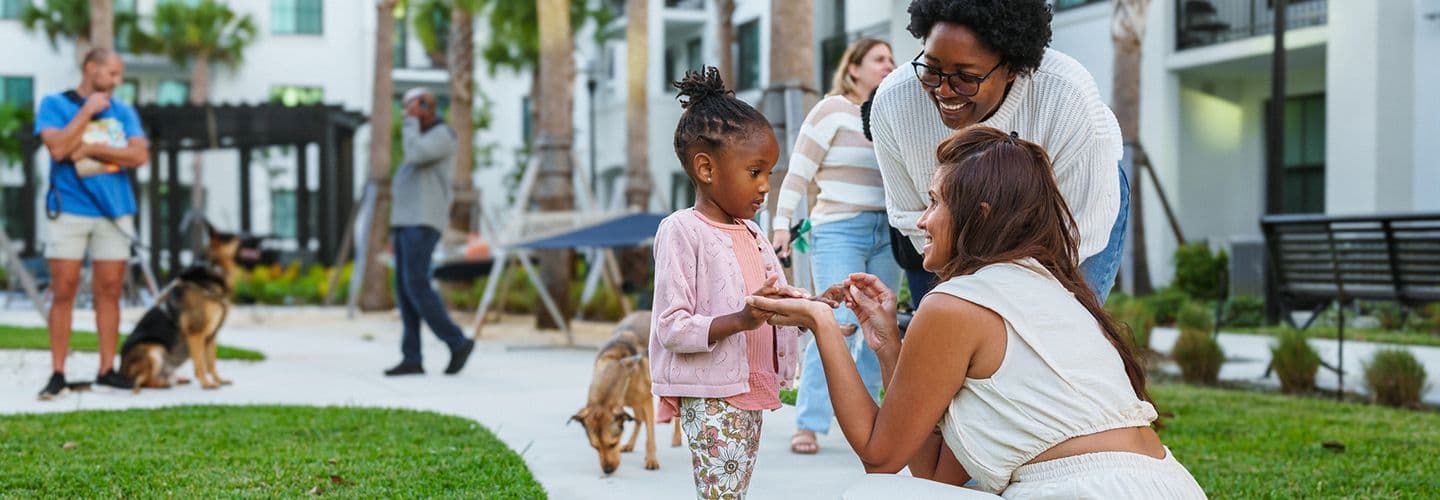


Since 2005, Bridge Meadows has advanced its mission to create and inspire intergenerational communities that enhance the well-being of children, parents, and elders. The program's social purpose is to provide permanent families and stable homes for children who have been impacted by the child welfare system.
Bridge Meadows has been covered in national publications, including the Washington Post and The New York Times, for its ability to leverage intergenerational communities to foster meaningful social connections and relationships, ultimately enabling residents to thrive and flourish. Additionally, Bridge Meadows was recently designated by the Grandfamilies & Kinship Support Network: A National Technical Assistance Center as an exemplary kinship/grandfamilies program.
This brief summarizes the results of Child Trends’ evaluation of the program, which was guided by two key research goals: (1) to assess how Bridge Meadows delivers its services and how well they align with the organization’s mission and social purpose; and (2) to understand how the program’s activities contribute to its intended outcomes for youth, parents, and elders. To conduct this evaluation, Child Trends reviewed relevant documents, including Bridge Meadows’ program materials, logic model, and theory of change; and conducted focus groups and individual interviews with residents and staff.
About Bridge Meadows
Bridge Meadows operates under a “recipe” for community building that is anchored in three main components: 1) intergenerational residents brought together by a shared commitment to providing permanency for youth formerly in foster care; 2) staff who deliver clinical services and support to strengthen relationship-building and improve residents' well-being; 3) and affordable housing communities intentionally designed to encourage social interaction and help residents thrive.
Bridge Meadows’ communities are comprised of a diverse group of residents from three generations: youth who have been impacted by the foster care system and need permanency (e.g., guardianship or adoption); adult parents (e.g., foster and birth parents, kinship caregivers) committed to providing permanence to youth; and elders who engage in community living and serve as mentors, friends, and caregivers to the children and to each other. Bridge Meadows leverages the connections and supports afforded by these intergenerational communities to support children’s healing from the trauma of foster care.
Findings
Successes
Bridge Meadows communities successfully build strong connections across generations by bringing together residents who share a commitment to providing permanency to youth formerly in foster care, and by further facilitating those connections via dedicated clinical staff and well-designed housing communities.
Bridge Meadows communities create connections across all generations.
At Bridge Meadows, residents share a powerful goal: using intergenerational relationships to support the permanency of youth who have been impacted by the foster care system. By forming meaningful and lasting connections, many residents are strongly committed to staying in the community to enjoy and nurture these bonds. Community activities—such as shared meals, child care support, and informal gatherings—play a vital role in fostering this deep sense of connection. Prior to joining Bridge Meadows, many elders had experienced isolation, often feeling disconnected from family and social networks after their retirement. In contrast, their time at Bridge Meadows has reportedly brought them a renewed sense of belonging and purpose through strong relationships and shared experiences. Parents highlighted the value of both peer and elder mentorship, as well as the sharing of resources that support their daily lives and strengthen communal ties. Elders and parents alike observed that youth became more trusting and confident in their time at Bridge Meadows, forming stronger peer relationships and engaging in fewer conflicts. Together, these intergenerational interactions form the heart of a thriving and healing community.
Clinical staff help residents navigate and facilitate intergenerational relationship-building.
The evaluation underscored the vital role of community support specialists (CSSs) in fostering a warm and supportive environment where residents can truly thrive. CSSs are the primary clinical staff on-site in Bridge Meadows communities, and often coordinate activities that nurture relationships and build connections. For example, during the holiday season, CSSs organize community dinners in shared spaces, creating opportunities for togetherness and celebration. In our focus groups, residents consistently expressed deep appreciation for the dedication of CSSs. Some residents have even stepped forward to assist CSSs with tasks that deepen Bridge Meadow’s community spirit.
The intentional housing design in Bridge Meadows communities fosters social connection and trust between residents.
Stable, safe, and affordable housing is essential for Bridge Meadows to function as a community dedicated to helping residents heal from past traumas. Bridge Meadows leadership views this housing not just as a basic need, but as a foundation for connection, growth, and thriving. Many residents indicated that the physical design of their homes and communities significantly contributes to their experiences living in intergenerational housing. This design ultimately fosters opportunities for social connections and relationship-building. All residents highlighted particular aspects of their community’s design that foster such connections, including the numerous community rooms (e.g., arts and craft rooms, libraries, and meeting rooms) and outside community spaces such as gardens. Parents, specifically, shared that the community’s central outside space offers clear lines of sight to watch children playing outside; similarly, many valued the adequate community lighting for its safety.
Opportunities
To enhance its impact, Bridge Meadows should strengthen connections among residents across racial backgrounds and improve communication with property management.
Some residents find it difficult to build connections across races and ethnicities.
The evaluation found that both residents and staff have observed growing racial diversity within the community. However, some residents shared that racial differences make it harder to connect, and several others reported experiences of racism. In response, Bridge Meadows has provided training to residents on racial diversity and is exploring other strategies to foster understanding, build relationships across races, and promote inclusivity.
Residents report inconsistent performance for property management companies.
While many residents expressed deep satisfaction with the design of their communities, some residents and staff reported occasional issues with property management companies (e.g., incorrect late rent notices, unclear operating hours). Many residents suggested that their community living experience could be improved with more consistent and effective property management. For their part, Bridge Meadows staff reported understanding the importance of addressing concerns related to property management companies and stated a commitment to continued collaboration with property management partners whose values align with organizational goals.
Suggested citation
Washington, T., Ball, J., & Piña, G. (2025). Highlights from evaluating an intergenerational community that supports children formerly in foster care. Child Trends. DOI: 10.56417/1536j3957o