


In 2023, a record 22.6 million U.S. households were rent-burdened; in other words, they spent more than 30 percent of their income on housing. The current housing affordability crisis is even more acute for households with children, who are at the greatest risk for experiencing eviction, housing instability, and homelessness. Access to affordable housing is important for children’s health and development; however, the supply of affordable and appropriately sized (e.g., has enough bedrooms) housing is insufficient to meet the needs of renter households with children and very low incomes.
Measuring access to affordable housing
Access to affordable rental housing is often measured by supply and demand. For example, it might be measured as the number of affordable rental units available per household in a specific region, where “affordable” is defined as housing units with rents that do not exceed a certain threshold (e.g., less than 30% of the area median income).1 Prior studies examining affordability and availability of rental housing have found that, nationally, there are only 56 affordable and available homes for every 100 renters with very low incomes. However, this likely underestimates the full extent of the gap in affordable housing because it does not account for whether available housing has sufficient bedrooms for households of all sizes.
Building on this prior work, we bring a family-centered approach to understanding housing access. This approach accounts for housing affordability and availability while adding the extent to which available housing has enough bedrooms to meet families’ needs (for our definitions of affordable, available, and appropriately sized, please see the text box below).
Definitions
Affordable: Housing units with rent and utilities that do not exceed 30 percent of a given income threshold.1
Available: Rental units that are either vacant or are already meeting the demand of a household whose income and bedroom needs match that housing unit.
Appropriately sized: Rental units with a sufficient number of bedrooms for the household size (i.e., 1 bedroom per 2 coupled/partnered adults or 1 non-coupled/partnered adult, 1 bedroom per 2 children). For example, a family of four with two married parents and two children would need two bedrooms; a family of five with one parent, a grandparent, and three children would need four bedrooms.
Households with very low incomes: Households with incomes at or below 50 percent of the median income of their geographic area of residence (i.e., the area median income, or AMI). This includes all households with incomes below 50 percent of the AMI, including those with extremely low incomes—defined as those with incomes below 30 percent of the AMI.
Households with moderately low incomes: Households with incomes greater than 50 percent and up to 80 percent of the median income of their geographic area of residence (i.e., the area median income or AMI).
Key Findings
No state has a sufficient stock of affordable, available, and appropriately sized units to meet the housing needs of renter households with children and very low incomes. Nationally, there are only 29 affordable, available, and appropriately sized housing units for every 100 renter households with children and very low incomes. Moreover, more than one in four states (14 of 51) have less than 30 affordable, available, and appropriately sized housing units for every 100 renter households with children and very low incomes.
The rental housing gap is particularly stark for households with very low incomes that need more than two bedrooms. Nationally, there are 33 affordable and available two-bedroom units for every 100 renter households with children and very low incomes that need them, but only 28 three-bedroom units and 18 four-bedroom units for every 100 households that need them. This shortage of larger rental units—specifically those with four bedrooms—also persists among families with moderately low incomes.
Our findings underscore the pressing nature of the country’s ongoing housing affordability crisis for households with children, and especially for those that need three or more bedrooms. As our nation continues to grapple with the ongoing housing crisis, affordable housing developers and policymakers must keep in mind the 1.8 million households with children and very low incomes who need larger rental units.
Map: No state has a sufficient supply of affordable and appropriately sized housing units for renter households with children and the lowest incomes
The following map shows the number of affordable, available, and appropriately sized rental units per 100 renters with children and very low incomes within each state.
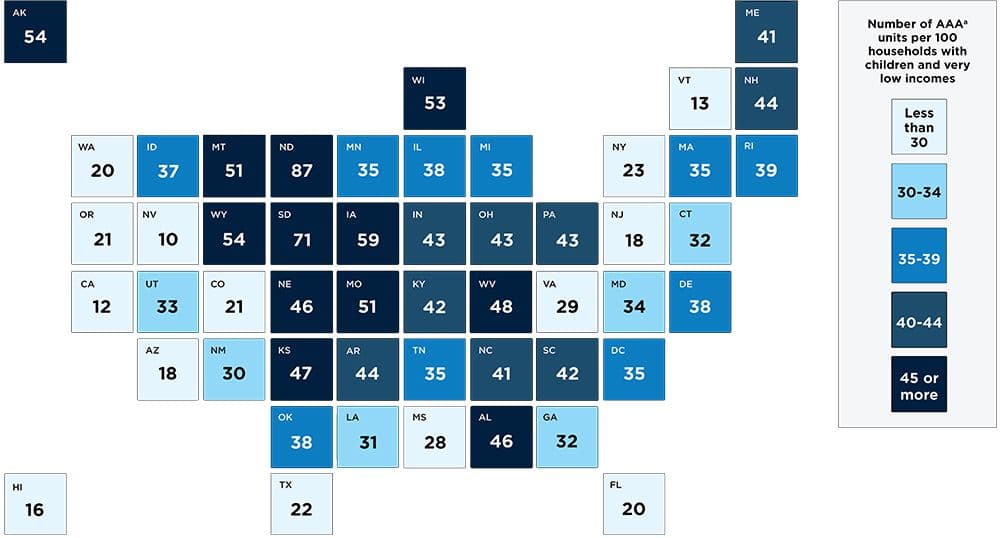
Notes: Data are drawn from the 2022 1-year American Community Survey (ACS) microdata from IPUMS USA, University of Minnesota. Analysis closely replicates the methodology of The Gap report by the National Low Income Housing Coalition (NLIHC) with the addition of a third element of appropriate size (match between number of bedrooms in a rental unit and family size). Our methodology is described in detail below. Households with very low incomes are those with incomes at or below 50 percent of the median income of the geographic area in which they live (i.e., the area median income, or AMI). For reliability of these estimates, please refer to the Table.
a AAA = Affordable, available, and appropriately sized. Affordable: Housing units with rent and utilities that do not exceed 30 percent of a given income threshold. Appropriately sized: Rental units with a sufficient number of bedrooms for the household size (1 bedroom per 2 coupled/partnered adults or 1 non-coupled/partnered adult, 1 bedroom per 2 children). Available: Rental units that are either vacant or not occupied by a household with a higher income, a household that has fewer household members than needed for the number of bedrooms, or a household without children.
Table: The rental housing gap is worse for households with very low incomes that need more than two bedrooms.
The following table shows, by state, the supply (i.e., the number of affordable, available, and appropriately sized [AAA] rental units) for each 100 renter households with children in each income and bedroom category. We also include the surplus or deficit of affordable, available, and appropriately sized [AAA] rental units for households with children in each income and bedroom needs category.
Note: Numbers marked with an asterisk (*) should be interpreted with caution due to unreliable estimates as a result of smaller sample sizes for some populations of interest. Unreliable estimates are those with a Coefficient of Variation (CV) of 30% or higher. Estimates were flagged as unreliable in the following cases: For surplus (or deficit), if either the supply, the demand, or both were unreliable. For the ratio per 100 households, if either the numerator (supply), the denominator (demand), or both were unreliable.
To better understand the availability of affordable and appropriately sized rental housing for households with children, we drew on 2022 1-year American Community Survey (ACS) microdata from IPUMS USA, University of Minnesota. The data contain information on occupied and vacant housing units, as well as the characteristics of households that occupy these units. Our analysis closely replicates the methodology of The Gap report by the National Low Income Housing Coalition (NLIHC). However, in addition to affordability and availability, our analysis accounted for the match between the number of bedrooms in a rental unit and family size.
The key steps in our analysis included the following:
- Household income classification. Households were classified into three income categories (very low income, moderately low income, and moderate and higher income) based on thresholds relative to the local area median income (AMI) with adjustments for household size. For metropolitan areas, the AMI was based on the median family income (MFI) for Core Based Statistical Areas (CBSAs) as provided by Census Table B19113; each housing unit in ACS data was matched to a CBSA based on their Public Use Microdata Area (PUMA), using the Missouri Data Center’s MABLE/Geocorr 2022 Geographic Correspondence Engine. For non-metropolitan areas, we calculated state-level non-metro MFIs using the family income variable from the ACS. MFIs were adjusted for household size, based on HUD adjustment factors. Households with very low incomes had incomes at or below 50 percent of the AMI; households with moderately low incomes had incomes above 50 percent and up to and including 80 percent of the AMI; moderate- and higher-income households had incomes above 80 percent of the AMI.
- Housing unit affordability match. Rental units were classified as affordable if the rent (including utilities) did not exceed 30 percent of the highest income in the relevant income threshold, after adjusting for the bedroom size per HUD guidance. For example, if gross rent (including utilities) for a unit was equal to or less than 30 percent of the top income threshold for households with very low incomes, then the unit is classified as affordable for those households. Units with no recorded housing costs (e.g., those that are fully subsidized) were automatically assumed affordable for households with very low incomes.
- Housing unit size matched to household size. Rental units were classified as having a sufficient number of bedrooms for the household size if they had at least one bedroom for every two coupled/partnered adults, one bedroom for every non-coupled/partnered adult, and one bedroom for every two children. Households with children under age 18 living on their own were excluded from this analysis. (Note: Given the complexity of relationships among household members, a small number of households may have been estimated to require slightly more or fewer bedrooms than their actual needs.)
- Housing unit availability for matched households with children. Rental units were classified as available if they were vacant or were already meeting the demand of a household whose income and bedroom needs matched that housing unit. This step is to account for the fact that households that fall outside the specified income and bedroom needs category or households without children are sometimes occupying—and therefore reducing the supply of—rental units that are appropriate for households with children within the specified income and bedroom needs category. For example, if a unit that is affordable to a household with a very low income is occupied by a household with a moderately low income, it is not available for the very low-income household to rent. Similarly, if a three-bedroom unit is occupied by a two-parent, two-child household whose needs are technically aligned with a two-bedroom rental, then that unit is not available for other households needing three-bedroom units. And finally, if an affordable and appropriately sized unit is occupied by a household without children, then it is not available for rent by a household with children. Units lacking complete plumbing or kitchen facilities were excluded from this analysis.
- Housing gap estimation. For each income and bedroom category, we calculated the number of available rental housing units in each state for households with children that were affordable and appropriately sized, based on household income and size: This is the state’s supply of available, affordable, and appropriately sized rental units for households with children. We then calculated the number of households with children under age 18, by income level and bedroom needs, in each state: This is the state-level demand among households with children for rental units that meet their needs (i.e., are affordable and appropriately sized). For the country as a whole and for each state, we then calculated the ratio of supply to demand (supply divided by demand, multiplied by 100) for each income and bedroom category. These numbers are presented in the table above. The map presents the ratio of supply to demand for households with children and very low incomes, for each state, aggregated across all bedroom sizes.
Acknowledgements
This data point would not have been possible without generous contributions of time, resources, and thought partnership from a number of people. First, we are incredibly grateful for Dan Emmanuel and the team at the National Low Income Housing Coalition (NLIHC), both for their generosity and willingness to share their methodology and code, and for taking the time to respond to our many questions. The incredible work of the NLIHC in their annual Gap Report inspired this data point. We also appreciate the feedback from Nathan Bossie of the U.S. Department of Housing and Urban Development and Joe Willard of HopePHL on the early development of the product. From our Child Trends team, we want to also thank Katie Richards for her careful review of our analytic code, Dr. Renee Ryberg and Kristen Harper for their thoughtful review and guidance, and Carlise King for her support. Finally, this product would not have been possible without the Child Trends communications team, including Catherine Nichols, who designed our map; Brent Franklin for his careful editing and whose conversations helped inspire this piece; and Matt Haugen, Stephen Russ, Olga Morales, Kelley Bennett, and Emily Baqir.
Footnotes
1 Housing affordability is typically measured using a threshold of 30 percent of household income spent on housing costs. However, this standard metric may oversimplify the complex financial tradeoffs families face. A more precise understanding of housing burden would consider whether families have sufficient remaining income to cover other essential needs—such as food, health care, transportation, and child care—after paying for housing. The true measure of affordability should reflect housing costs in the context of a family's complete budget for basic necessities.
Suggested citation
Shaw, S., Thomson, D., Yadatsu-Ekyalongo, Y., Sun, S., & Schuelke, M. (2025). All states have insufficient housing for renter households with children and very low incomes. Child Trends. DOI: 10.56417/5677h6412j