
The total fertility rate, one of the most commonly used measures to track fertility trends across countries, increased slightly in the United States in 2024, although it remains near historic lows.

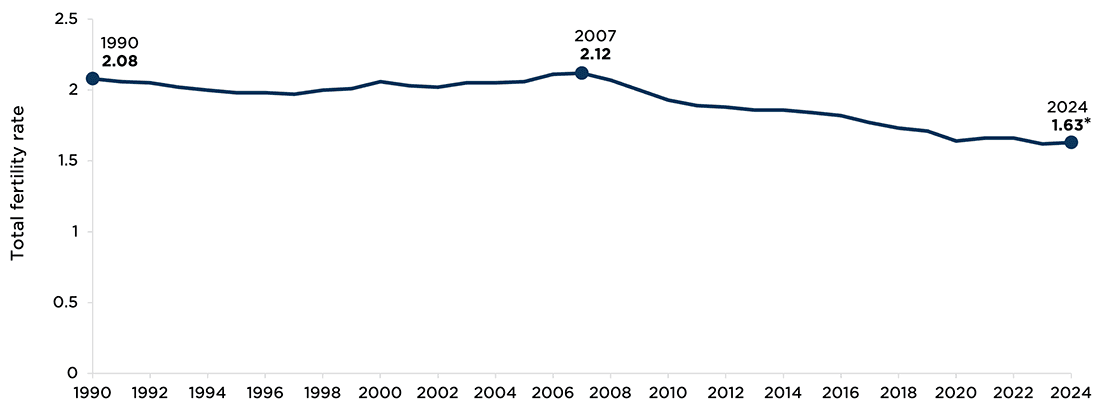
According to provisional data from the Centers for Disease Control and Prevention (CDC), the total fertility rate—which estimates the average number of children a woman is expected to have during her lifetime, based on current age-specific fertility rates—stood at 1.63 births in 2024. This represented an increase of less than 1 percent from 2023 (1.62), while the rate remains 23 percent lower than its most recent peak in 2007 (2.12).
Figure 1: Despite occasional upticks, the U.S. total fertility rate has trended down and remains near historic lows
Source: Data for 1990-2023 come from Driscoll, A.K., & Hamilton, B.E. (2025). Effects of age-specific fertility trends on overall fertility trends: United States, 1990–2023. National Vital Statistics Reports; vol 74 no 3. National Center for Health Statistics. https://www.cdc.gov/nchs/data/nvsr/nvsr74/nvsr74-3.pdf
Data for 2024 come from Hamilton, B.E., Martin, J.A., & Osterman, M.J.K. (2025). Births: Provisional data for 2024. Vital Statistics Rapid Release. 2025 Apr;(38):1–10. DOI: https://dx.doi.org/10.15620/cdc/174587
Over the past century, the total fertility rate has generally been lowest during periods of economic uncertainty—including during the Great Depression, the 1970s energy crisis, and the Great Recession. However, even during the period of recovery following the Great Recession, prior to the onset of the COVID-19 pandemic, the total fertility rate continued to decline in the United States. It has remained near or below the replacement level of approximately 2.1 births—the level needed for a country’s population to remain stable (assuming no changes in rates of mortality or immigration)—since the early 1970s.
Child Trends closely tracks data on birth rates and has explored the decline in other publications. Our experts have examined a wide range of factors related to family planning decisions, including those related to the provision of family planning services. If you’re interested in working with us on related research, please reach out to Elizabeth Wildsmith, PhD by emailing ewildsmith@childtrends.org.