


The Importance of Integrated Pediatric Primary Care
Decades of research on the social determinants of health (SDOH)—i.e., nonmedical, psychosocial factors that influence health outcomes—illustrate the value of incorporating the social determinants into pediatric primary care, which serves as the first line of defense for monitoring children’s health and development. With current clinical practice guidelines recommending 14 preventative visits prior to kindergarten, pediatricians have an opportunity to screen for SDOH in a setting that children already visit and then to connect families with resources as needed. Research evaluating efforts to bring psychosocial interventions into the primary care context illustrates several barriers to successful implementation, including lack of physician time and capacity, ineffective workflows (e.g., limited availability of standardized tools for assessing SDOH, limited referral options for positive screens), inadequate physician training and confidence to address complex psychosocial issues, and physicians’ perceptions that SDOH are outside their scope of practice.
In response to these challenges, integrated pediatric primary care embeds a specialized provider—typically a social worker, developmental specialist, or psychologist—whose primary focus is to work side-by-side with physicians to support developmental and psychosocial screenings, including SDOH; coordinate referrals; and provide short-term consultation to families. Integrated pediatric primary care programs show evidence for promoting healthy child development and well-being relative to traditional primary care, but they are also difficult to sustain due to the complex health care financing systems that drive medical practice workflows.
To boost implementation and long-term sustainability, a handful of states are looking toward several novel Medicaid reimbursement solutions, including enhanced payments for integrated primary care models that demonstrate evidence of effectiveness. The HealthySteps program (see textbox) is an evidence-based pediatric primary care model for children from birth to age 3 that integrates a child development and behavioral health promotion and prevention expert (HealthySteps specialist) into primary care. In Maryland, HealthySteps began in 2016 in one university family practice clinic and has since expanded to four additional sites. In January 2023, Maryland Medicaid became the first state agency to institute an enhanced Medicaid payment for practices implementing HealthySteps with fidelity. These practices receive an additional $15 for every newborn, well child, follow-up, and acute visit for children from birth to age 3.
About the HealthySteps Program
Initially developed three decades ago as one of the first integrated primary care programs for young children, HealthySteps has now expanded to 329 practices in 25 states and the District of Columbia, serving over 482,000 children nationwide. A program of ZERO TO THREE, HealthySteps is an evidence-based pediatric primary care model for children birth to age 3 that integrates a child development and behavioral health promotion and prevention expert (HealthySteps specialist) into primary care. In alignment with a public health model that aims to use limited resources efficiently, HealthySteps uses a three-tiered approach to match interventions to the patient’s level of need. Through team-based pediatric visits, HealthySteps specialists partner with pediatricians to promote healthy development, psychosocial well-being, and positive caregiver-child relationships and parenting practices, and to support referral coordination and service connection. Based in early childhood development science, numerous evaluations of HealthySteps have shown positive child, family, and provider/practice outcomes. Since 2017, cost savings analyses conducted by an external party across multiple HealthySteps sites found that, for every $1 invested in HealthySteps, state Medicaid agencies realize an estimated $2.63 in savings each year due to lower utilization of high-cost health care services and improved health outcomes—translating to a 163 percent return on investment.
This brief highlights key lessons learned from Maryland’s journey in implementing an enhanced payment model for HealthySteps, which reflects a unique partnership among the HealthySteps National Office at ZERO TO THREE (see box), the University of Maryland Medical System, Maryland Medicaid, and Child Trends. This initiative was supported by National Child Traumatic Stress Initiative Community Treatment and Service Center funding from the Substance Abuse and Mental Health Services Administration (SAMHSA). We hope this effort contributes to the broader body of knowledge by communicating the value of integrated pediatric primary care and sharing a particular strategy that Medicaid and other insurers can use to increase reimbursement for integrated care programs like HealthySteps.
Lessons From Expanded Payment for HealthySteps Integrated Care in Maryland
Establishing the enhanced payment code was critical for cultivating relationships between Medicaid, state behavioral health agencies, and clinical leadership.
HealthySteps champions in Maryland proactively built relationships and partnerships with state Medicaid administrators, representing a key driver of successful development of the enhanced payment structure. Maryland participated in the ZERO TO THREE Infant and Early Childhood Mental Health Policy Project, which includes members from the state's behavioral health authority and Medicaid office, university partners, advocates, and early childhood mental health service sectors. Through this initiative, the team promoted long-term financial sustainability of HealthySteps and enhanced Medicaid cost savings. In 2021, through the Maryland Maternal and Child Health Care Initiative, funded by the governor’s office, Maryland’s Health Services Cost Review Commission (HSCRC) included HealthySteps in its Maternal and Child Health Funding Plan as one of five designated population-based health programs. This designation allowed Medicaid insurers to apply for the HSCRC funds to allow Medicaid providers to implement HealthySteps and use an enhanced payment code.
Physicians say the enhanced payment code is easy to use for preventative visits, and they’ve increased their use of the code over time.
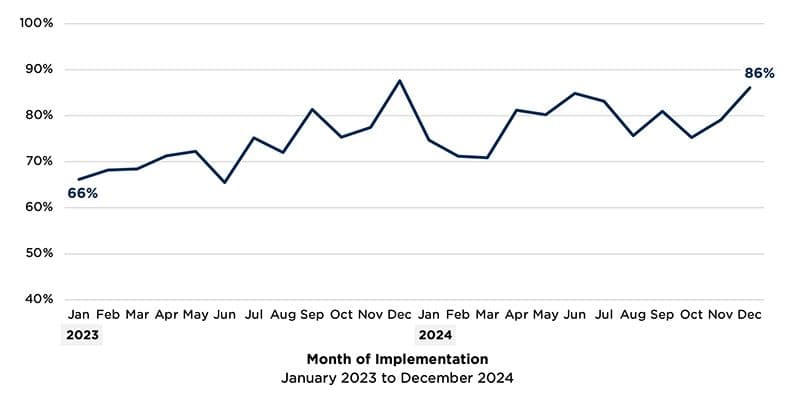
Child Trends and the University of Maryland have tracked use of the enhanced payment code in Maryland over time since the start of its implementation in January 2023. These data reflect nearly 7,000 encounters in a large, urban hospital primary care practice serving predominantly Medicaid-insured patients. Two key data points emerged from evaluation of expanded pay use:
- First, providers’ use of the code increased over the course of implementation, beginning at 66 percent of all eligible encounters at the start of implementation and increasing to 88 percent by two years post-implementation (see Figure 1).
- Second, use of the code appears to differ by type of encounter, with a higher rate of use for preventative visits (76% in 2023; 83% in 2024) and lower for follow-ups (63% in 2023; 67% in 2024) and acute visits (69% in 2023; 64% in 2024). In a 2025 survey of 11 physicians using the code, nearly all (n=9, 82%) providers indicated that the code is easy to use for preventative visits. Somewhat fewer thought the code was easy to use for follow-up or acute visits (n=7, 64%) or were unsure whether it could be used at all for these visits (n=4, 36%). Across visit types, resident trainees were generally less familiar with the code than physicians.
Figure 1: Providers’ use of enhanced payment code for eligible HealthySteps medical encounters
Source: Authors’ calculation of patient health data extracted from Epic health record software at the University of Maryland School of Medicine
The most common barriers to code use were practitioners forgetting or being in a rush (particularly during follow-up or acute visits), followed by not knowing when to use the code. Providers suggested that an automated application of the code in the electronic medical record for all eligible encounters could be more effective than relying on the provider to manually apply the code. Residents also suggested additional provider education about code use.
Enhanced payment helps cover the cost of HealthySteps, but supplemental funding is still needed.
In Maryland, one urban hospital center’s primary care practice had 2,500 to 2,700 encounters per year that were eligible for enhanced payment, translating to over $52,000 per year of revenue if applied to all eligible encounters. This figure does not account for potential cost savings from reduced emergency department and other costly encounters demonstrated in previous studies of HealthySteps and in large studies of adult patients. Depending on the qualifications and experience of an individual integrated HealthySteps specialist, the enhanced payment revenue could currently cover most—but not all—of the position’s full-time salary and benefits. Because of providers’ satisfaction with the program and existing studies demonstrating return on investment, two pediatric primary care practices within the state hospital system committed to a shared cost model with Maryland Medicaid to partially cover funding for the HealthySteps specialist position without significant reliance on external funding support. In the absence of adequate reimbursement, integrated care programs rely heavily on less predictable funding sources such as short-term grants, philanthropy, or state dollars to provide services. Underinvestment in early childhood integrated primary care is a missed opportunity to improve child health and wellness outcomes.
Conclusion
Integrated pediatric primary care has a growing evidence base for promoting child health while reducing overall health care costs, primarily by incorporating specialists into medical settings focused on child development, psychosocial needs, and SDOH for children and families. Our youngest children and their families benefit from early investments in high-quality health programs like HealthySteps, but our health care system is not designed to incentivize long-term health outcomes that are driven by SDOH. Maryland’s successful development of a novel enhanced payment system for HealthySteps was the result of relationship-building among state agencies, health and mental health providers, and technical assistance providers, along with gubernatorial investment in maternal and child health. HealthySteps still requires additional braided or matched funding, in addition to enhanced payment by insurers to sustain its implementation. HealthySteps and other programs like it have demonstrated the business case and public health argument for expanding investments in the future health of our youngest children.
Suggested citation
Vivrette, R., Onigbanjo, M.T., Connors, K., Verhoye, A., Wodrich, H., & Edwards, S.E. (2025). Enhanced Medicaid payment for integrated primary care is a promising strategy for promoting child health. Child Trends. DOI: 10.56417/5992r8345y