
Studies show that kinship care—an arrangement in which a child lives with relatives or close family friends when their parents are unable to provide a safe home—helps children stay connected to family, culture, and community while supporting their emotional well-being, academic success, and healing from trauma. Children in foster care are often placed with relatives or other kin, which is commonly referred to as “formal” kinship care. A new Child Trends analysis of federal foster care data shows that states vary widely in their use of formal kinship care placements.
Across all states, 2 to 56 percent of children in foster care were placed with relatives in fiscal year 2024
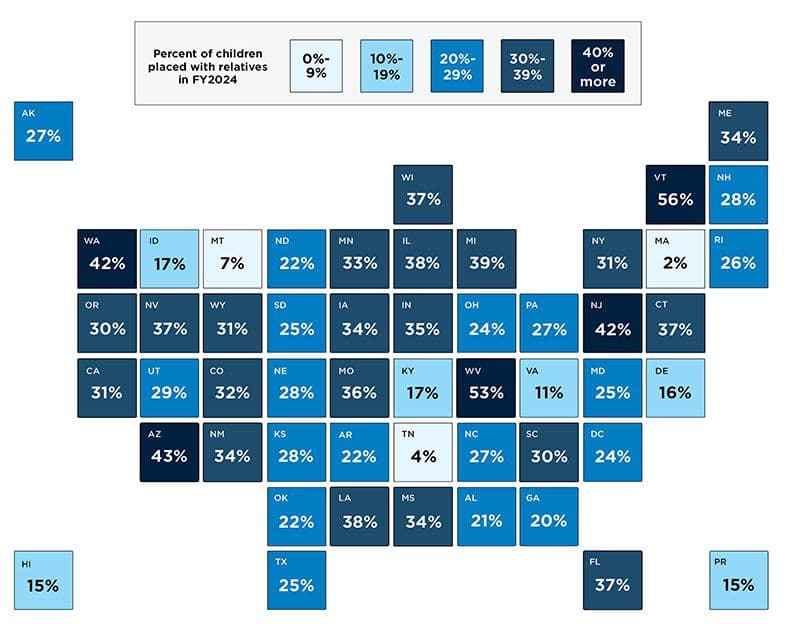
Source: Child Trends’ analysis of data from the Adoption and Foster Care Reporting and Analysis System (AFCARS).
Notes: The figure includes children from birth to age 20 whose most recent placement was with relatives. This includes children in care and placed with relatives on the last day of the fiscal year as well as children who exited foster care before the end of the fiscal year and who were placed with relatives before exiting. Note also that the format of the AFCARS Foster Care file changed from FY2021 to FY2022, thus limiting the comparability of data to previous years. Data presented here may differ from other published analyses due to differences in methodology and data quality.
In fiscal year 2024, 30 percent of children in foster care in the United States were placed with relatives. At the state level, the figure ranges from 2 percent in Massachusetts to 56 percent in Vermont, largely due to differences in state-level kinship care practices and policies. Over the past 20 years, federal funding and regulations have increasingly promoted kinship care, but each state is responsible for instituting its own kinship care policies—including eligibility and licensing requirements and financial support for kinship caregivers—resulting in a wide range of policies across the country.
To learn more about kinship caregiving in your state, visit our Child Welfare Data Interactive, a one-of-a-kind data tool that allows users to examine state and national child welfare data. The kinship caregiving page includes information from a 2022 Child Trends survey of kinship care policies, including state requirements to identify and notify relatives when a child comes to the attention of the child welfare agency and the types of services and assistance provided to kinship caregivers.
Looking to partner with Child Trends to examine key child welfare indicators? Contact Sarah Catherine Williams, MSW at swilliams@childtrends.org.