




The 2024 Syphilis Solutions Summit: Strengthening Birth & Community Supports, held August 28, 2024, provided a virtual platform for community health workers, community-based birth workers (e.g., OB-GYNs, doulas, midwives), and anyone else interested in learning more about congenital syphilis. The summit explored current trends, fostered peer connections, and facilitated discussions on strategies to decrease congenital syphilis rates in communities. Participants had the opportunity to improve their knowledge about congenital syphilis awareness, testing, and treatment throughout pregnancy. These materials were developed in collaboration with the Centers for Disease Control and Prevention (CDC).
Watch the Recording
You can now watch the recording to learn more about awareness, testing, and treatment of congenital syphilis throughout pregnancy. Speakers will share how cases of congenital syphilis have affected their communities.
 Play video
Additional Resources
Want to make a difference in your community? Our Syphilis and Congenital Syphilis Resource List provides numerous resources, including general information about syphilis and congenital syphilis, tools for clinicians, and resources for community outreach and awareness, including for those outside of the healthcare and public health fields. Additionally, our downloadable resource guide, Reduce Congenital Syphilis in Your Area, provides actionable steps for both health care providers and anyone else passionate about public health. Use it to build your knowledge and skills in combatting congenital syphilis.
To learn about more specific efforts in your state or community—or to share additional suggestions—email us at nish@childtrends.org. Stay informed about new resources, free virtual trainings, meetings, and more by joining our mailing list.
Frequently Asked Questions
Attendees asked great questions throughout the Summit. This section compiles answers to some of their questions, which have been lightly edited for clarity.
Q: Can primary syphilis lesions appear anywhere on the body?
A: Yes, syphilis lesions can occur anywhere in the body, in theory. However, they usually appear on the genitals (penis or vagina), mouth, or anus. These areas are more susceptible because they are the primary points of contact with the infection and the tissue is more sensitive in these areas.
Q: Does everyone go through primary and secondary stages before a latent stage? Or do some people go in a different order?
A: Most people progress through the stages of syphilis linearly (i.e., they will go through primary then secondary then reach the latent phase). However, some people might “go backward”—specifically, they may be in the latent stage for a time and then experience primary and secondary syphilis symptoms again. This backtracking might be seen among people with HIV and others whose immune systems work a little differently.
Q: How do you know whether someone has had syphilis for a year or more if they are in the latent stage (i.e., how can you distinguish between early and late latent stages)?
A: It is difficult to distinguish between early and late latent stages of syphilis. The only real way to know is if the patient’s medical file has a negative test and the test was performed in the last year.
Q: If someone is in the latent stage of syphilis and they are tested, will they get a positive result on a syphilis test?
A: Yes, a person in the latent stage of syphilis will typically test positive for syphilis. During the latent stage, the infection is still present in the body, even though there are no visible symptoms. Syphilis tests detect antibodies that remain in the bloodstream throughout all stages of the infection, including latent syphilis, and will result in a positive test.
Q: How long does it take for patients to get results when they are tested?
A: Rapid point-of-care syphilis tests take 10-15 minutes to provide a result. Lab-based serologic testing can take hours to days to get results, depending on whether a lab runs them immediately, waits to run them in batches, or sends them to an outside laboratory.
Q: I'm thinking about how people would find out when to get tested if someone is unaware that they would benefit from testing. Would any changes in normal blood work (e.g., tests taken at someone's yearly physical) show any signs of possible syphilis (i.e., to suggest that a person should be tested), or would someone just have to request being tested?
A: Changes in blood work may be caused by many things, and no changes would lead a health care provider to consider syphilis over other conditions. Someone would have to have syphilis testing to know. Syphilis testing should be performed with other STI testing in places with high syphilis prevalence.
Q: When should rapid point-of-care syphilis testing be used?
A: If people are able to return for care, lab-based testing is appropriate. Rapid point-of-care syphilis tests in the United States are currently only treponemal tests, which may remain positive for life even after treatment for some people. As such, if someone has not been treated for syphilis previously and if they are unlikely to return for care, rapid point-of-care tests are a great option to facilitate same-day presumptive treatment while awaiting the results of lab-based testing. For more information, refer to this guidance on using rapid point-of-care syphilis tests.
Q: I would love your thoughts about testing at delivery in birthing hospitals when these hospitals send tests out to labs. We see challenges in providing results after the birthing parent and baby return home. Do you have any thoughts about using rapids that are treponemal tests for Labor & Delivery units?
A: Systems need to be improved to get results faster. Until that's possible, rapid point-of-care tests should be used for people who have not previously been treated for syphilis to facilitate presumptive treatment prior to hospital discharge as well as neonatal evaluation. Lab-based testing should still always be sent.
Q: Are the rapid point-of-care syphilis tests provided by the state or where would these tests be accessible to get?
A: The U.S. health care system is complicated, which means that rapid point-of-care syphilis tests are available in different ways in different places. People and/or organizations interested getting rapid point-of-care syphilis tests can start by asking their local health department. If the local health department does not have information about such tests, people can also obtain information through the infectious diseases department of a local hospital.
Q: Is syphilis testing done if a baby has jaundice?
A: No, syphilis testing is not automatically done if a baby has jaundice alone.
Q: We had a recent case where a mom tested negative in the first and third trimesters with rapid plasma reagin tests (RPRs). She was not tested at delivery. She later learned that she was syphilis-positive when her child was 4 months old. The baby had a normal birth but is showing the effects of congenital syphilis at 4 months. Please discuss the recommendation for universal Congenital Syphilis screening at birth.
A: Unfortunate cases like these are exactly why the American College of Obstetricians and Gynecologists (ACOG), the national body that makes recommendations for OB/GYNs, began recommending universal syphilis screening at all deliveries (and at the initiation of prenatal care and in the early third trimester) in the United States in April 2024.
Q: With the high increase in syphilis among all people, regardless of risk factors, are there conversations about recommending regular yearly testing for syphilis along with other STIs?
A: CDC recommends syphilis testing along with other STIs whenever indicated in communities with a high prevalence of syphilis.
Q: Is treatment the same at each stage?
A: People who are diagnosed with primary, secondary, or early latent syphilis symptoms should be treated with one shot of benzathine penicillin G. People with late latent syphilis or latent syphilis of an unknown duration should receive three shots, each spaced one week apart.
Q: Is there a timeframe after which treatment will no longer help?
A: Without early treatment, people can suffer permanent damage, including vision and hearing loss, changes to the heart and blood vessels, and changes to the brain. While treatment cannot undo any permanent damage from syphilitic infections, it can prevent further damage. Treatment also prevents spread to one’s sex partner(s) and via pregnancy.
Q: Is there any other treatment available for syphilis? What about for folks who have a penicillin allergy?
A: Penicillin is the only treatment for people during pregnancy. If a person with syphilis is pregnant and has a penicillin allergy, they should receive penicillin desensitization and treatment. If a person is not pregnant and has a penicillin allergy, they can be treated with doxycycline.
Q: Why are rates of syphilis cases increasing at such a high rate?
A: Once syphilis is in a community, it spreads. Now syphilis is present in most communities and will keep spreading until we drastically increase testing and treatment. This is especially the case because a person can still transmit syphilis even though their primary and secondary symptoms go away on their own without treatment.
Q: How was the following graph created?
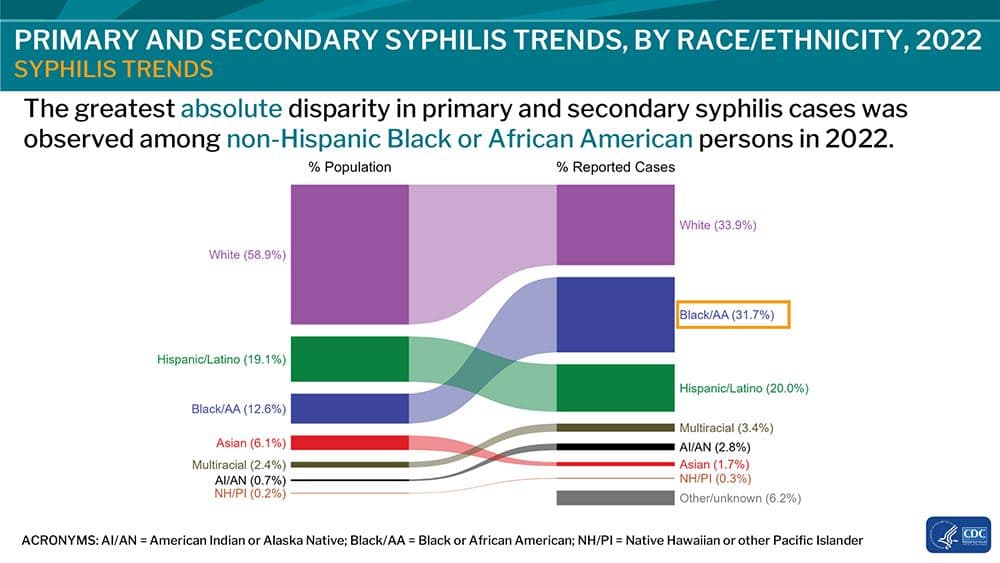
A: This is a Sankey diagram, or a type of data visualization that shows the flow of values from sources to destinations using bands that divide and merge at specified nodes in the process. The diagram above shows the disparities in primary and secondary syphilis cases across different racial and ethnic groups. On the left side, it shows the percentages of each group within the total U.S. population, while the right side displays their corresponding percentages of syphilis cases.
The percentages of primary and secondary (P&S) syphilis cases by race and Hispanic ethnicity were disproportionate to the percentages among the total population of the United States in 2022. The greatest absolute disparity was observed among non-Hispanic Black or African American persons, who represented 31.7 percent of reported P&S syphilis cases (n = 18,696; 33.8% of P&S syphilis cases with reported race or Hispanic ethnicity) despite being 12.6 percent of the U.S. population, or 19.1 percent more cases than would be expected based on their proportion of the population. The greatest relative disparity was among non-Hispanic American Indian or Alaska Native persons, who represented 2.8 percent of reported P&S syphilis cases (n = 1,623; 2.9% of P&S syphilis cases with reported race or Hispanic ethnicity) despite being 0.7 percent of the U.S. population, or a burden 4.0 times what would be expected based on their proportion of the population. Additionally, non-Hispanic Native Hawaiian or other Pacific Islander persons, non-Hispanic persons of multiple races, and Hispanic or Latino persons of any race(s) were also overrepresented among P&S syphilis cases relative to their proportion of the population.
This report includes data from years that coincide with the COVID-19 pandemic, which introduced uncertainty and difficulty in interpreting STI surveillance data. See Impact of COVID-19 on STIs for more information.
See Technical Notes for information on syphilis case reporting.
Data for this diagram is based on 2022 STI Surveillance.
Connect with Us
If you wish to know more or would like to share additional suggestions, please email nish@childtrends.org. If you would like to stay updated on new resources, free virtual trainings, meetings, and more, sign up for our newsletter.
This publication was made possible by cooperative agreement CDC-RFA-PS-23-0007 from the Centers for Disease Control and Prevention (CDC). Its contents are solely the responsibility of the authors and do not necessarily represent the official views of the Centers for Disease Control and Prevention (CDC).
Suggested citation
Stowers, M., Regan, E., Garcia, K., & Rogers, J. (2025). Lessons and resources from the 2024 Syphilis Solutions Summit. Child Trends. DOI: 10.56417/1974g9221u