The Supporting Emerging Adults Developmental Framework is a multi-year project that aims to support community organizations that serve systems-involved emerging adults (ages 16-25) and, ultimately, to transform how justice systems serve emerging adults by integrating Positive Youth Development (PYD) and developmentally appropriate approaches into a framework tailored for practitioners. Funded by the Annie E. Casey Foundation, this project is a collaborative effort between Child Trends, Michelle L. Farr (JUST alittle LOVE LLC, JaL), and six community-based organizations across the country that focus on systems-involved emerging adults (the “research team”).
Background
Considerable gaps exist in the supports available to emerging adults as they transition into adulthood, especially for those who have been involved in the juvenile or criminal legal systems. Although various systems provide some support beyond age 18, the juvenile and criminal justice systems often exacerbate challenges by failing to provide meaningful transition planning and by reinforcing structural barriers to education, employment, housing, and well-being.
Evidence shows that emerging adults experience the highest recidivism rates and some of the most pronounced racial disparities of any age group in the adult criminal legal system. Yet the adult system rarely offers developmentally appropriate services, programs, or opportunities that support healthy transitions to adulthood. The Support Young Adults Developmental Framework project was created to address these gaps by centering emerging adults’ needs, strengths, growth, and leadership.
Intended impacts
The Support Young Adults Developmental Framework project is designed to:
- Develop a framework and toolkit that describe how systems, communities, and support networks for emerging adults can help them achieve positive outcomes.
- Support organizations that provide transition supports, especially workforce development and reentry programs for emerging adults returning from incarceration or participating in diversion programs.
- Promote emerging adult engagement and leadership in programming by creating meaningful opportunities for them to shape, lead, and reflect on the work.
Over time, the project aims to shift how justice systems and community partners conceptualize and support emerging adults, moving toward more healing-centered, developmentally appropriate, and equity-centered approaches.
Project design
To meet these goals, the project has progressed in two main phases.
Phase 1: Developing the STRENGTH principles
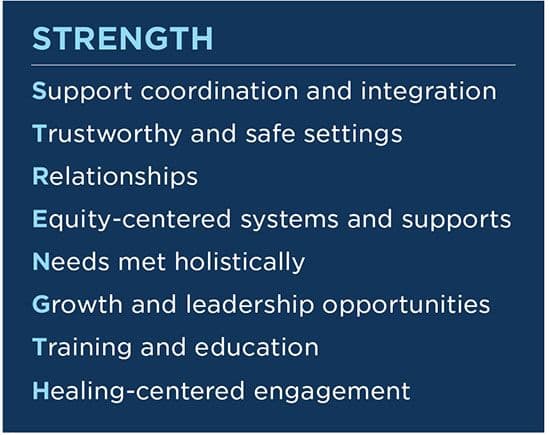
Child Trends developed the STRENGTH principles in partnership with Annie E. Casey Foundation fellows who bring lived experience in the juvenile or criminal legal systems, ChildFocus Partners, system leaders, and community stakeholders. These principles, first outlined in a white paper by the research team, provide an actionable roadmap for aligning policies, programs, and practices with a positive, equity-centered vision for young adult success.
Figure 1: STRENGTH principles
Phase 2: Emerging Adult Justice Community of Learning
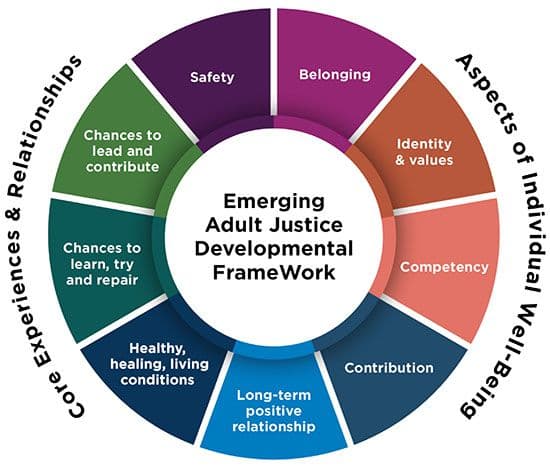
In the second phase, the research team launched the Emerging Adult Justice Community of Learning, a cohort of six youth-serving organizations across the country identified by the Annie E. Casey Foundation. Through this community, Child Trends and its partners provided technical assistance to help sites design and implement projects guided by the STRENGTH principles and the Emerging Adult Justice Developmental Framework (EAJDF). The EAJDF offers a playbook for justice systems and community partners to support successful transitions to adulthood by focusing on developmentally appropriate strategies, strong cross-system partnerships, and the central role of community organizations in supporting emerging adults.
Figure 2: Emerging Adult Justice Developmental Framework
Project activities over five years
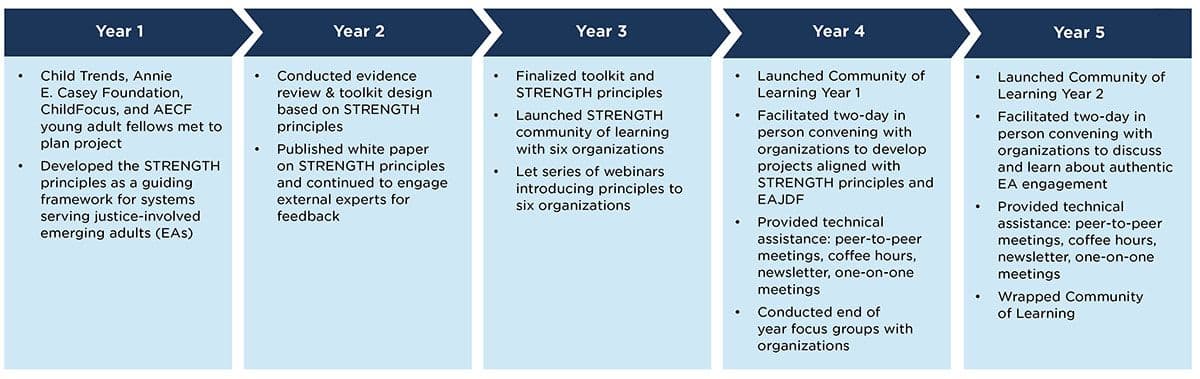
Below is a five-year project timeline with the following phases and milestones.
Figure 3: Timeline of project activities
Relevant publications
- STRENGTH principles white paper: Introduces the eight principles and their evidence base, and articulates a vision for developmentally appropriate, equity-centered support for emerging adults.
- Emerging Adult Justice Developmental Framework (EAJDF): Provides a framework for justice systems and community partners to align policies, practices, and collaborations with the developmental needs of emerging adults.
- STRENGTH implementation toolkit (forthcoming): This will update the framework from the white paper and include the assessment checklists for each principle, along with planning tools to help organizations apply the principles in their programs.
- Emerging adult engagement strategies in the Community of learning: This blog will highlight strategies our partner organizations used to promote engagement among emerging adults.
- Community of learning case studies (forthcoming): This document will highlight each site’s activities, adaptations, and lessons learned to share diverse implementation strategies and emerging impacts.
Core team members
- Fadumo M. Abdi
- Zakia Redd
- Michelle L. Farr, JUST alittle LOVE LLC (JaL)
Community of learning sites
- UTEC
- The Fortune Society
- RISE Reentry Program
- The Education and Employment Ministry (TEEM)
- Free Minds Book Club & Writing Workshop (Free Minds)
- Anti-Recidivism Coalition (ARC)
Acknowledgements
The Support Young Adults Developmental Framework project and the STRENGTH principles were made possible through the dedication and expertise of many contributors. We acknowledge Tiffany Allen (ChildFocus Partners), Felipe Franco (Annie E. Casey Foundation), and the AECF fellows Billie-Ann Bruce and Jasmine Snell for their contributions to the development of the STRENGTH principles. We are grateful to current Child Trends staff Kris Moore, Rachel Rosenberg, and Kristine Chan, as well as past staff members Hannah Lantos and Joselyn Angeles‑Figueroa, who played key roles in developing the STRENGTH framework, providing feedback, and launching the Community Learning Cohort at different stages of the project. We also acknowledge Lael Chester’s contribution to the development of the frameworks and project.
Funder
This project is funded by the Annie E. Casey Foundation.