

Healthy marriage and relationship education (HMRE) programs are designed to help couples develop the skills and knowledge they need to build stable, good-quality relationships that promote family well-being. Partners who participate in these programs sometimes have experienced significant adversity in childhood, such as experiences of maltreatment, that can affect their relationships as adults.
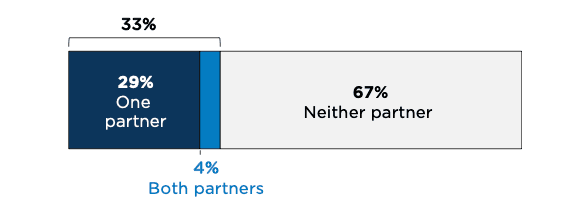
According to a new analysis of data from the Supporting Healthy Marriage study—an evaluation of federally funded HMRE services for heterosexual couples who had or were expecting children—at least one partner in 33 percent of couples[1] seeking HMRE services reported that they had experienced maltreatment in childhood (Figure 1). Maltreatment was defined as having “often” experienced verbal abuse, physical abuse, or neglect while growing up.[2] Experiences of maltreatment were more common among wives (22%) than among husbands (17%).[3][4] In 4 percent of couples, both partners reported experiencing maltreatment in childhood. The most common type of maltreatment reported was emotional abuse (28%), followed by neglect (19%) and physical abuse (15%).
Figure 1. In 33 percent of couples seeking HMRE services, at least one partner reported childhood maltreatment*
Percentage of couples in which either partner reported experiencing childhood maltreatment**
Data Source: 2003-2014 Supporting Healthy Marriage (SHM) evaluation.
*Maltreatment was defined as reporting experiencing emotional abuse, physical abuse, or neglect "often."
**Includes couples in which at least one partner provided information on childhood maltreatment (N=6,217).
Couples in which at least one partner has experienced maltreatment in childhood might need additional support from HMRE programs to help them recover from the trauma these experiences may have inflicted. If left unaddressed, the long-term effects of childhood maltreatment—which could include mental health difficulties, behavioral problems, and difficulty forming and maintaining healthy relationships—can hinder their family life and their children’s well-being. Individuals who experience childhood maltreatment are more likely to experience marital difficulties, such as lower communication quality, greater marital conflict, and lower marital satisfaction. A history of childhood maltreatment is also associated with difficulty engaging in positive parent-child interactions that can affect children’s development.
Given the high prevalence of maltreatment among couples who are likely to seek HMRE services, it’s critical that HMRE programs adopt trauma-informed approaches in their programming—especially since leaving couples’ mental health needs unaddressed may reduce the effectiveness of HMRE programming. Trauma-informed approaches involve increasing program staff awareness about trauma and its effects, educating staff on how trauma manifests in individuals and families, creating a safe space for couples that minimizes the risk of re-traumatization, and recognizing the signs of trauma among clients and responding appropriately. While federal funding for HMRE programming does not allow the use of funds to provide mental health services, programs can still offer a warm handoff (i.e., a referral) to partnering organizations that can provide these services.
The 2003-2014 Supporting Healthy Marriage evaluation was the first large-scale, multi-site study to test the impact of federally funded marriage education programs on marital stability and quality, and on adult and child well-being. Heterosexual couples who were married and had a child were eligible to participate, as were those expecting a child. Income was not considered for eligibility, but most couples lived in households with low incomes (about 82% of couples lived in households with incomes under 200% of the federal poverty level). Eligible couples were recruited into the study and randomly assigned into a program or a control group from February 2007 to December 2009. A total of 6,298 couples participated in the study. About 43 percent of couples in the sample identified as Hispanic, with 21 percent identifying as White and 11 percent as Black; the remainder indicated they were of another race or interracial. Couples were assessed at baseline and at 12 months and 30 months after they first entered the study. Each partner reported on their experiences of childhood maltreatment at baseline. Specifically, they were asked to indicate how often a parent, stepparent, or parent figure had done any of the following while they were growing up: sworn at, insulted, or put them down (emotional abuse); hit, slapped, or hurt them so badly they were bruised or cut (physical abuse); or neglected them so that they did not get the attention and care they needed (neglect). To determine the percentage of couples in which at least one partner had experienced maltreatment, we included couples in which at least one partner had provided information about maltreatment in childhood. In 363 couples, data for one partner was missing, so the estimated prevalence of maltreatment in both partners is a conservative estimate.
This project is supported by Award No. 90PR0014-01-00 from the Office of Planning, Research, & Evaluation. The authors are solely responsible for the contents of the data point, which do not necessarily represent the views of our funder. The authors would like to thank Mindy Scott and Rebecca Vivrette for their reviews, Dana Thomson for her overall guidance in the project, and Julie Gilbertsen for her research assistance and fact check.
Footnotes
[1] For this analysis, “couples” refers to the husbands and wives analyzed in the study.
[2] Information on sexual abuse during childhood was not collected in the study. Thus, estimates are likely to underrepresent maltreatment experiences in childhood.
[3] Programs in this multi-site study varied in how they verified marital status. Consequently, some couples (18%) were not legally married at the beginning of the study. For simplicity, we refer to all couples and individuals as if they were married.
[4] The difference in the prevalence of maltreatment between wives and husbands is statistically significant at the .05 level.
[5] Hsueh, J., Alderson, D. P., Lundquist, E., Michaelopoulos, C., Gubits, D., & Fein, D. (2012). The Supporting Healthy Marriage Evaluation: Early Impacts on Low-Income Families, Technical Supplement (OPRE Report 2012-27). Office of Planning, Research and Evaluation, Administration for Children and Families, & U.S. Department of Health and Human Services.
[6] Lundquist, E., Hsueh, J., Lowenstein, A. E., Faucetta, K., Gubits, D., Michalopoulos, C., & Knox, V. (2014). A Family-Strengthening Program for Low-Income Families: Final Impacts from the Supporting Healthy Marriage Evaluation (OPRE Report 2014-09A). Office of Planning, Research and Evaluation, Administration for Children and Families, & U.S. Department of Health and Human Services.
Suggested citation
Ramos-Olazagasti, M., & Gebhart, T. (2023). Childhood maltreatment among couples seeking relationship education services calls for trauma-informed approaches. Child Trends. https://doi.org/10.56417/1104q451f